

Last updated October 10, 2026. Educational information, not medical advice: see our Medical Disclaimer.
If hot flashes, night sweats or poor sleep are wearing you down, you’ve probably wondered about hormone replacement therapy (HRT). Maybe you’ve also heard it’s risky, or that you have to wait until your periods stop. The guidance has changed a lot in recent years. In 2026 the FDA approved label changes that removed breast cancer, heart disease and dementia statements from the most prominent “boxed” warning on menopausal hormone therapy (FDA).
This guide explains whether you can take HRT during perimenopause, what it helps, the different types, what the evidence says about risks, who shouldn’t take it, and how to talk to your doctor about it. If you’re not sure you’re in perimenopause yet, start with our perimenopause symptoms checklist.
Key Takeaways
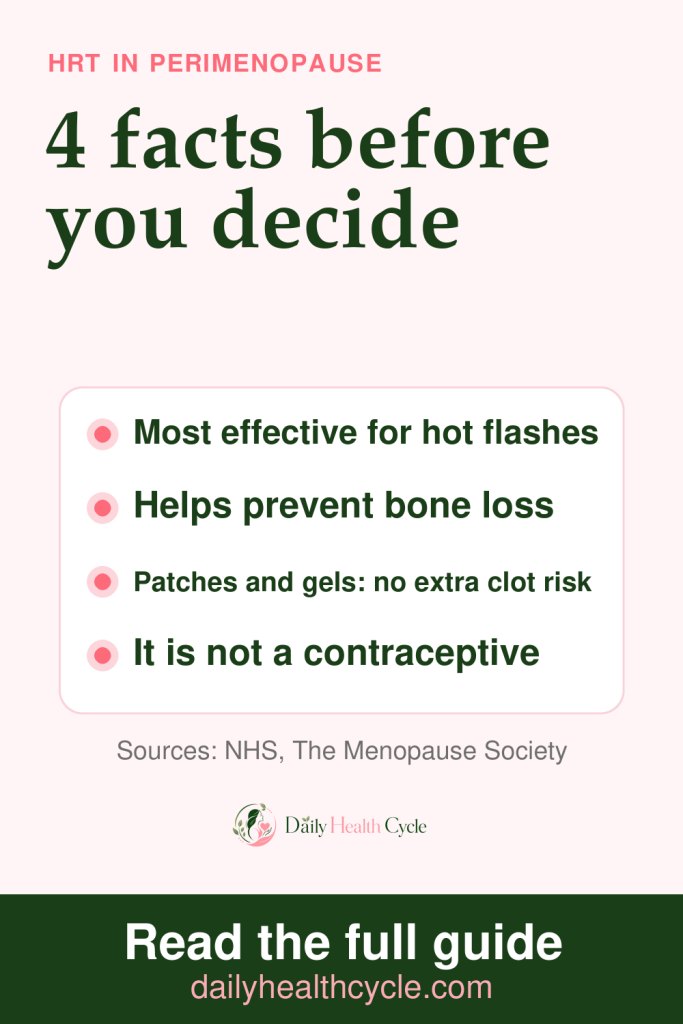
- You don’t have to wait until your periods stop. The NHS says you can usually take HRT if you’re having menopause symptoms, and there’s a type designed for women who still have periods.
- Hormone therapy is the most effective treatment for hot flashes and night sweats, and it prevents bone loss and fractures (The Menopause Society, 2022).
- For women under 60 or within 10 years of menopause who have no reasons to avoid it, the benefits generally outweigh the risks. The risks depend on the type, dose, duration and how you take it.
- Patches, gels and sprays don’t increase the risk of blood clots the way tablets can (NHS). Combined HRT adds around 5 extra cases of breast cancer per 1,000 women who take it for 5 years.
- HRT is not a contraceptive. In perimenopause you can still get pregnant, so you’ll need contraception too.
In this article:
- Can You Take HRT During Perimenopause?
- What HRT Helps
- Types of HRT
- HRT Risks: What the Evidence Says
- Who Shouldn’t Take HRT
- Side Effects and the First Few Months
- HRT Is Not Contraception
- If HRT Isn’t Right for You
- How to Talk to Your Doctor About HRT
- HRT in Perimenopause FAQ
Can You Take HRT During Perimenopause?
Yes. The NHS says you can usually take HRT if you’re having menopause symptoms (NHS), and it advises anyone with symptoms of perimenopause or menopause to talk to a doctor, nurse or pharmacist about it (NHS). Many women first notice symptoms years before their final period, so waiting for periods to stop isn’t necessary.
What changes is the type. If you still have periods, the NHS says you’ll usually be offered sequential (cyclical) combined HRT. Continuous combined HRT is usually recommended once you’re post-menopause (NHS). Not sure which stage you’re in? Our guide to perimenopause vs menopause explains the difference.
What HRT Helps
According to The Menopause Society’s 2022 position statement, hormone therapy remains the most effective treatment for hot flashes and night sweats (vasomotor symptoms) and for the vaginal and urinary changes of menopause (genitourinary syndrome of menopause). It has also been shown to prevent bone loss and fractures (The Menopause Society, Menopause, 2022).
The NHS describes the main benefit simply: HRT is effective at relieving most perimenopause and menopause symptoms, and it helps prevent osteoporosis by raising your estrogen level (NHS). If hot flashes are your main problem, our guide on how to stop hot flashes compares HRT with the other options.
Two common worries are worth clearing up. HRT isn’t a weight-loss treatment, but the NHS says there’s little evidence that most types make you put on weight; our guide to perimenopause weight gain covers what does. And for heart palpitations, the evidence is more limited: a 2022 review found only cautious support for estradiol.
Types of HRT
HRT comes in two main combinations and several forms (NHS):
| Type | Who it’s for | Why |
|---|---|---|
| Estrogen-only | Women who have had a hysterectomy (no womb) | There’s no womb lining to protect |
| Sequential (cyclical) combined | Women who still have a womb and still have periods | Estrogen plus a progestogen, which lowers the risk of womb cancer |
| Continuous combined | Women who still have a womb and are post-menopause | Estrogen plus a progestogen, which lowers the risk of womb cancer |
Source: NHS.
Ways of taking it. Estrogen can be taken as tablets, skin patches, a gel or a spray. Low-dose vaginal estrogen, used as a cream, gel, tablet or ring, mainly helps vaginal symptoms. The progestogen part can come from a hormonal coil (such as Mirena), which also works as contraception (NHS). How you take estrogen matters for safety, as the next section explains.
“Bioidentical” hormones. The FDA has approved hormone products that are identical to the hormones your body makes. But many products marketed as “bioidentical hormones” are compounded drugs, which are not FDA-approved, and the FDA says it has no evidence that they are safe and effective (FDA). Ask your doctor about FDA-approved options first.
HRT Risks: What the Evidence Says
The risks of hormone therapy aren’t one-size-fits-all. The Menopause Society says they depend on the type, dose and duration, how it’s taken, when it’s started and whether a progestogen is used. For women younger than 60 or within 10 years of menopause who have no reasons to avoid it, the benefit-risk balance is favorable for bothersome hot flashes and for preventing bone loss. Starting more than 10 years after menopause or after 60 looks less favorable, because the absolute risks of heart disease, stroke, blood clots and dementia are higher (The Menopause Society, 2022).
Here’s what the NHS says about each risk (NHS):
- Breast cancer: around 5 extra cases in every 1,000 women who take combined HRT for 5 years. The risk rises the longer you take it and the older you are, and falls again after you stop. There’s little or no increase with estrogen-only HRT.
- Blood clots: HRT tablets can increase the risk, though it’s still very low. Patches, sprays and gels do not increase it.
- Stroke: tablets (but not patches, gel or spray) slightly increase the risk, which is still very low, particularly if you’re under 60.
- Heart disease: research shows HRT has little or no effect on the risk of coronary heart disease.
Overall, the NHS says the benefits of HRT usually outweigh the risks.
What changed with the FDA warning
In November 2025, the FDA began removing references to cardiovascular disease, breast cancer and probable dementia from the boxed warning on menopausal hormone therapy, and in February 2026 it approved the first updated labels. The boxed warning about endometrial (womb) cancer stays on systemic estrogen-only products, and the FDA’s labeled recommendation is to start systemic HRT within 10 years of menopause onset or before age 60 (HHS; FDA). The risks above haven’t disappeared; what changed is how prominently they’re presented, so your own health history still matters most.
Who Shouldn’t Take HRT
HRT may not be suitable if you (NHS):
- have a history of breast, ovarian or womb cancer
- have a history of blood clots (patches or gels may still be an option instead of tablets)
- have untreated high blood pressure, which needs to be controlled first
- have liver disease
- are pregnant
Your doctor will also look at your age, how long it’s been since your periods changed, and your personal and family history of heart disease, stroke and cancer.
Side Effects and the First Few Months
Estrogen can cause headaches, breast tenderness, nausea, leg cramps, mood changes and spotting or unexpected bleeding. Progestogen can cause period-like changes, breast soreness, headaches, tiredness, mood changes and acne. These often go away after a few weeks, and the NHS suggests sticking with treatment for at least 3 months if possible. Irregular bleeding or spotting usually settles within 6 months (NHS). If side effects don’t settle, a different dose, type or form often helps.
Bleeding that’s heavy, keeps going beyond the first months or starts after it had settled should be checked. Our guide to irregular periods in perimenopause explains which bleeding patterns need a doctor.
HRT Is Not Contraception
This is easy to miss in perimenopause: it’s still possible to get pregnant while taking HRT. The NHS advises using contraception until 2 years after your last period if you’re under 50, or for 1 year after your last period if you’re over 50 (NHS). A hormonal coil can do double duty, providing the progestogen part of HRT and contraception at the same time.
If HRT Isn’t Right for You
If you can’t or don’t want to take HRT, you still have options. The NHS says cognitive behavioral therapy (CBT) may be offered for hot flashes and night sweats, and that vaginal estrogen can treat dryness and soreness (NHS). The FDA has also approved a nonhormonal medicine for moderate to severe hot flashes (HHS). Our guide to perimenopause treatment options compares them side by side.
How to Talk to Your Doctor About HRT
You’ll get more out of the appointment if you go in prepared. Bring:
- a few weeks of notes on your symptoms, sleep and periods
- your personal and family history of breast cancer, blood clots, stroke and heart disease
- a list of your medicines and supplements
- your contraception plans
Useful questions to ask: Which type and form would suit me, and why? Would a patch or gel be safer for me than tablets? How long should I try it before we review it? What bleeding pattern is normal on this type? What are my nonhormonal options? The NHS says HRT is usually taken for 2 to 5 years but can be longer in some cases, and The Menopause Society recommends reviewing the benefits and risks of continuing at regular intervals.
HRT in Perimenopause FAQ
When should you start HRT?
There’s no need to wait until your periods stop: the NHS says you can usually take HRT if you’re having menopause symptoms. Timing matters for safety, though. The Menopause Society says the benefit-risk balance is favorable for women under 60 or within 10 years of menopause, and the FDA’s updated labeling recommends starting systemic HRT within that window.
Does HRT cause weight gain?
The NHS says there’s little evidence that most types of HRT make you put on weight, and a Cochrane review of 22 trials found no extra weight gain beyond what normally happens around menopause. Midlife weight gain is common with or without HRT.
Does HRT increase the risk of breast cancer?
Combined HRT slightly increases it: the NHS estimates around 5 extra cases in every 1,000 women who take it for 5 years. The risk rises with longer use and older age and falls after you stop. Estrogen-only HRT causes little or no increase.
How long can you take HRT?
The NHS says HRT is usually taken for 2 to 5 years, but it can be longer in some cases. The Menopause Society recommends reviewing the benefits and risks of continuing with your doctor at regular intervals rather than stopping at a fixed date.
Is bioidentical HRT safer?
Not necessarily. The FDA has approved hormone products identical to the hormones your body makes, but many products sold as “bioidentical hormones” are compounded drugs that aren’t FDA-approved, and the FDA says it has no evidence they’re safe and effective. FDA-approved options are the better-studied choice.
Can I take testosterone in perimenopause?
Sometimes. The NHS says testosterone gel or cream can help improve low sex drive for some women, and you may be able to get it on prescription from a menopause specialist. Ask your doctor whether it makes sense for you.
Your Next Step
Track your symptoms for a few weeks so you can show your doctor a clear picture, then book an appointment to talk through whether HRT, or another option, suits you. Not sure your symptoms are perimenopause at all? Take our free perimenopause test.
Free printable
Perimenopause symptom & cycle tracker
Track your periods, sleep, hot flashes and mood on one page, then bring it to your appointment. Enter your email to download it.
About the author: Jessica Bordo writes Daily Health Cycle out of personal interest in women’s health, not as a clinician. Each article summarizes what sources such as the NHS, The Menopause Society, the FDA and published research say, and links to them so you can check the claims yourself. No medical reviewer is listed for this article, so use it to prepare questions for your own clinician, not to replace their advice. Our editorial standards explain how we source and check articles.
This article is for general education and isn’t medical advice. See our full disclaimer and talk with a qualified clinician about your own care.