

Last updated October 7, 2026. Educational information, not medical advice: see our Medical Disclaimer.
Perimenopause weight gain often feels unfair: you’re eating the way you always have, yet your jeans fit differently and the extra weight seems to settle around your middle. You’re not imagining it. The NHS says weight gain during perimenopause and menopause is common, and that it often happens around the stomach and upper body (NHS).
This guide explains what’s really driving the change (hint: it’s not only hormones), why the weight tends to collect at your waist, which other causes are worth ruling out, and what has evidence behind it, from exercise and sleep to hormone therapy and weight-loss medicines. If you’re still working out whether you’re in perimenopause at all, start with our perimenopause symptoms checklist.
Key Takeaways
- Weight gain in perimenopause and menopause is common and often settles around the stomach and upper body (NHS). Mayo Clinic says it often continues at about 1.5 pounds (0.7 kg) a year through the 50s.
- Hormones mainly change where fat goes and how much muscle you keep. In the SWAN study, the rate of fat gain doubled and muscle mass began to fall at the start of the menopause transition, while overall weight kept rising at the same steady pace as before.
- Aging, muscle loss, poor sleep, less activity and genetics all play a part. An underactive thyroid, PCOS and some medicines can also cause weight gain, so they’re worth ruling out.
- What helps most: aerobic activity plus strength training at least twice a week, slightly smaller portions with fewer added sugars and less alcohol, and better sleep (Mayo Clinic).
- Hormone therapy doesn’t cause extra weight gain, according to a Cochrane review, but it isn’t a weight-loss treatment. Prescription weight-loss medicines are an option for some women and are a decision to make with a doctor.
In this article:
- Why Perimenopause Weight Gain Happens
- Why the Weight Settles Around Your Middle
- Other Causes Worth Ruling Out
- What Actually Helps
- When to See a Doctor
- Perimenopause Weight Gain FAQ
- Your Next Step
Why Perimenopause Weight Gain Happens
Many women notice the change before their periods stop. Mayo Clinic says it’s common for weight gain to start a few years before menopause, during perimenopause, and to continue at about 1.5 pounds (0.7 kilograms) a year as women go through their 50s (Mayo Clinic).
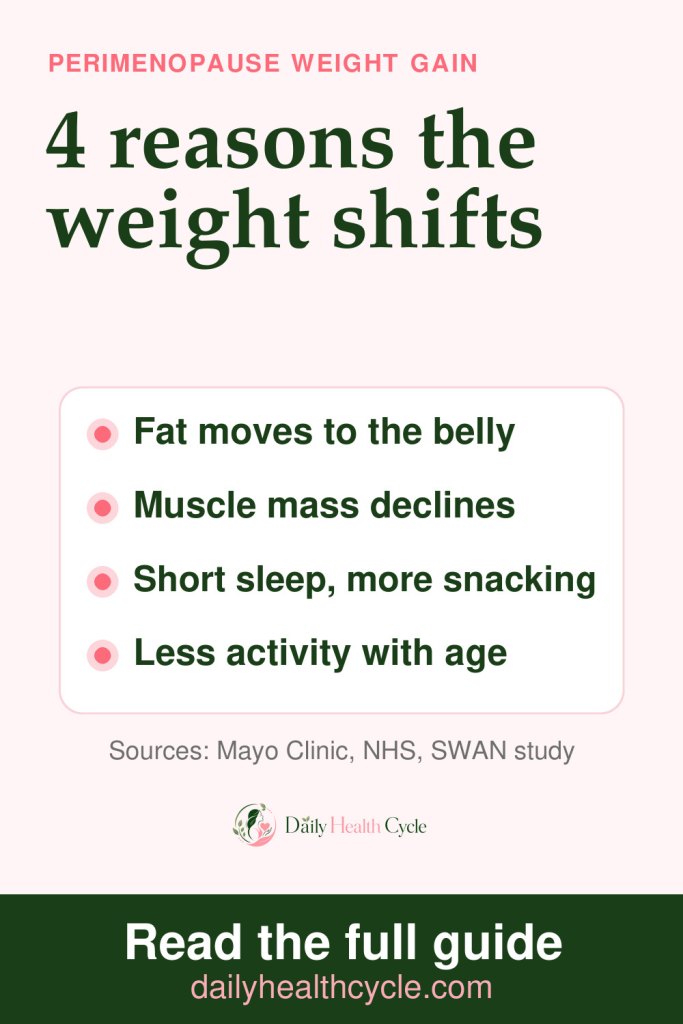
But hormones aren’t the whole story. According to Mayo Clinic, the hormonal changes of menopause make it more likely that weight collects around the belly, yet hormonal changes alone don’t necessarily cause weight gain. Instead, it’s usually linked to aging, lifestyle, diet and genetics:
- Muscle loss. Muscle mass typically goes down with age while fat increases. Losing muscle slows the rate at which your body uses calories, so eating the same amounts can lead to gradual weight gain.
- Moving less. Many people become less active as they get older, often without noticing.
- Short sleep. When people don’t get enough sleep, they tend to snack more, take in more calories and move less. Night sweats can make that worse; our guide on how to stop hot flashes covers what helps.
- Genetics. If your parents or other close relatives carry extra weight around the abdomen, you’re more likely to as well.
The largest long-term study of women going through menopause backs this up. Researchers in the Study of Women’s Health Across the Nation (SWAN) tracked body composition with body scans before and after the final period. Weight climbed steadily before the menopause transition and did not speed up when it began. What changed was what the weight was made of: at the start of the transition, the rate of fat gain doubled and lean (muscle) mass started to fall. Both trends continued until about 2 years after the final period and then leveled off (Greendale et al., JCI Insight, 2019).
In other words, the scale may not jump, but your shape can change. That’s why building and keeping muscle matters so much in these years.
Why the Weight Settles Around Your Middle
Before menopause, many women store extra weight on their hips and thighs. As estrogen falls, the hormonal changes make it more likely that weight collects around the belly instead (Mayo Clinic).
Some of that is visceral fat, the deeper fat that surrounds the organs. In a SWAN study of 362 women, visceral fat rose by about 8.2% a year in the 2 years before the final period and by about 5.8% a year afterward, with no significant change earlier. That increase was linked to thickening of the walls of the carotid artery in the neck, an early sign of artery disease (Samargandy et al., Menopause, 2021).
This is why the change matters for more than how clothes fit. Mayo Clinic says extra weight, especially around the belly, raises the risk of heart and blood vessel disease, type 2 diabetes and breathing problems, as well as breast, colon and endometrial cancers. A simple check from the NHS: try to keep your waist measurement to less than half your height (NHS).
Stress hormones are often blamed for belly fat too. Our article on cortisol and belly fat looks at what the research actually shows.
Other Causes Worth Ruling Out
Because weight gain is so common in midlife, it’s easy to blame everything on perimenopause. The NHS lists these medical causes, which are worth checking if the gain feels fast or comes with other new symptoms (NHS):
- An underactive thyroid. Putting on weight is a common symptom, along with tiredness, feeling cold, constipation, low mood, dry hair or hair loss, and irregular or heavy periods (NHS). Many of these overlap with perimenopause, which is why a thyroid blood test is often part of the workup. Our guide to hormonal imbalance symptoms explains how these conditions overlap.
- Polycystic ovary syndrome (PCOS), now also called polyendocrine metabolic ovarian syndrome (PMOS). If you also have irregular periods, acne or extra facial hair, see our PCOS symptoms guide.
- Cushing’s syndrome, a rarer condition caused by high levels of the stress hormone cortisol.
- Some medicines, including some steroids, antidepressants and beta blockers. If you think a medicine is behind your weight gain, talk to your doctor before stopping or changing it.
If you’re also exhausted all the time, our guide to the causes of constant fatigue in women covers what to check.
What Actually Helps
There’s no magic formula to prevent or reverse menopausal weight gain, Mayo Clinic says, but sticking to the basics helps. Here’s what has the most evidence behind it.
Move more, and add strength training
Mayo Clinic recommends at least 150 to 300 minutes a week of moderate aerobic activity, such as brisk walking, or 75 to 150 minutes of vigorous activity, such as jogging, plus strength training at least twice a week (Mayo Clinic). That matches the CDC’s guidelines for adults (CDC).
Strength training deserves special attention in perimenopause. As you gain muscle, your body burns calories more efficiently, which makes weight easier to manage. It also helps maintain and build bone density, which falls with menopause. If you want to lose weight rather than just stop gaining, you may need to exercise more than the minimum. Activities you enjoy, such as gardening, yoga or other active hobbies, all count.
Eat a little less, without skimping on nutrition
To stay at your current weight, you may need about 200 fewer calories a day in your 50s than you did in your 30s and 40s, Mayo Clinic says, and fewer still to lose weight. Its practical suggestions:
- Fill up on fruits, vegetables and whole grains, especially less processed ones with more fiber and protein.
- Lean toward plant-based eating: legumes, nuts, soy, fish and low-fat dairy, with meat in smaller amounts and olive oil in place of butter.
- Watch added sugar. It adds nearly 300 calories a day to the average American diet, and about half comes from sweetened drinks such as soda, juice, energy drinks and sweetened coffee and tea.
- Limit alcohol, which adds calories and raises the risk of weight gain.
Protect your sleep
Short sleep nudges you toward more snacking and less movement (Mayo Clinic). Moving more can also help you sleep better, which makes it easier to stay active, so the two support each other. If night sweats or anxiety keep waking you, treating them can help your weight too. Our guide to perimenopause anxiety covers the 3 a.m. worry spiral.
Hormone therapy: what it can and can’t do
Many women avoid hormone therapy (HRT) because they’ve heard it causes weight gain. A Cochrane review of 22 randomized trials found no evidence of that: estrogen, alone or combined with a progestogen, did not cause extra weight gain beyond what normally happens around menopause (Norman et al., Cochrane Database of Systematic Reviews, 2000).
It isn’t a weight-loss treatment, though. Mayo Clinic says hormone therapy may help redistribute belly fat and may make weight easier to manage by improving sleep, but it hasn’t been shown to cause weight loss. It’s used mainly for hot flashes and other menopause symptoms. Our guide to perimenopause treatment options explains how the benefits and risks are weighed up.
Prescription weight-loss medicines
For some women, medicines are an option alongside lifestyle changes. In 2023 the FDA approved tirzepatide (Zepbound) for chronic weight management in adults with a body mass index (BMI) of 30 or more, or 27 or more with at least one weight-related condition such as high blood pressure, type 2 diabetes or high cholesterol. It’s meant to be used with a reduced-calorie diet and more physical activity. In trials, adults without diabetes on the highest dose lost an average of 18% of their body weight compared with those on a placebo (FDA).
These medicines have real side effects. The most common include nausea, diarrhea, vomiting, constipation and stomach discomfort, and the FDA notes that tirzepatide causes thyroid tumors in rats, though it’s unknown whether it does in humans. Whether one is right for you is a decision to make with your doctor.
Be wary of weight-loss supplements
Products promising to melt menopause belly fat are everywhere. Be careful: the FDA has found weight-loss products sold online and in stores that contain hidden drug ingredients not listed on the label, some of which can be dangerous (FDA). Check with your doctor or pharmacist before taking any supplement for weight.
When to See a Doctor
Gradual weight gain in midlife is common, but it’s worth booking an appointment if:
- you’re gaining weight quickly or without any change in how you eat or move
- the gain comes with tiredness, feeling cold, constipation, dry hair or hair loss, or heavier periods, which can point to an underactive thyroid (NHS)
- you also have irregular periods, acne or extra facial or body hair, which can be signs of PCOS
- it started after you began a new medicine
- your waist measures more than half your height (NHS), or you’d like to talk about your risk of heart disease or diabetes, or about medical weight-loss options
Ask whether a thyroid test, blood sugar check and cholesterol test make sense for you. If your symptoms seem hormonal, our complete perimenopause and menopause guide explains what to expect next.
Perimenopause Weight Gain FAQ
Can perimenopause cause sudden weight gain?
Perimenopause weight gain is usually gradual. Mayo Clinic says it often continues at about 1.5 pounds (0.7 kg) a year through the 50s. Fast or unexplained weight gain is worth checking with a doctor, because an underactive thyroid, PCOS (also called PMOS), Cushing’s syndrome and some medicines, including some steroids, antidepressants and beta blockers, can cause it (NHS).
Does HRT cause weight gain?
The evidence says no. A Cochrane review of 22 randomized trials found that estrogen, alone or with a progestogen, did not cause extra weight gain beyond what normally happens around menopause. Mayo Clinic adds that hormone therapy may help redistribute belly fat and improve sleep, but it hasn’t been shown to cause weight loss.
How long does perimenopause weight gain last?
In the SWAN study, the faster fat gain and muscle loss that start with the menopause transition continued until about 2 years after the final period, then leveled off. Weight itself often keeps creeping up by about 1.5 pounds a year through the 50s (Mayo Clinic), so healthy habits still matter after menopause.
Why does perimenopause weight gain go to the belly?
As estrogen falls, weight is more likely to collect around the belly than on the hips and thighs (Mayo Clinic). In a SWAN study of 362 women, deep belly (visceral) fat rose by about 8% a year in the 2 years before the final period. The NHS describes perimenopause weight gain as often happening around the stomach and upper body.
Can you lose weight during perimenopause?
Yes, though it can take more effort than it used to. Mayo Clinic says you may need about 200 fewer calories a day in your 50s than in your 30s and 40s just to stay at the same weight. Combining aerobic activity, strength training at least twice a week, fewer added sugars, less alcohol and better sleep works best, and prescription weight-loss medicines are an option for some women.
Your Next Step
Pick one change you can keep this week, such as two short strength sessions or swapping sweetened drinks for water, and measure your waist once a month rather than weighing yourself every day. Our free printable perimenopause symptom and cycle tracker (PDF) has room to note your sleep, energy and periods alongside it. Not sure your symptoms are perimenopause at all? Take our free perimenopause test.
About the author: Jessica Bordo writes Daily Health Cycle out of personal interest in women’s health, not as a clinician. Each article summarizes what sources such as the NHS, Mayo Clinic, the FDA and published research say, and links to them so you can check the claims yourself. No medical reviewer is listed for this article, so use it to prepare questions for your own clinician, not to replace their advice. Our editorial standards explain how we source and check articles.
This article is for general education and isn’t medical advice. See our full disclaimer and talk with a qualified clinician about your own care.