

Last updated October 17, 2026. Educational information, not medical advice: see our Medical Disclaimer.
Insulin resistance has become a buzzword on social media, often blamed for belly fat, cravings and fatigue. The reality is both simpler and more important: insulin resistance usually causes no symptoms at all for years, which is exactly why so many women don’t know they have it. The CDC says 8 in 10 US adults with prediabetes don’t know it (CDC).
This guide explains what insulin resistance is, the insulin resistance symptoms in women that can show up that can show up, why midlife and perimenopause raise the risk, which tests to ask for, and what reliably helps.
Key Takeaways
- Insulin resistance means your cells don’t respond well to insulin, so your body needs more of it to keep blood sugar normal. Over time it can lead to prediabetes and type 2 diabetes.
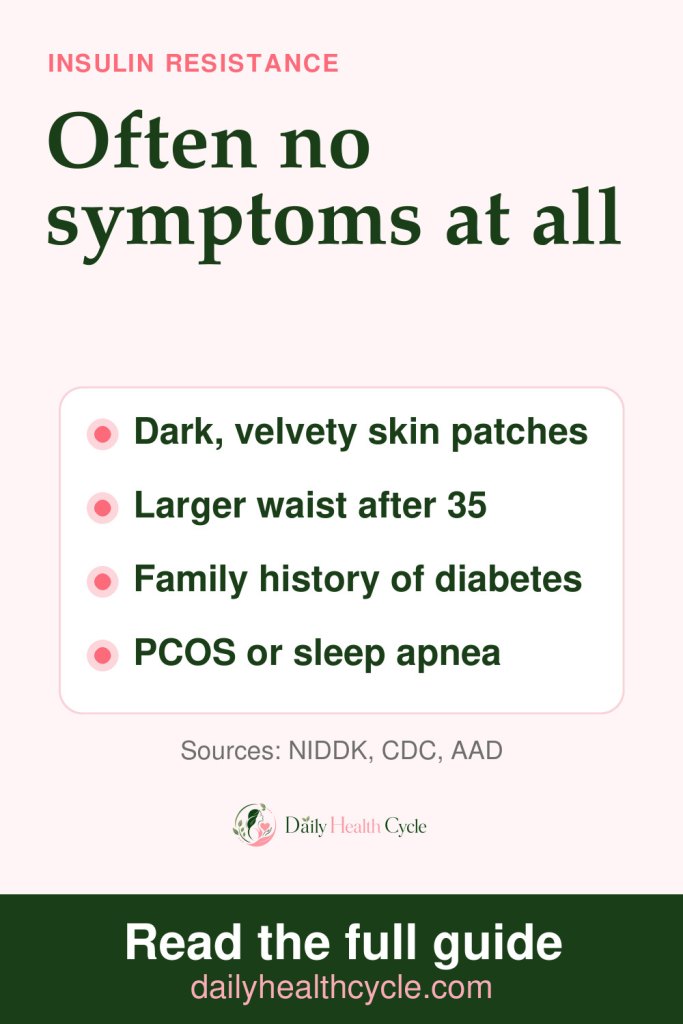
- It usually has no symptoms (NIDDK). One visible sign is dark, velvety patches of skin, often around the neck, armpits or groin.
- Risk rises with age 35 and over, a large waist, inactivity, family history, PCOS and sleep apnea. Belly fat tends to increase around menopause.
- Simple blood tests, an A1C or fasting glucose test, can show prediabetes: an A1C of 5.7% to 6.4% or fasting glucose of 100 to 125 mg/dL.
- Losing 5% to 7% of body weight and getting at least 150 minutes of activity a week cut the risk of type 2 diabetes by 58% in the Diabetes Prevention Program (CDC).
In this article:
- What Is Insulin Resistance?
- Insulin Resistance Symptoms and Signs in Women
- Who’s at Risk, and Why Midlife Matters
- Tests to Ask For
- How to Improve Insulin Resistance
- Insulin Resistance FAQ
What Is Insulin Resistance?
Insulin is the hormone that moves sugar (glucose) from your blood into your cells for energy. With insulin resistance, your body doesn’t respond to insulin the way it should, which can lead to higher blood sugar and weight gain (NIDDK). The CDC explains that cells gradually stop responding well to insulin, the pancreas makes more to compensate, and extra sugar the liver can’t store is turned into body fat (CDC).
For a while, that extra insulin keeps blood sugar in the normal range. When it can’t keep up anymore, blood sugar rises into the prediabetes range and, eventually, type 2 diabetes. The good news is that this process can often be slowed or reversed, especially if it’s caught early.
Insulin Resistance Symptoms and Signs in Women
Here’s the honest answer: people with insulin resistance and prediabetes usually have no symptoms (NIDDK). The CDC adds that you can’t tell if someone has insulin resistance by looking at them. Cravings, tiredness and weight gain are common in midlife for many reasons, so they can’t confirm insulin resistance on their own.
A few signs are worth knowing:
- Dark, velvety patches of skin (acanthosis nigricans), often around the neck, armpits or groin. The American Academy of Dermatology says this can be a sign of prediabetes (AAD), and the CDC lists dark patches in these areas among the signs of diabetes.
- Signs that blood sugar is already high: peeing often, increased thirst and hunger, losing weight without trying, blurry vision, numbness or tingling in the hands or feet, fatigue, slow-healing cuts, and frequent urinary tract or yeast infections (CDC). The CDC notes that type 2 diabetes symptoms often take several years to develop, and some people never notice any.
Because symptoms are so unreliable, knowing your risk factors and getting tested matter far more than watching for signs.
Who’s at Risk, and Why Midlife Matters
The NIDDK lists these risk factors for insulin resistance and prediabetes (NIDDK):
- overweight, obesity or a large waist size
- being 35 or older
- a family history of diabetes
- being African American, American Indian, Asian American, Hispanic/Latino or Pacific Islander
- not being physically active, and smoking
- a history of gestational diabetes or a baby weighing 9 pounds or more
- conditions such as polycystic ovary syndrome (PCOS), Cushing’s syndrome and sleep apnea
- some medicines, such as glucocorticoids (steroids)
The CDC stresses that overweight and obesity are risk factors but aren’t required: you can have insulin resistance at a normal weight (CDC).
Why perimenopause and menopause matter. Women are generally more protected than men from metabolic problems such as insulin resistance, and research reviews link that protection to estrogen (De Paoli et al., American Journal of Pathology, 2021). Around menopause, that changes: deep belly (visceral) fat tends to increase in the years around the final period, and a larger waist is itself a risk factor. Our guide to perimenopause weight gain explains what happens to body fat in these years, and our article on cortisol and belly fat looks at the stress side.
If you have PCOS, insulin resistance is especially common; our PCOS symptoms guide explains the connection.
Tests to Ask For
Testing for insulin resistance itself is mainly used in research. In everyday care, doctors check your blood sugar instead (NIDDK):
| Test | What it measures | Prediabetes range |
|---|---|---|
| A1C | Your average blood sugar over about 3 months | 5.7% to 6.4% |
| Fasting plasma glucose | Blood sugar after not eating overnight | 100 to 125 mg/dL |
| Oral glucose tolerance test | Blood sugar 2 hours after a sugary drink | 140 to 199 mg/dL |
Source: NIDDK. If you have risk factors, ask your doctor whether you’re due for one of these tests, along with a cholesterol check.
How to Improve Insulin Resistance
The most reliable evidence comes from the Diabetes Prevention Program. People with prediabetes who lost 5% to 7% of their body weight, by eating fewer calories and getting at least 150 minutes of physical activity a week, had a 58% lower rate of type 2 diabetes, and 71% lower for people 60 and older (CDC). For a woman weighing 180 pounds, 5% to 7% is about 9 to 13 pounds.
The CDC recommends (CDC):
- Being active. Physical activity makes your body more sensitive to insulin. Aim for at least 150 minutes a week of moderate activity such as brisk walking, plus strength training, which our weight gain guide covers in detail.
- Losing weight if you’re carrying extra, which can increase insulin sensitivity.
- Eating a balanced diet with non-starchy vegetables, fruits, whole grains and lean proteins, which helps lower blood sugar so your pancreas doesn’t have to release as much insulin.
- Managing stress and getting enough sleep. Night sweats and insomnia are common in perimenopause; our guide on how to stop hot flashes can help.
The CDC’s National Diabetes Prevention Program offers year-long lifestyle change programs, in person and online, for people with prediabetes. Ask your doctor about one near you. For some people, medicines are also an option; our guide to perimenopause weight gain covers prescription weight-loss medicines.
Insulin Resistance FAQ
What are the first signs of insulin resistance in women?
Usually there are none. The NIDDK says people with insulin resistance and prediabetes usually have no symptoms. One visible sign can be dark, velvety patches of skin, often around the neck, armpits or groin, which the American Academy of Dermatology says can be a sign of prediabetes. A blood test is the only reliable way to know.
Does menopause cause insulin resistance?
It can raise the risk. Research reviews link women’s relative protection from metabolic problems to estrogen, and deep belly fat tends to increase in the years around the final period. A large waist and age 35 or older are both risk factors for insulin resistance (NIDDK).
How do I test for insulin resistance?
In everyday care, doctors test blood sugar rather than insulin resistance itself. An A1C of 5.7% to 6.4%, a fasting glucose of 100 to 125 mg/dL or a 2-hour glucose tolerance result of 140 to 199 mg/dL indicates prediabetes (NIDDK).
Can insulin resistance be reversed?
Often it can be improved a lot. In the Diabetes Prevention Program, people with prediabetes who lost 5% to 7% of their body weight and got at least 150 minutes of activity a week had a 58% lower rate of type 2 diabetes (CDC). Physical activity directly makes your body more sensitive to insulin.
Can you have insulin resistance if you’re not overweight?
Yes. The CDC says overweight and obesity are risk factors but you don’t have to have them to have insulin resistance. Family history, inactivity, PCOS, sleep apnea and some medicines also raise the risk.
Your Next Step
If you have two or more risk factors, especially a growing waistline, a family history of diabetes or PCOS, ask your doctor for an A1C or fasting glucose test at your next visit. Then pick one change you can keep, such as a daily 20-minute walk. Curious how your other symptoms fit together? Our guide to hormonal imbalance symptoms is a good next read.
Free printable
Perimenopause symptom & cycle tracker
Track your periods, sleep, hot flashes and mood on one page, then bring it to your appointment. Enter your email to download it.
About the author: Jessica Bordo writes Daily Health Cycle out of personal interest in women’s health, not as a clinician. Each article summarizes what sources such as the CDC, the NIH and published research say, and links to them so you can check the claims yourself. Use these guides to prepare questions for your own clinician, not to replace their advice. Our editorial standards explain how we source and check articles.
This article is for general education and isn’t medical advice. See our full disclaimer and talk with a qualified clinician about your own care.