
Last updated November 12, 2026. Educational information, not medical advice: see our Medical Disclaimer.
GLP-1 medicines such as Wegovy, Ozempic and Zepbound are everywhere, and many women in their 40s and 50s are wondering whether they could help with the weight that seems to arrive with perimenopause. They can be genuinely effective, but they’re not right for everyone, and there are a few things women in midlife should know that rarely make the headlines, from birth control to muscle loss.
This guide to GLP-1 in menopause and perimenopause explains what these medicines are, who they’re approved for, what results to expect, the side effects and risks, and how they fit with perimenopause and hormone therapy. If you’re still working out why your weight is changing, start with our guide to perimenopause weight gain.
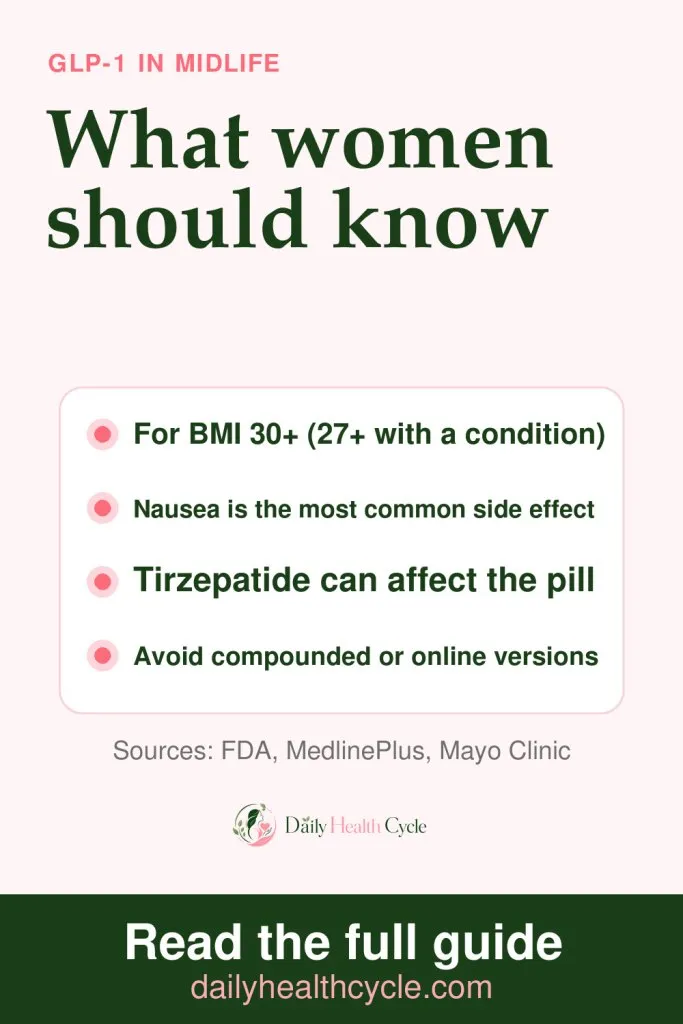
Quick answer: Using GLP-1 in menopause: semaglutide (Wegovy) and tirzepatide (Zepbound) are FDA-approved for weight management in adults with a BMI of 30 or more, or 27 or more with a weight-related condition. They reduce appetite but can cause nausea and some muscle loss, and tirzepatide can make birth control pills less effective.
Key Takeaways
- GLP-1 medicines act like gut hormones that reduce appetite and food intake. Semaglutide (Wegovy) and tirzepatide (Zepbound) are FDA-approved for chronic weight management, alongside diet and activity.
- They’re approved for adults with a BMI of 30 or more, or 27 or more with a weight-related condition such as high blood pressure, type 2 diabetes or high cholesterol.
- Common side effects are nausea, vomiting, diarrhea and constipation. Some of the weight lost can be muscle, so strength training matters.
- Tirzepatide can make birth control pills less effective, and semaglutide should be stopped 2 months before a planned pregnancy. Both matter in perimenopause, when pregnancy is still possible.
- Avoid cheap online or compounded versions: the FDA has reported dosing errors, hospitalizations and counterfeit products.
In this article:
- What GLP-1 Medicines Are
- Who They’re Approved For
- What Results to Expect
- Side Effects and Risks
- What Women in Perimenopause Should Know
- Can GLP-1 Medicines Help With Menopause Symptoms?
- Microdosing GLP-1s for Menopause
- Compounded and Online GLP-1s
- GLP-1 FAQ
What GLP-1 Medicines Are
GLP-1 medicines work on receptors for hormones released by the gut, reducing appetite and how much you eat. Tirzepatide (Zepbound) acts on two of these hormone receptors, GLP-1 and GIP; the same ingredient is sold as Mounjaro for type 2 diabetes (FDA). Semaglutide is sold as Wegovy for weight management and Ozempic for type 2 diabetes. Both are weekly injections.
In 2024 the FDA also approved Wegovy to reduce the risk of cardiovascular death, heart attack and stroke in adults with cardiovascular disease and either obesity or overweight, the first weight-loss medicine with that approval (FDA).
Who They’re Approved For
For weight management, the FDA approved Zepbound for adults with a BMI of 30 or more, or 27 or more with at least one weight-related condition such as high blood pressure, type 2 diabetes or high cholesterol, used with a reduced-calorie diet and more physical activity (FDA). Semaglutide 2.4 mg (Wegovy) was tested in the STEP 1 trial in adults meeting the same BMI criteria (STEP 1). These medicines shouldn’t be combined with other GLP-1 products.
They aren’t approved for hot flashes or other menopause symptoms, and they don’t replace hormone therapy. If menopause symptoms are your main problem, our guides to HRT in perimenopause and perimenopause treatment options cover what works.
What Results to Expect
In the trials that led to Zepbound’s approval, adults without diabetes on the highest dose lost an average of 18% of their body weight compared with those on a placebo (FDA).
There’s still little research specifically on women around menopause. One Mayo Clinic study looked back at 106 postmenopausal women taking semaglutide. After 12 months, the 16 women also using menopause hormone therapy had lost an average of 16% of their body weight, compared with 12% for those not on hormone therapy, and both groups saw improvements in blood sugar, blood pressure and cholesterol. The study was small and observational, and the authors call for larger studies to confirm it (Hurtado et al., Menopause, 2024).
What happens if you stop? In an extension of the STEP 1 trial, 327 people who had lost an average of 17.3% of their weight on semaglutide regained 11.6 percentage points of it within a year of stopping treatment (Wilding et al., Diabetes, Obesity and Metabolism, 2022). For most people, these are long-term medicines.
Side Effects and Risks
Common side effects of semaglutide include nausea, vomiting, diarrhea, stomach pain, constipation, heartburn and headache; tirzepatide has similar digestive side effects and can reduce appetite (MedlinePlus; MedlinePlus). They’re usually worst when starting or increasing the dose.
- Thyroid tumors: semaglutide may increase the risk of thyroid tumors, so tell your doctor about any personal or family history of thyroid cancer (MedlinePlus). The FDA notes tirzepatide caused thyroid tumors in rats, though it’s unknown whether it does in humans.
- Pancreatitis and gallbladder disease: tell your doctor if you’ve had either. Ongoing pain in the upper left or middle of the stomach needs urgent medical attention (MedlinePlus).
- Muscle loss: most of the weight lost on semaglutide is fat, but a 2024 review of six studies found that lean (muscle) mass made up anywhere from almost 0% to 40% of the weight lost (Bikou et al., 2024). Because women already tend to lose muscle around menopause (see our weight gain guide), strength training at least twice a week is especially important.
For the full list, how long nausea lasts, the pill, pregnancy and the warning signs that need urgent help, see our guide to GLP-1 side effects in women.
What Women in Perimenopause Should Know
You can still get pregnant. Perimenopause doesn’t mean you can’t conceive, and these medicines affect contraception and pregnancy planning:
- Tirzepatide may make hormonal birth control less effective. Your doctor may suggest using another type of birth control for 4 weeks after starting and for 4 weeks after each dose change (MedlinePlus).
- Semaglutide should be stopped 2 months before a planned pregnancy, and you should call your doctor right away if you become pregnant while taking it (MedlinePlus).
Hormone therapy and GLP-1s together. Hormone therapy isn’t a weight-loss treatment, but the Mayo Clinic study above suggests the two may work well together. If you’re considering both, talk them through with your doctor. Our guide to HRT in perimenopause explains the benefits and risks.
Rule out other causes first. Weight gain in your 40s can also come from an underactive thyroid, PCOS or medicines; our insulin resistance guide explains which blood tests to ask for.
Can GLP-1 Medicines Help With Menopause Symptoms?
It isn’t proven yet. GLP-1 medicines are approved for weight management and type 2 diabetes, not for hot flashes, sleep or mood. A 2026 review of the research concluded that they are effective for weight management in menopause and may help ease hot flashes, but only a limited number of studies reported that. The authors point out that the human studies are retrospective or short-term, often small, and that most trials lasted only three to six months (Graczyk et al., Cureus, 2026).
Better evidence is on the way. Mayo Clinic is running a phase 4 trial to determine the effect of tirzepatide on hot flashes and night sweats in postmenopausal women with obesity. It is open for enrollment and has not published results (Mayo Clinic).
Until those results are in, treat any effect on hot flashes as a possible bonus, not a reason to start a GLP-1. For the symptoms themselves, see our guides to how to stop hot flashes and HRT in perimenopause.
Microdosing GLP-1s for Menopause
“Microdosing” a GLP-1 is widely promoted to women in midlife as a gentler way to lose menopause weight. According to reporting by AARP, it is not a defined medical term. It usually means taking less than the approved dose, often of a compounded product. Here is what the doctors AARP interviewed said:
- The low doses have not been tested. GLP-1 medicines have only been rigorously studied at standard doses, and Yale physician Dr. Reshma Ramachandran notes that the FDA has not approved a microdose.
- A smaller dose may mean a smaller benefit. Lowering the dose could reduce the other benefits these medicines provide, such as protection for the heart.
- The extra claims are unproven. AARP found no evidence to support social media claims of added benefits such as reduced inflammation.
- Compounded products carry their own risks. The FDA does not review them for safety, effectiveness or quality, as the next section explains.
If cost or side effects are the reason a smaller dose appeals to you, say so to your prescriber. Adjusting the dose of an approved medicine is their decision to make with you. For the full evidence, the risks and what to ask instead, see our guide to microdosing GLP-1 in menopause.
Compounded and Online GLP-1s
Cheap “semaglutide” from online sellers and some telehealth companies is tempting, but the FDA warns that unapproved versions don’t go through its review for safety, effectiveness and quality. It has received reports of side effects, some requiring hospitalization, that may be linked to dosing errors with compounded injectable semaglutide, and it’s aware of counterfeit Ozempic in the US supply. The FDA advises getting a prescription from your own doctor, filling it at a state-licensed pharmacy, and being cautious of companies offering deep discounts or skipping a proper medical screening (FDA).
GLP-1 FAQ
Can GLP-1 medicines help with menopause weight gain?
They can help with weight loss for women who meet the criteria: a BMI of 30 or more, or 27 or more with a weight-related condition (FDA). In one Mayo Clinic study of 106 postmenopausal women on semaglutide, average weight loss after 12 months was 12% to 16%. They don’t treat other menopause symptoms such as hot flashes.
Can I take a GLP-1 with HRT?
Many women do, under a doctor’s care. In a small Mayo Clinic study, postmenopausal women taking semaglutide alongside menopause hormone therapy lost more weight at 12 months (16% vs 12%) than those not on hormone therapy. The authors say larger studies are needed to confirm this.
Do GLP-1 medicines affect birth control?
Tirzepatide (Zepbound, Mounjaro) may make hormonal birth control less effective, so your doctor may suggest another method for 4 weeks after starting and after each dose change (MedlinePlus). Semaglutide should be stopped 2 months before a planned pregnancy.
Will I regain weight if I stop a GLP-1?
Many people do. In the STEP 1 trial extension, people who had lost an average of 17.3% of their weight on semaglutide regained 11.6 percentage points within a year of stopping. For most people, these are long-term medicines.
Are compounded or online GLP-1s safe?
The FDA warns that unapproved versions aren’t reviewed for safety, effectiveness or quality. It has received reports of side effects, some requiring hospitalization, linked to dosing errors with compounded semaglutide, and it’s aware of counterfeit Ozempic. Get a prescription from your doctor and use a state-licensed pharmacy.
Do GLP-1 medicines help with hot flashes?
It isn’t proven. A 2026 review found only a limited number of studies reporting fewer hot flashes, most of them small or short. A Mayo Clinic trial of tirzepatide for hot flashes is under way, with no results yet. GLP-1 medicines aren’t approved for menopause symptoms.
Does microdosing a GLP-1 work for menopause weight gain?
There’s no trial evidence that it does. GLP-1 medicines have only been rigorously studied at standard doses, and the FDA hasn’t approved a microdose. A lower dose may also give less of the heart benefit seen at full doses.
Your Next Step
If you’re thinking about a GLP-1, book an appointment and bring your current weight, waist measurement, any recent blood test results, your medicines and your contraception plans. Ask whether you meet the criteria, which medicine suits you, how to protect your muscle mass, and what the plan is long term. Whatever you decide, the basics in our perimenopause weight gain guide still apply.
Free printable PDF
Perimenopause symptom & cycle tracker
A one-page PDF to print and fill in by hand: periods, sleep, hot flashes and mood, ready to bring to your appointment. Enter your email and the download link appears right away.
Prefer to track on your phone? Use our online symptom tracker, no email needed.
Keep reading: GLP-1 Side Effects in Women: What to Expect and When to Get Help and Stopping GLP-1 Medicines: Will You Regain the Weight?.
Sources cited in this article
- FDA: Fda approves new medication chronic weight management (fda.gov)
- FDA (fda.gov)
- STEP 1 (pubmed.ncbi.nlm.nih.gov)
- Hurtado et al., Menopause, 2024 (pubmed.ncbi.nlm.nih.gov)
- MedlinePlus (medlineplus.gov)
- MedlinePlus (medlineplus.gov)
- Bikou et al., 2024 (pubmed.ncbi.nlm.nih.gov)
- Graczyk et al., Cureus, 2026 (pmc.ncbi.nlm.nih.gov)
- Mayo Clinic: Cls 20589486 (mayo.edu)
- AARP: Microdosing glp1 drugs for weight loss (aarp.org)
- FDA: Fdas concerns unapproved glp 1 drugs used weight loss (fda.gov)
Last checked November 12, 2026. Spot an outdated source? Tell us.
About the author: Jessica Bordo writes Daily Health Cycle out of personal interest in women’s health, not as a clinician. Each article summarizes what sources such as the FDA, the NIH and published research say, and links to them so you can check the claims yourself. Use these guides to prepare questions for your own clinician, not to replace their advice. Our editorial standards explain how we source and check articles.
This article is for general education and isn’t medical advice. See our full disclaimer and talk with a qualified clinician about your own care.