
Last updated November 14, 2026. Educational information, not medical advice: see our Medical Disclaimer.
Waking up drenched, kicking off the covers, changing your pyjamas at 3am: night sweats are one of the most disruptive parts of perimenopause. They don’t just make nights uncomfortable. Broken sleep can leave you exhausted, foggy and short-tempered the next day. The good news is that there’s a lot you can do, from simple bedroom changes to treatments with strong evidence.
Quick answer: Perimenopause night sweats are hot flashes that happen while you sleep, caused by changing hormone levels. The NHS suggests a cool bedroom, light bedding, and cutting back on triggers such as alcohol, caffeine and spicy food. HRT is the most effective treatment, and CBT can help with sleep. See a GP if night sweats come with fever, weight loss or a cough.
Key Takeaways
- Night sweats are hot flashes that happen at night. The NHS says sleep problems may be worse if you also have night sweats.
- In the SWAN study, frequent hot flashes and night sweats lasted a median of 7.4 years in total, and continued for a median of 4.5 years after the final period.
- Simple steps help: a cool bedroom, lightweight clothing, a fan, and avoiding triggers such as alcohol, caffeine, hot drinks and spicy food (NHS).
- HRT is the most effective treatment. Non-hormonal options and CBT also have good evidence.
- Night sweats aren’t always hormonal. Medicines, anxiety, low blood sugar and infections can also cause them, so see a GP if you have fever, a cough or unexplained weight loss.
What Are Night Sweats?
The NHS describes hot flushes as a sudden feeling of heat in your face, neck and chest that can make you sweat a lot. When they happen at night, they’re called night sweats. They can last several minutes, and you may wake up hot, then feel cold and clammy as the sweat dries.
They’re caused by the hormone changes of perimenopause, which affect the part of the brain that controls body temperature. They can start while you’re still having periods, and they’re among the most common symptoms of the transition.
How Night Sweats Affect Your Sleep
The NHS says sleep problems in perimenopause may be worse if you also have night sweats, and that poor sleep can leave you irritable, stressed and anxious. Over weeks and months, broken nights can feed into other symptoms, such as constant tiredness, anxiety and brain fog.
That’s why treating night sweats can improve more than just your nights. The 2026 ACOG guideline strongly recommends hormone therapy for hot flashes and the sleep problems they cause (Contemporary OB/GYN summary).
How Long They Last
Longer than many women expect. In the SWAN study, frequent hot flashes and night sweats lasted a median of 7.4 years in total, and continued for a median of 4.5 years after women’s final period (Avis et al., JAMA Internal Medicine, 2015). Women whose symptoms started earlier, while they were still having regular periods, tended to have them for longer.
So if night sweats are affecting your life, it’s worth treating them rather than waiting for them to pass. Our guide to how long perimenopause lasts covers the wider timeline.
What You Can Try Tonight
The NHS suggests these steps for hot flushes and night sweats:
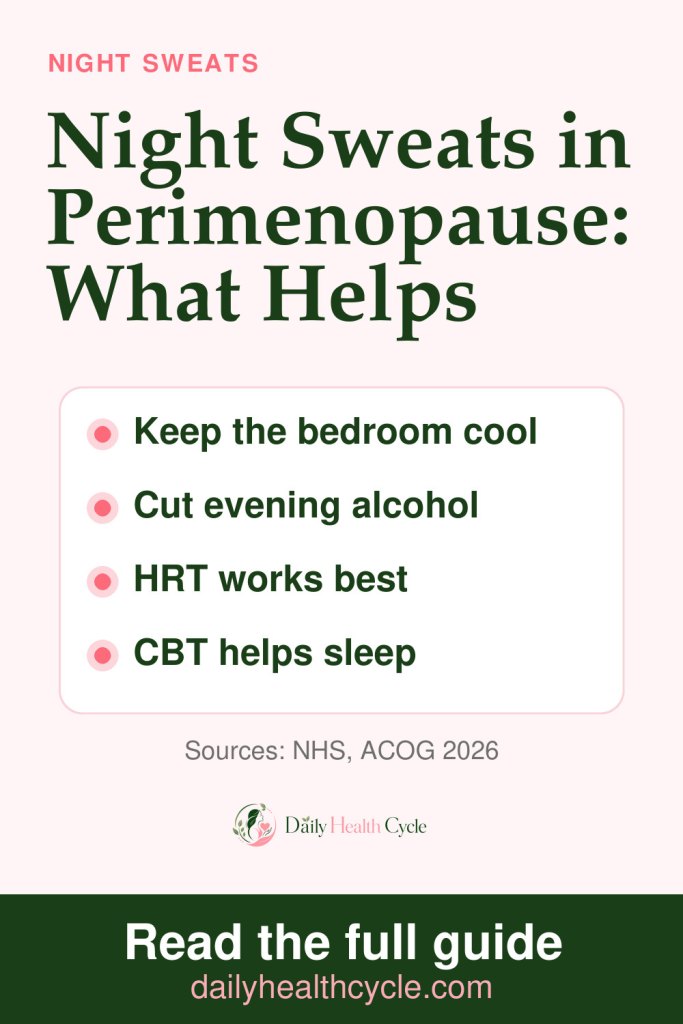
- Keep your bedroom cool at night, and use a fan
- Wear lightweight clothing, and choose light bedding you can easily kick off
- Take a cool shower or have a cold drink when you feel one starting
- Avoid or cut down on triggers, such as spicy food, caffeine, hot drinks, smoking and alcohol, especially in the evening
- Find ways to reduce stress, exercise regularly, and keep to a healthy weight
- Keep to a regular sleep routine
A practical tip many women find useful: keep a glass of cold water and a change of clothes by the bed, so you can deal with a sweat quickly and get back to sleep.
Treatments That Work
- HRT is the most effective treatment for hot flashes and night sweats. ACOG’s 2026 guideline strongly recommends it for women without reasons to avoid it, ideally started before 60 or within 10 years of menopause. See HRT in perimenopause.
- Non-hormonal medicines, including some SSRI and SNRI antidepressants, gabapentin, and the newer medicines fezolinetant and elinzanetant, also have good evidence. Gabapentin is often taken at bedtime.
- Cognitive behavioural therapy (CBT) can help with hot flashes and with sleep problems (NHS).
Supplements and herbal remedies are widely sold for night sweats, but the evidence for them is limited. Our guide on how to stop hot flashes compares every option in detail.
When It Might Not Be Perimenopause
Sweating at night can simply be a too-warm room or heavy bedding. But the NHS lists other causes of night sweats too:
- Anxiety
- Some medicines, such as certain antidepressants, steroids and painkillers
- Low blood sugar (hypoglycaemia)
- Alcohol or drug use
- Hyperhidrosis, a harmless condition that causes excessive sweating
If a medicine is the cause, your GP may be able to suggest an alternative. Don’t stop a prescribed medicine without talking to them first.
When to See a Doctor
The NHS advises seeing a GP if:
- Night sweats happen regularly and wake you up or worry you
- You also have a very high temperature, or feel hot, cold or shivery
- You also have a cough or diarrhoea
- You’re losing weight for no reason
It’s also worth booking an appointment if night sweats are affecting your sleep, work or mood, even if you’re sure they’re hormonal. Tracking them for a few weeks helps. Our free symptom tracker includes night sweats and sleep.
Night Sweats FAQ
Why do I get night sweats in perimenopause?
Night sweats are hot flashes that happen while you sleep. They’re caused by the hormone changes of perimenopause, which affect how your body controls its temperature. They can start while you’re still having periods.
How long do perimenopause night sweats last?
Often for several years. In the SWAN study, frequent hot flashes and night sweats lasted a median of 7.4 years in total, and continued for a median of 4.5 years after the final period. That’s why it’s worth treating them if they affect your life.
What is the best treatment for night sweats?
HRT is the most effective treatment for hot flashes and night sweats. If you can’t or don’t want to take hormones, some antidepressants, gabapentin, fezolinetant and elinzanetant have good evidence, and CBT can help with sleep. Talk to your doctor about which suits you.
Can night sweats be a sign of something serious?
Usually they’re harmless, but not always. The NHS says to see a GP if night sweats come with a very high temperature, a cough, diarrhoea, or weight loss for no reason, or if they happen regularly and worry you.
What can I do at night to stop sweating?
The NHS suggests keeping your bedroom cool, using a fan, wearing lightweight clothing, having a cool shower or cold drink, and avoiding triggers such as spicy food, caffeine, hot drinks, smoking and alcohol, especially in the evening.
Your Next Step
Start with the bedroom changes tonight and cut back on evening alcohol and caffeine for two weeks. If night sweats are still waking you up, talk to your GP about HRT or non-hormonal options: you don’t have to put up with years of broken sleep.
Free printable PDF
Perimenopause symptom & cycle tracker
A one-page PDF to print and fill in by hand: periods, sleep, hot flashes and mood, ready to bring to your appointment. Enter your email and the download link appears right away.
Prefer to track on your phone? Use our online symptom tracker, no email needed.
Sources cited in this article
- NHS: Symptoms (nhs.uk)
- Contemporary OB/GYN summary: Acog guideline expands menopause vms sleep and mood recommendations (contemporaryobgyn.net)
- Avis et al., JAMA Internal Medicine, 2015 (pubmed.ncbi.nlm.nih.gov)
- NHS: Things you can do (nhs.uk)
- NHS: Night sweats (nhs.uk)
Last checked November 14, 2026. Spot an outdated source? Tell us.
About the author: Jessica Bordo writes Daily Health Cycle out of personal interest in women’s health, not as a clinician. Each article summarizes what sources such as the NHS, NICE and published studies say, and links to them so you can check the claims yourself. Use these guides to prepare questions for your own clinician, not to replace their advice. Our editorial standards explain how we research and update articles.
This article is for general education and isn’t medical advice. See our full disclaimer and talk with a qualified clinician about your own care.