

Last updated November 8, 2026. Educational information, not medical advice: see our Medical Disclaimer.
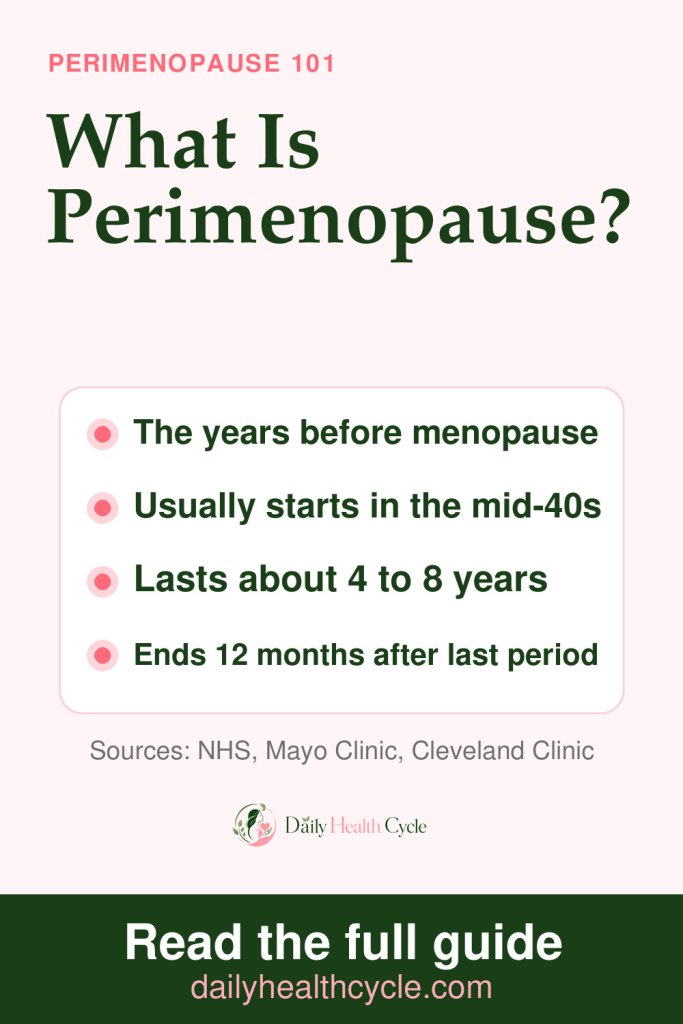
Quick answer: Perimenopause is the transition before menopause, when your ovaries slow down and estrogen and progesterone rise and fall unpredictably. Periods become irregular and symptoms like hot flashes, poor sleep and mood changes can start. It usually begins in the mid-40s, lasts around 4 to 8 years, and ends at menopause: 12 months in a row without a period.
Key Takeaways
- Perimenopause is the stage when periods become irregular; menopause is when they have stopped for 12 months in a row (NHS).
- It usually starts in the mid-40s, but can begin in the mid-30s or as late as the mid-50s (Cleveland Clinic).
- It typically lasts about 4 to 8 years.
- Common signs: irregular periods, hot flashes, night sweats, poor sleep, mood changes and vaginal dryness.
- You can still get pregnant until menopause is confirmed, so keep using contraception if you don’t want a baby.
- Diagnosis is usually based on age and symptoms; hormone blood tests are often unreliable.
What is perimenopause? It’s the stretch of years before your periods stop for good, when your ovaries gradually wind down and your hormones become less predictable. Many women first notice it as periods that suddenly behave differently, sleep that falls apart, or mood changes that don’t feel like their usual selves. This guide explains what’s happening, when it starts, how long it lasts, and when to get checked. For the full picture, see our complete perimenopause and menopause guide.
What Is Perimenopause? A Simple Definition
Perimenopause means “around menopause”. The NHS puts it simply: perimenopause is when your periods become irregular, and menopause is when they stop altogether (NHS). Mayo Clinic describes it as the time before menopause when your body is getting ready to stop having periods (Mayo Clinic).
Menopause itself is a single point in time: it’s confirmed once you’ve gone 12 months in a row without a period (and you’re not using hormonal contraception, which can hide your natural cycle). Perimenopause is everything that leads up to that point. The years after it are called postmenopause.
What Happens in Your Body
Perimenopause is driven by changes in two key hormones, estrogen and progesterone (Mayo Clinic). As your ovaries age, they release eggs less regularly. Estrogen doesn’t fall in a smooth line: Cleveland Clinic notes that levels can swing sharply up and down, and the usual balance with progesterone is disrupted (Cleveland Clinic). Those ups and downs are why symptoms can come and go, and why one month can feel completely different from the next.
When Does Perimenopause Start?
Most women notice it in their mid-40s, but Cleveland Clinic says it can begin as early as the mid-30s or as late as the mid-50s, roughly eight to ten years before menopause. Menopause usually happens between 45 and 55 (NHS), and the average age in the US is 51 (ACOG). Smoking and a family history of early menopause can bring it on earlier (Mayo Clinic). Our guide to what age perimenopause starts covers the typical range in more detail.
How Long Does Perimenopause Last?
Usually several years. The Menopause Society estimates roughly 4 to 8 years; Cleveland Clinic gives an average of about four years, with some women going through it in a few months and others for up to eight. Starting earlier tends to mean a longer transition. Because perimenopause is defined by its end point, you can only know exactly how long yours lasted in hindsight. See how long perimenopause lasts for the full timeline.
Early vs Late Perimenopause
Doctors often split the transition into two stages using a system called STRAW+10:
- Early perimenopause: your cycles start to vary, with a persistent difference of 7 days or more between one cycle and the next.
- Late perimenopause: you start skipping periods, with gaps of 60 days or more. Hot flashes are often most common in this stage.
Common Signs of Perimenopause
Symptoms vary a lot from woman to woman. These are the ones health bodies list most often (Mayo Clinic; Cleveland Clinic; NHS):
- Irregular periods: shorter or longer cycles, skipped periods, heavier or lighter bleeding. See irregular periods in perimenopause.
- Hot flashes and night sweats. See how to stop hot flashes.
- Sleep problems, often made worse by night sweats.
- Mood changes, including irritability, low mood and anxiety. See perimenopause anxiety.
- Worse PMS in the days before a period. See PMS, PMDD and perimenopause.
- Memory problems and brain fog.
- Vaginal dryness and discomfort during sex. See vaginal dryness in perimenopause.
- Bladder changes, such as needing to pee more urgently.
- Changes in sex drive. See low libido in perimenopause.
Want to go through them one by one? Use our perimenopause symptoms checklist, or take the free 6-question perimenopause test to see whether your symptoms point to perimenopause or something else.
Perimenopause vs Menopause vs Postmenopause
| Stage | What it means | Periods |
|---|---|---|
| Perimenopause | The transition: hormones fluctuate, ovulation becomes less regular | Still happen, but often irregular |
| Menopause | A single point: 12 months in a row with no period | Stopped |
| Postmenopause | All the years after menopause | None (any bleeding needs checking) |
For a closer comparison, read perimenopause vs menopause.
Can You Get Pregnant During Perimenopause?
Yes. Fertility falls, but as long as you’re still having periods, pregnancy is possible (Mayo Clinic). Ireland’s health service advises keeping contraception for 1 year after your last period if you’re 50 or over, and for 2 years if you’re under 50, and says you can stop at 55 (HSE). HRT is not a contraceptive (NHS). Our guide to getting pregnant during perimenopause explains more.
How Is Perimenopause Diagnosed?
Usually from your age, your symptoms and your period pattern, not from a blood test. Cleveland Clinic explains that hormone tests are often unreliable during perimenopause because levels swing from day to day, so a single result can be misleading. In the UK, NICE guidance says women over 45 with typical symptoms can be diagnosed without lab tests (NICE). If you’re younger, your doctor is more likely to run tests to rule out other causes. Our guide to the FSH test for perimenopause explains what a blood test can and can’t tell you.
What Helps With Perimenopause Symptoms?
Nothing stops perimenopause, but there’s a lot you can do about the symptoms:
- Hormone therapy (HRT) is the most effective treatment for hot flashes and night sweats for many women. See HRT in perimenopause.
- Non-hormonal medicines such as some antidepressants and gabapentin can ease hot flashes (Cleveland Clinic).
- Vaginal moisturisers, lubricants and vaginal estrogen for dryness.
- Everyday habits: the NHS recommends a balanced diet with calcium-rich foods, regular weight-bearing and strength exercise, a vitamin D supplement, regular sleep routines, not smoking and keeping alcohol within limits (NHS).
Our guide to perimenopause treatment options compares what the evidence says for each.
When to See a Doctor
- Your symptoms bother you or affect your daily life.
- Bleeding is very heavy, lasts longer than 7 days, happens between periods or after sex, or your periods come less than 21 days apart (Mayo Clinic; Cleveland Clinic).
- You bleed again after going 12 months without a period: talk to a doctor straight away.
- You’re under 45 and noticing these changes. Menopause before 45 is called early menopause and is worth investigating (NHS). See early menopause.
Free printable
Perimenopause symptom & cycle tracker
Track your periods, sleep, hot flashes and mood on one page, then bring it to your appointment. Enter your email to download it.
Keep reading: Perimenopause Symptoms: A Checklist for Your 40s and Perimenopause vs Menopause: What’s the Difference?
Frequently Asked Questions
What is perimenopause in simple terms?
It’s the time before menopause when your ovaries are winding down. Your hormones go up and down, your periods become irregular, and symptoms like hot flashes or poor sleep can start. It ends when you’ve gone 12 months without a period.
What is the first sign of perimenopause?
For most women it’s a change in periods: cycles that get shorter or longer, skipped periods, or bleeding that’s heavier or lighter than usual. Sleep problems, night sweats and mood changes are also common early signs.
At what age does perimenopause start?
Usually in the mid-40s, but it can begin as early as the mid-30s or as late as the mid-50s. See what age perimenopause starts.
How long does perimenopause last?
Around 4 to 8 years for most women, though some go through it in a few months and others take longer. Starting earlier tends to mean a longer transition.
Is there a test for perimenopause?
There’s no single reliable test. Doctors usually diagnose it from your age, symptoms and period pattern, because hormone levels change from day to day. You can take our free perimenopause self-check to prepare for your appointment.
Can you get pregnant during perimenopause?
Yes. It’s less likely, but pregnancy is possible as long as you’re still having periods. Keep using contraception until your doctor confirms you no longer need it.
What is the difference between perimenopause and menopause?
Perimenopause is the transition, when periods still happen but become irregular. Menopause is the point when you’ve had no period for 12 months in a row.
Sources: What are menopause and perimenopause? — NHS · Things you can do — NHS · Perimenopause — Mayo Clinic · Perimenopause — Cleveland Clinic · The Menopause Years — ACOG · Contraception and menopause — HSE · Menopause: diagnosis and management (NG23) — NICE · STRAW+10 staging — ASRM
About the author
Jessica Bordo writes Daily Health Cycle out of personal interest in women’s health, not as a clinician. She shares practical, source-linked content to help women feel more confident in their bodies, make informed choices, and build healthier everyday habits. More about Jessica
This article is for educational purposes only and isn’t a substitute for professional medical advice, diagnosis, or treatment. Read our medical disclaimer.
Sources cited in this article
- NHS: What are menopause and perimenopause (nhs.uk)
- Mayo Clinic: Syc 20354666 (mayoclinic.org)
- Cleveland Clinic: 21608 perimenopause (my.clevelandclinic.org)
- ACOG: The menopause years (acog.org)
- HSE: Contraception and menopause (www2.hse.ie)
- NHS: Things you can do (nhs.uk)
- NICE (nice.org.uk)
- STRAW+10 staging — ASRM (asrm.org)
Last checked November 8, 2026. Spot an outdated source? Tell us.