
Last updated October 11, 2026. Educational information, not medical advice: see our Medical Disclaimer.
Vaginal dryness is one of the most common changes of perimenopause and menopause, and one of the least talked about. It can make sex uncomfortable, cause itching or burning in everyday life, and even send you to the bathroom more often. The NHS lists dryness, a burning feeling, irritation or itching in and around the vagina among the symptoms of perimenopause and menopause (NHS).
The good news: it’s very treatable. This guide explains why it happens, which other causes to rule out, what helps (from simple moisturizers to low-dose vaginal estrogen), and when to see a doctor. If you’re still working out whether you’re in perimenopause, start with our perimenopause symptoms checklist.
Key Takeaways
- Falling estrogen makes the vaginal tissues thinner, drier and less elastic. Mayo Clinic says symptoms can start in perimenopause or not until a few years after menopause.
- Doctors now call this genitourinary syndrome of menopause (GSM). The Menopause Society estimates it affects about 27% to 84% of postmenopausal women, and says it’s likely underdiagnosed and undertreated.
- Over-the-counter vaginal moisturizers and lubricants are enough for most women with mild symptoms.
- For moderate to severe symptoms, low-dose vaginal estrogen works well and, according to The Menopause Society, doesn’t need to be paired with a progestogen.
- See a doctor for any bleeding after menopause, bleeding after sex, unusual discharge, or dryness that doesn’t improve after a few weeks of self-care.
In this article:
- Is Vaginal Dryness a Sign of Perimenopause?
- Symptoms to Watch For
- Other Causes of Vaginal Dryness
- What Helps Vaginal Dryness
- If You’ve Had Breast Cancer
- When to See a Doctor
- Vaginal Dryness FAQ
Is Vaginal Dryness a Sign of Perimenopause?
It can be. Estrogen keeps the lining of the vagina thick, moist and stretchy. As levels fall, Mayo Clinic explains, the tissues become thinner, drier, less elastic and more fragile. Symptoms can start bothering you in the years leading up to menopause, or they may not become a problem until a few years after it, and not everyone gets them (Mayo Clinic).
You may see this called “vaginal atrophy.” Doctors now use the term genitourinary syndrome of menopause (GSM), because the same hormone changes affect the bladder and urinary tract too. It’s common: The Menopause Society’s 2020 position statement estimates it affects about 27% to 84% of postmenopausal women, can significantly affect sexual function and quality of life, and is likely underdiagnosed and undertreated (The Menopause Society, Menopause, 2020). In other words, many women put up with it when they don’t have to.
Symptoms to Watch For
According to Mayo Clinic, GSM can cause (Mayo Clinic):
- dryness, burning or itching in the vagina
- a thin, watery, yellow or gray discharge
- pain during sex because of less lubrication, or light bleeding after sex
- a frequent or urgent need to pee, or burning when you pee
- leaking urine
- more frequent urinary tract and vaginal infections
The urinary side is easy to miss. The NHS notes that menopause can bring more UTIs, or symptoms that feel like a UTI, and needing to pee more often than usual, including at night (NHS).
Other Causes of Vaginal Dryness
Hormones aren’t the only cause. The NHS and Mayo Clinic also list (NHS; Mayo Clinic):
- pregnancy and breastfeeding
- some medicines, such as hormonal birth control and antidepressants
- surgery to remove both ovaries, a hysterectomy, chemotherapy or pelvic radiation, and hormonal treatment for breast cancer
- not feeling aroused enough during sex
- perfumed soaps, washes and douches
- conditions such as diabetes and Sjögren’s syndrome
If you’re unsure whether your symptoms are hormonal, our guide to hormonal imbalance symptoms explains which conditions overlap.
What Helps Vaginal Dryness
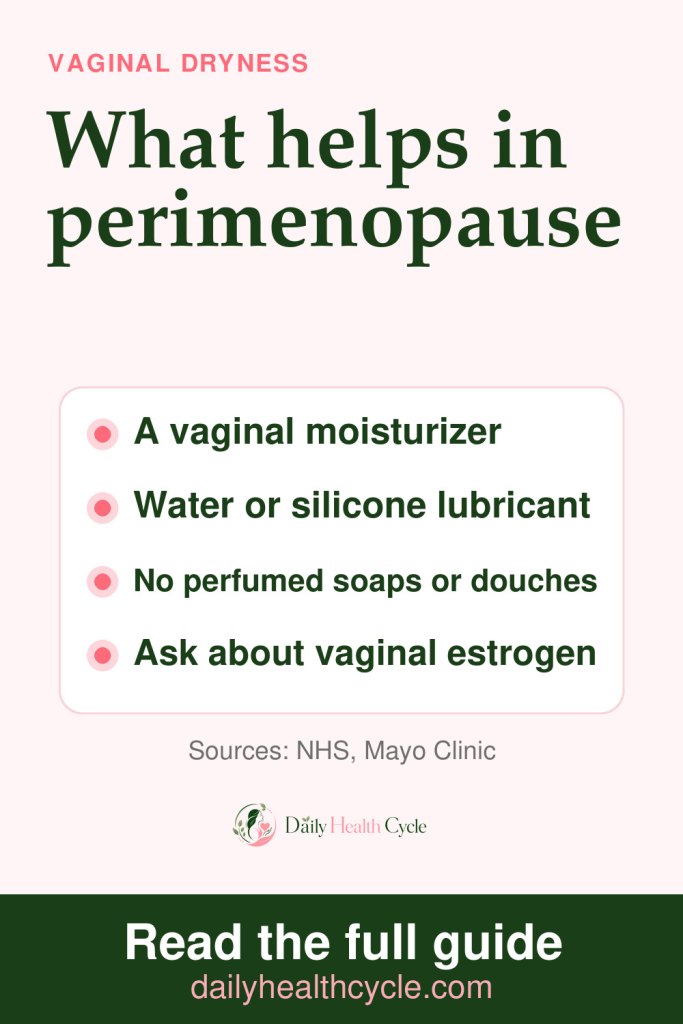
The Menopause Society says nonhormone products available without a prescription give enough relief for most women with mild symptoms, while low-dose vaginal estrogen and a few other prescription options work well for moderate to severe symptoms (The Menopause Society, 2020). Here’s how the options compare.
Vaginal moisturizers and lubricants
These do different jobs, and many women use both (Mayo Clinic):
- Vaginal moisturizers restore some moisture for everyday comfort. You may need to use one every few days, and the effect lasts longer than a lubricant’s.
- Lubricants are used just before sex to ease friction and pain. Choose water-based or silicone-based ones without glycerin or warming ingredients, which can irritate sensitive tissue. Avoid oil-based products such as petroleum jelly if you use latex condoms, because they can break them down.
Gentle everyday habits
The NHS advises against perfumed soaps, washes and douches in and around the vagina, and against using creams that aren’t made for the vagina, which can make irritation worse (NHS). Mayo Clinic adds that giving yourself time to become aroused before sex helps with natural lubrication, and that regular sexual activity, with or without a partner, increases blood flow and helps keep vaginal tissues healthy.
Low-dose vaginal estrogen
If moisturizers aren’t enough, vaginal estrogen is the most common next step. It comes as a cream, a small tablet or insert, or a soft ring that’s replaced about every three months. Because it works directly on the vaginal tissue, it uses lower doses than estrogen taken by mouth, and less of the hormone reaches the bloodstream (Mayo Clinic).
The Menopause Society says a progestogen isn’t needed alongside low-dose vaginal estrogen, though studies of its effect on the womb lining haven’t gone beyond a year (The Menopause Society, 2020). Treatment usually starts with daily use for one to a few weeks, then drops to once to a few times a week, depending on the product.
Other prescription options
- Vaginal DHEA (prasterone): a nightly insert for moderate to severe symptoms, especially painful sex.
- Ospemifene: a daily pill for moderate to severe painful sex.
- Systemic HRT: if dryness comes with hot flashes or other menopause symptoms, estrogen pills, patches or gel may treat everything at once. Our guide to HRT in perimenopause explains the benefits and risks.
- Vaginal dilators and pelvic floor physical therapy can help if sex has become painful or the vagina feels tighter.
Sources: Mayo Clinic; The Menopause Society. Vaginal laser treatments are widely advertised, but The Menopause Society says there aren’t enough placebo-controlled trials to judge whether they work or are safe.
If You’ve Had Breast Cancer
Start with nonhormonal options, Mayo Clinic advises: moisturizers, lubricants and vaginal dilators. If they don’t help, your oncologist and your doctor can discuss whether low-dose vaginal estrogen might be appropriate; ospemifene is another option for women with a history of estrogen-dependent breast cancer. Systemic estrogen generally isn’t recommended, especially if the cancer was hormone-sensitive (Mayo Clinic). The Menopause Society notes there isn’t yet enough data to confirm the safety of vaginal estrogen or DHEA after breast cancer, so the decision should involve your cancer team.
When to See a Doctor
Book an appointment if (NHS; Mayo Clinic):
- dryness has lasted a few weeks and self-care isn’t helping, or it affects your daily life
- sex is still painful after using a moisturizer or lubricant
- you have unusual discharge, burning or soreness
- you have bleeding after sex, between periods or after menopause
It can feel awkward to bring up, but Mayo Clinic notes that many women have these symptoms yet few seek treatment. Diagnosis usually involves a pelvic exam and, if you have urinary symptoms, a urine test. Bleeding after menopause always needs checking; our guide to irregular periods in perimenopause explains which bleeding patterns to report.
Vaginal Dryness FAQ
Can perimenopause cause vaginal dryness before periods stop?
Yes. Mayo Clinic says symptoms of genitourinary syndrome of menopause can start bothering you in the years leading up to menopause, while you’re still having periods, or not until a few years after menopause. Falling estrogen makes the vaginal tissues thinner, drier and less elastic.
What’s the difference between a vaginal moisturizer and a lubricant?
A vaginal moisturizer is used every few days to restore some moisture for everyday comfort, and its effect lasts longer. A lubricant is used just before sex to reduce friction and pain. Mayo Clinic suggests water- or silicone-based lubricants without glycerin or warming ingredients.
Is vaginal estrogen the same as HRT?
Not quite. Low-dose vaginal estrogen works directly on the vaginal tissue, and less of the hormone reaches the bloodstream than with pills, patches or gel (Mayo Clinic). The Menopause Society says a progestogen isn’t needed with low-dose vaginal estrogen. Systemic HRT treats the whole body and is used when dryness comes with hot flashes or other symptoms.
Can vaginal dryness cause UTIs or bladder problems?
They often go together. The same drop in estrogen affects the urinary tract, and Mayo Clinic lists a frequent or urgent need to pee, burning when you pee, leaking urine and more frequent urinary tract infections among the symptoms of genitourinary syndrome of menopause.
Can I use vaginal estrogen after breast cancer?
Possibly, but only after talking to your cancer team. Mayo Clinic recommends trying moisturizers, lubricants and dilators first, and notes ospemifene as an option after estrogen-dependent breast cancer. The Menopause Society says there isn’t yet enough data to confirm the safety of vaginal estrogen after breast cancer.
Your Next Step
Try a vaginal moisturizer a few times a week and a water- or silicone-based lubricant for sex. If you’re no better after a few weeks, ask your doctor about low-dose vaginal estrogen or other options. Want to see the bigger picture? Our guide to perimenopause treatment options covers every symptom, and our free perimenopause test can help you decide whether it’s time to talk to a doctor.
Free printable
Perimenopause symptom & cycle tracker
Track your periods, sleep, hot flashes and mood on one page, then bring it to your appointment. Enter your email to download it.
About the author: Jessica Bordo writes Daily Health Cycle out of personal interest in women’s health, not as a clinician. Each article summarizes what sources such as the NHS, Mayo Clinic, The Menopause Society and published research say, and links to them so you can check the claims yourself. Use these guides to prepare questions for your own clinician, not to replace their advice. Our editorial standards explain how we source and check articles.
This article is for general education and isn’t medical advice. See our full disclaimer and talk with a qualified clinician about your own care.