Last updated October 11, 2026. Educational information, not medical advice: see our Medical Disclaimer.
“Hormonal imbalance” is one of the most searched phrases in women’s health, and one of the most loosely used. Cleveland Clinic defines it simply: having too much or too little of one or more hormones (Cleveland Clinic). Because hormones influence periods, skin, weight, sleep and mood, the signs are wide-ranging, and almost every one of them can also have a cause that has nothing to do with hormones. This guide explains the common hormonal imbalance symptoms, the conditions that can sit behind them, how doctors actually check, and when it’s worth booking an appointment.
Key Takeaways
- “Hormonal imbalance” means too much or too little of one or more hormones (Cleveland Clinic). It describes a problem; it doesn’t say which hormone is involved or why.
- Common signs in women include irregular or heavy periods, acne, excess hair growth or hair loss, hot flashes, vaginal dryness and low interest in sex, but each can have several causes.
- Conditions behind these signs include PCOS (now called PMOS by the NHS), thyroid problems, perimenopause and menopause, and pregnancy, as well as everyday factors such as stress and weight change (NHS).
- Testing is targeted. Doctors choose blood tests based on your symptoms, and the Endocrine Society says claims that saliva tests can customize hormone doses aren’t supported by the data (Endocrine Society).
- See a doctor if your periods are irregular or your pattern changes, or if symptoms are new, persistent or affecting daily life.
Not sure which one this is?
Perimenopause, menopause and PCOS share a lot of overlapping symptoms. Take our free 2-minute self-check for a starting point on what to read next and what to bring up with your doctor.
In this article:
- What “Hormonal Imbalance” Actually Means
- Common Signs and What They Can Point To
- Conditions Behind Hormone-Related Symptoms
- How Doctors Check
- What Helps
- When to See a Doctor
- Hormonal Imbalance FAQ
- Your Next Step
What “Hormonal Imbalance” Actually Means
Endocrine glands release hormones directly into your bloodstream (Cleveland Clinic), so a change can affect several body systems at once, which is why the signs are so varied. Cleveland Clinic lists stress, certain medicines and steroid use (usually temporary), growths on hormone-producing glands, damage to those glands and autoimmune conditions as causes of a true imbalance. For how stress and cortisol relate to weight around the middle, see our guide to cortisol belly fat.
Not every change is a problem. During a normal menstrual cycle, estrogen and progesterone levels rise and fall in a regular pattern (ACOG), and life stages such as puberty, pregnancy and the menopause transition also change your periods (NHS). Symptoms that follow your cycle aren’t automatically an imbalance.
It helps to treat “hormonal imbalance” as a description rather than a diagnosis. The useful question is which hormone is involved and why, and a clinician works that out from your history and targeted tests, not from a quiz.
Common Signs and What They Can Point To
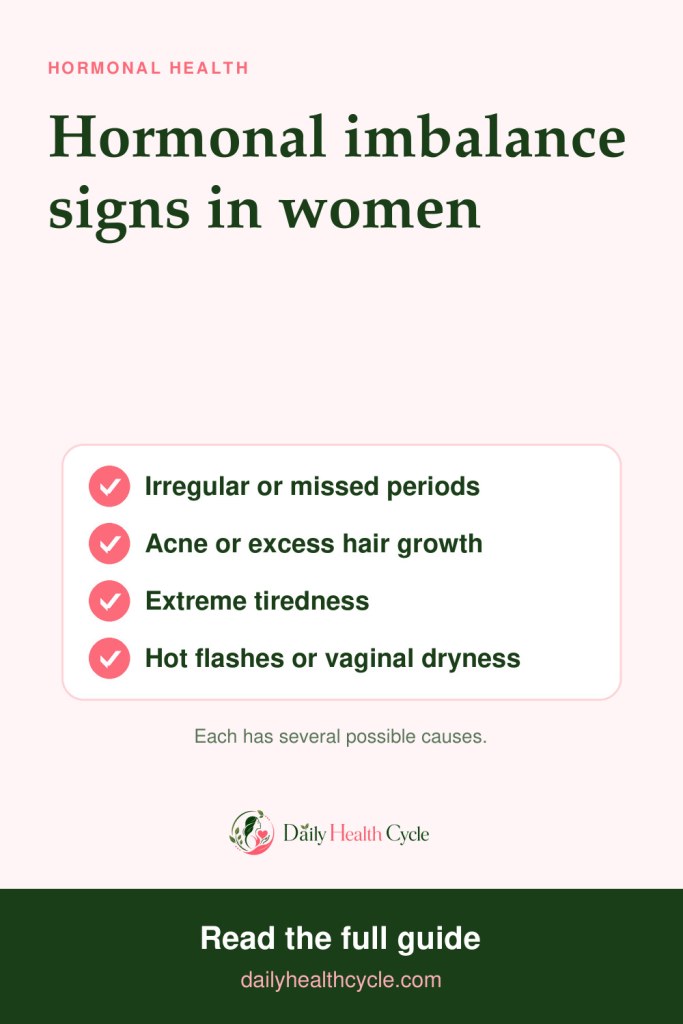
No single sign proves an imbalance. This table shows common signs and conditions a clinician may consider. It isn’t a checklist for diagnosing yourself.
| Sign | What a clinician may consider | Source |
|---|---|---|
| Irregular periods or long gaps between them | PCOS/PMOS, thyroid problems, pregnancy, hormonal contraception, weight change, stress and anxiety, excessive exercise, perimenopause | NHS |
| Heavy periods | An underactive thyroid, or non-hormonal causes such as fibroids and polyps | NHS; ACOG |
| Acne, excess hair on the face or body, thinning scalp hair | PCOS/PMOS | Office on Women’s Health |
| Weight gain or difficulty losing weight | PCOS/PMOS, underactive thyroid | NHS; NHS |
| Extreme tiredness, feeling cold, dry skin, low mood, trouble concentrating | Underactive thyroid | NHS |
| Hot flashes, vaginal dryness, changing periods in your 40s | Perimenopause | Cleveland Clinic |
| Low interest in sex | Sex-hormone changes, among other causes | Cleveland Clinic |
Notice how much the rows overlap: irregular periods, tiredness and weight change each appear under more than one condition. That overlap is the reason to get a proper check rather than guess. Tiredness on its own has its own long list of causes, which we cover in our guide to causes of constant fatigue in women.
Conditions Behind Hormone-Related Symptoms
PCOS (also called PMOS)
PCOS affects about 1 in 10 women of childbearing age, and most diagnoses happen in a woman’s 20s and 30s (Office on Women’s Health). Signs include irregular periods, excess hair on the face or body, acne, thinning scalp hair, and weight gain or difficulty losing weight. There is no single test: doctors use exams, an ultrasound and blood tests. The NHS now uses the name polyendocrine metabolic ovarian syndrome (PMOS) for the same condition, and says there is no cure but treatments and lifestyle changes can help symptoms (NHS). Our guide to PCOS symptoms has the full checklist and explains how it’s diagnosed. If thinning hair is your main concern, our guide to perimenopause hair loss covers the other common causes.
Thyroid problems
An underactive thyroid can cause extreme tiredness, feeling cold, weight gain, constipation, trouble concentrating, low mood, dry skin, hair loss, and irregular or heavy periods. Hashimoto’s disease, a common cause, is most common in women and usually starts between 30 and 50, though anyone can get an underactive thyroid. It’s diagnosed with blood tests for thyroid-stimulating hormone (TSH) and thyroxine (T4) (NHS).
Perimenopause and menopause
A change in your periods is often the first sign of perimenopause (ACOG), frequently alongside hot flashes, sleep changes or mood shifts. Our perimenopause symptoms checklist, our complete perimenopause and menopause guide and our guide to irregular periods in perimenopause cover this stage in depth.
Other causes worth ruling out
Your clinician may also check for pregnancy, high levels of the hormone prolactin (hyperprolactinemia), and problems with the uterus such as polyps, fibroids or adenomyosis (ACOG). Everyday factors matter too: the NHS lists significant weight loss or gain, stress and anxiety, excessive exercise and hormonal contraception among causes of irregular periods (NHS). If you’re under 40 and your periods become irregular or stop, ask about it. NICE recommends considering an FSH blood test in people under 40 in whom menopause is suspected (NICE).
How Doctors Check
Cleveland Clinic says providers typically order blood tests to check hormone levels, sometimes alongside glucose or insulin tolerance tests (Cleveland Clinic). Which tests you get depends on your symptoms. For a suspected thyroid problem the NHS describes blood tests for TSH and T4 (NHS), and for PCOS/PMOS blood tests for hormone levels and insulin resistance, plus an ultrasound of the ovaries in people over 18 (NHS).
Testing isn’t always needed. NICE says perimenopause can be identified without laboratory tests in otherwise healthy people aged 45 or over who have symptoms and a change in their cycle, and advises against using tests such as anti-Müllerian hormone, inhibin A or B and estradiol for that purpose at that age (NICE). ACOG, by contrast, describes perimenopause as a diagnosis of exclusion, so other causes of abnormal bleeding are checked first (ACOG).
A word on at-home and saliva tests
Home hormone kits are heavily marketed, but a single reading is hard to interpret because hormone levels rise and fall across your cycle and life stages. The Endocrine Society says claims that simple saliva tests can provide the information needed to customize hormone doses are not supported by scientific data confirming assay quality control, standardization or clinical correlations (Endocrine Society). If you’re thinking of testing, ask a clinician which test, if any, fits your symptoms.
What about “adrenal fatigue”?
The Endocrine Society says no scientific proof exists to support adrenal fatigue as a true medical condition, and that people given the label may actually have adrenal insufficiency, depression, obstructive sleep apnea or other health problems. It also warns that supplements marketed for adrenal health lack FDA oversight and may cause harm (Endocrine Society). Your symptoms are real. The point is that an unproven label can delay finding the actual cause.
What Helps
Treatment depends entirely on the cause. Cleveland Clinic notes that deficiencies may be treated with hormone replacement, while excess hormone levels may need medication, surgery or radiation (Cleveland Clinic). An underactive thyroid is usually treated with levothyroxine tablets, with regular blood tests to check the dose (NHS). For PCOS/PMOS the NHS lists hormonal contraceptives for irregular periods, metformin for metabolic symptoms, hair-reduction medicines and fertility medicines where needed, alongside a healthy, balanced diet and regular exercise (NHS). For perimenopause, see our treatment options guide.
Be cautious with supplements sold to “balance your hormones”. Beyond the Endocrine Society’s warning above, The Menopause Society’s 2023 review did not recommend supplements or herbal remedies for hot flashes (The Menopause Society, 2023). Our guide to how to stop hot flashes covers the evidence.
When to See a Doctor
Consider booking an appointment if:
- Your periods are irregular or your normal pattern changes. The NHS says to speak to a GP, especially if periods last longer than 7 days, you bleed between periods, or irregular periods come with weight gain, tiredness, facial hair or skin changes (NHS).
- Your periods are irregular and you’re trying to get pregnant.
- Symptoms are new and persistent. Cleveland Clinic advises talking to your provider about new, persistent symptoms (Cleveland Clinic).
- You’re under 40 and your periods become irregular or stop.
- You’ve gone 12 months without a period and then have any bleeding. Mayo Clinic says to talk to a healthcare professional right away (Mayo Clinic).
- Symptoms are affecting your sleep, work or relationships.
- Get emergency care if you’re changing pads or tampons every hour for more than 2 hours in a row and you also have chest pain, shortness of breath, or feel lightheaded or dizzy. ACOG says to seek emergency medical care right away (ACOG).
A few weeks of notes make the appointment more useful. Our appointment steps explain what to track.
Keep reading: Worse PMS in Your 40s? PMS, PMDD and Perimenopause Explained and Endometriosis Symptoms and Diagnosis: What Women Should Know.
Hormonal Imbalance FAQ
Can you test your hormones at home?
Kits exist, but hormone levels vary across your cycle and life stages, so a single reading is easy to misread. The Endocrine Society says the claim that saliva tests can guide hormone doses isn’t supported by data on quality control, standardization or clinical correlations (Endocrine Society). A clinician can tell you which test, if any, suits your symptoms.
Can stress cause hormonal imbalance?
Stress can affect your hormones and your periods. Cleveland Clinic lists stress among the usually temporary causes of an imbalance (Cleveland Clinic), and the NHS lists stress and anxiety among the causes of irregular periods (NHS).
Is hormonal imbalance the same as PCOS?
No. PCOS (PMOS in the NHS’s wording) is one specific condition. “Hormonal imbalance” is a broad description that can also involve the thyroid, the menopause transition and other causes.
How do I balance my hormones naturally?
It depends on the cause, and finding the cause comes first. For PCOS/PMOS the NHS suggests a healthy, balanced diet and regular exercise alongside any treatment (NHS), but lifestyle changes don’t replace treatment for conditions such as an underactive thyroid.
Can perimenopause cause a hormonal imbalance?
Perimenopause is when the ovaries make less estrogen and hormone levels fluctuate, which is why periods and other symptoms change (ACOG). It’s a normal transition rather than a disorder, though its symptoms can be treated. See our complete guide.
Can a hormonal imbalance cause weight gain?
It can be one reason. The NHS lists weight gain as a symptom of an underactive thyroid and of PCOS (now also called PMOS). Weight change has many other causes too, so a doctor may check your thyroid and other hormones with blood tests rather than guessing.
Can a hormonal imbalance cause acne or hair loss?
Yes. The Office on Women’s Health links acne, extra hair on the face or body and thinning scalp hair to PCOS (PMOS), which involves higher androgen levels. Hair loss can also come from an underactive thyroid, low iron or perimenopause, so it’s worth getting checked rather than guessing.
Your Next Step
Track your cycle, symptoms and how they affect your days for a few weeks, then book a visit and bring your notes. For related reading, see our guides on irregular periods in perimenopause, the perimenopause symptoms checklist, constant fatigue in women and our complete perimenopause and menopause guide.
Sources: Hormonal imbalance — Cleveland Clinic · Polycystic ovary syndrome — Office on Women’s Health · Irregular periods — NHS · PCOS/PMOS — NHS · Underactive thyroid — NHS · Perimenopausal bleeding — ACOG · Abnormal uterine bleeding — ACOG · My periods have changed — ACOG · Menopause: identification and management (NG23) — NICE · Perimenopause — Mayo Clinic · Compounded bioidentical hormone therapy — Endocrine Society · Adrenal fatigue — Endocrine Society · 2023 nonhormone therapy position statement — The Menopause Society · Featured image: Shixart1985 / Wikimedia Commons (CC BY 2.0)
Free printable
Perimenopause symptom & cycle tracker
Track your periods, sleep, hot flashes and mood on one page, then bring it to your appointment. Enter your email to download it.
About the author: Jessica Bordo writes Daily Health Cycle out of personal interest in women’s health, not as a clinician. She summarizes what sources such as the NHS, ACOG, CDC and The Menopause Society say and links to them so you can check the claims yourself. Use these guides to prepare questions for your own clinician, not to replace their advice. Our authors page explains how we source and check articles.
This article is for general education and isn’t medical advice. Read our Medical Disclaimer and talk with a qualified clinician about your own care.