

Last updated October 15, 2026. Educational information, not medical advice: see our Medical Disclaimer.
Irritability that comes out of nowhere, tears over small things, bloating, sore breasts and a headache that arrives right on schedule: if your premenstrual week feels harder in your 40s, you’re not imagining it. Perimenopause adds its own mood changes, sleep problems and irregular cycles on top of the familiar pattern, and the two can be hard to tell apart.
If you have worse PMS in your 40s, this guide explains how PMS and its severe form, premenstrual dysphoric disorder (PMDD), change around perimenopause, how to tell what’s what, and the treatments with evidence behind them. If you’re still working out whether you’re in perimenopause, start with our perimenopause symptoms checklist.
Key Takeaways
- PMS causes mood swings, irritability, low mood, bloating, breast tenderness and headaches in the weeks before a period (NHS). PMDD is a much more severe form that seriously affects daily life.
- In one study that followed 436 women for 5 years, PMS actually became less common through the transition to menopause, but women with PMS were more likely to develop hot flashes, low mood, poor sleep and lower libido.
- Because perimenopause symptoms overlap with PMS and cycles become irregular, a symptom diary for at least two cycles is the best way to see the pattern.
- Exercise, sleep, less caffeine and alcohol, and smaller meals can ease symptoms. SSRI antidepressants are the first-line treatment for severe PMS and PMDD (Mayo Clinic).
- If you have thoughts of harming yourself, get help now: in the US, call or text 988.
In this article:
- PMS vs PMDD
- Does PMS Get Worse in Your 40s?
- PMS or Perimenopause? How to Tell
- What Helps
- Medical Treatments
- When to Get Help
- PMS and PMDD FAQ
PMS vs PMDD
Premenstrual syndrome (PMS) is the name for the symptoms many women get in the weeks before their period. The NHS lists mood swings, feeling upset, irritable or depressed, bloating or cramping, breast tenderness and headaches among the most common, and notes that symptoms can vary from month to month. It isn’t fully understood why PMS happens, but it may be linked to hormone changes across the menstrual cycle (NHS).
Premenstrual dysphoric disorder (PMDD) is a more severe form with similar but much more intense symptoms, especially emotional ones, that have a bigger impact on daily life (NHS). It’s less common than many online quizzes suggest. A 2024 review of 44 studies with more than 50,000 participants found that about 3.2% of women met the criteria when their symptoms were tracked over two cycles, compared with 7.7% when the diagnosis wasn’t confirmed by tracking (Reilly et al., Journal of Affective Disorders, 2024).
Does PMS Get Worse in Your 40s?
Many women feel that it does, but the research picture is more interesting. A study that followed 436 women in Philadelphia through the transition to menopause for 5 years found that PMS actually became less common with age and as periods changed. However, women who had PMS at the start were more likely over the following years to report hot flashes (about twice the odds), depressed mood (about 2.3 times), poor sleep and decreased libido, even after accounting for age and a history of major depression (Freeman et al., Obstetrics & Gynecology, 2004).
In other words, what feels like “worse PMS” in your 40s is often PMS overlapping with perimenopause symptoms. Swinging hormone levels can bring mood changes, poor sleep and night sweats that aren’t tied neatly to your cycle. Our guides to perimenopause anxiety and hot flashes cover those in detail.
PMS or Perimenopause? How to Tell
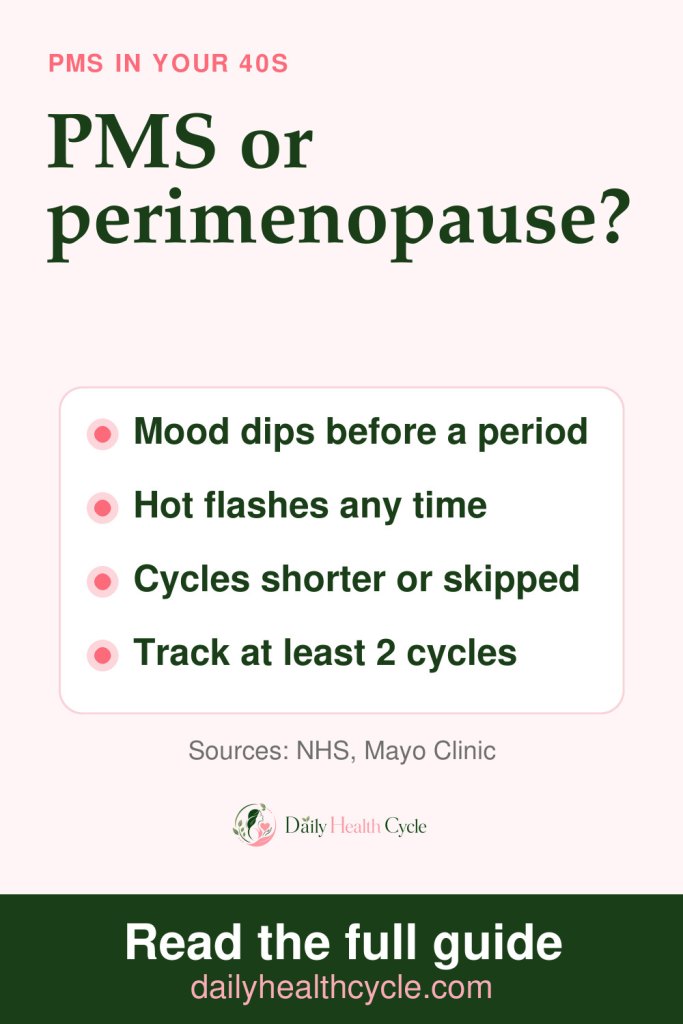
There’s no blood test for PMS. Doctors look for a predictable pattern: symptoms that appear before your period and ease once it starts. Mayo Clinic recommends recording your symptoms on a calendar or in a diary for at least two cycles, noting when they start and stop and the days your period starts and ends. Conditions such as thyroid problems, depression, anxiety and chronic fatigue syndrome can mimic PMS, so your doctor may suggest a thyroid test or mood screening (Mayo Clinic).
| Pattern | More likely |
|---|---|
| Symptoms start in the week or two before your period and ease once it begins | PMS (or PMDD if severe) |
| Hot flashes, night sweats or poor sleep at any point in your cycle | Perimenopause |
| Cycles getting shorter, longer or skipped | Perimenopause |
| Low mood that doesn’t lift after your period | See a doctor: it may be depression rather than PMS |
Irregular cycles make the pattern harder to spot, which is why tracking matters more in your 40s. Our guide to irregular periods in perimenopause explains what changes are normal.
What Helps
For many women, lifestyle changes ease PMS symptoms (Mayo Clinic; NHS):
- Move most days: at least 30 minutes of brisk walking, cycling, swimming or other aerobic activity can help with fatigue and low mood.
- Eat smaller, more frequent meals and limit salt to reduce bloating.
- Cut back on caffeine and alcohol, and don’t smoke.
- Protect your sleep and try relaxation techniques such as yoga, meditation or deep breathing.
- Use painkillers such as ibuprofen for cramps, breast pain and headaches.
- Keep a symptom diary to spot triggers and timing.
Supplements and herbs: calcium, magnesium, vitamin E, vitamin B6, chasteberry and evening primrose oil are all popular for PMS, but Mayo Clinic says the evidence is limited or lacking, and the NHS notes there isn’t much evidence that complementary treatments work. If you don’t get enough calcium from food, Mayo Clinic says a daily supplement may help. Check with a pharmacist before combining supplements with other medicines.
Medical Treatments
If lifestyle changes aren’t enough, your doctor may suggest (Mayo Clinic; NHS):
- SSRI antidepressants such as sertraline or fluoxetine, which are the first-line treatment for severe PMS and PMDD. Some women take them only in the two weeks before their period.
- Hormonal birth control that stops ovulation, which may relieve symptoms.
- Cognitive behavioral therapy (CBT).
- NSAIDs such as ibuprofen or naproxen for cramps and breast discomfort.
- A diuretic such as spironolactone if bloating and swelling don’t improve with exercise and less salt.
If symptoms continue, the NHS says you may be referred to a specialist. In perimenopause, it’s also worth discussing whether treating perimenopause symptoms such as hot flashes and poor sleep would help; our guide to perimenopause treatment options compares the choices.
When to Get Help
See a doctor if lifestyle changes haven’t helped or your symptoms are affecting your daily life (NHS). Bring two or more cycles of your symptom diary.
If you’re having thoughts of suicide or harming yourself, get help right away. In the US, call or text 988 to reach the 988 Suicide & Crisis Lifeline (988 Lifeline), or call 911 in an emergency. The NHS advises urgent help for anyone with PMDD who feels suicidal.
PMS and PMDD FAQ
Why is my PMS worse in my 40s?
Often it’s PMS overlapping with perimenopause. In a study that followed 436 women through the transition to menopause, PMS actually became less common with age, but women with PMS were more likely to develop hot flashes, low mood, poor sleep and lower libido. Those perimenopause symptoms can make the premenstrual week feel harder.
What’s the difference between PMS and PMDD?
PMDD is a more severe form of PMS with similar but much more intense symptoms, especially emotional ones, that seriously affect daily life (NHS). A 2024 review found about 3.2% of women meet the criteria for PMDD when symptoms are tracked over two cycles.
How do I know if it’s PMS or perimenopause?
Keep a symptom diary for at least two cycles. Symptoms that start before your period and ease once it begins point to PMS, while hot flashes, night sweats, poor sleep at any time of the month and cycles that get shorter, longer or skipped point to perimenopause. Many women in their 40s have both.
What is the best treatment for PMDD?
Mayo Clinic says SSRI antidepressants such as sertraline or fluoxetine are the first-line treatment for severe PMS and PMDD, and some women take them only in the two weeks before their period. Hormonal birth control and CBT are other options. If you have thoughts of harming yourself, call or text 988 in the US.
Do supplements help PMS?
The evidence is limited. Mayo Clinic says calcium, magnesium, vitamin E and vitamin B6 have been reported to help but evidence is limited or lacking, and the NHS notes there isn’t much evidence that complementary treatments work. If you don’t get enough calcium from food, a daily supplement may help.
Your Next Step
Start a symptom diary today and keep it for at least two cycles, noting your mood, sleep, hot flashes and the days your period starts and ends. That one record makes it far easier for your doctor to tell PMS, PMDD and perimenopause apart. Not sure it’s perimenopause? Take our free perimenopause test.
Free printable
Perimenopause symptom & cycle tracker
Track your periods, sleep, hot flashes and mood on one page, then bring it to your appointment. Enter your email to download it.
About the author: Jessica Bordo writes Daily Health Cycle out of personal interest in women’s health, not as a clinician. Each article summarizes what sources such as the NHS, Mayo Clinic and published research say, and links to them so you can check the claims yourself. Use these guides to prepare questions for your own clinician, not to replace their advice. Our editorial standards explain how we source and check articles.
This article is for general education and isn’t medical advice. See our full disclaimer and talk with a qualified clinician about your own care.