

Last updated October 13, 2026. Educational information, not medical advice: see our Medical Disclaimer.
If your interest in sex has faded in your 40s, you’re far from alone, and it’s not “all in your head.” The NHS lists reduced sex drive (loss of libido) among the symptoms of perimenopause and menopause (NHS). But hormones are only part of the story: sleep, stress, pain during sex, medicines and your relationship all play a role.
This guide explains what research shows about desire across the menopause transition, the most common causes of low libido in perimenopause, what helps, and the treatments with evidence behind them. If you’re not sure you’re in perimenopause yet, our perimenopause symptoms checklist is a good place to start.
Key Takeaways
- Low libido is a recognized perimenopause symptom. In the SWAN study of 3,302 women, sexual desire tended to decrease and pain during sex tended to increase by late perimenopause.
- Many causes overlap: falling hormones, vaginal dryness and painful sex, poor sleep, stress, depression, relationship issues, alcohol and some medicines, including some antidepressants and hormonal birth control (NHS).
- Fixing what’s fixable often helps most: treating vaginal dryness, reviewing medicines, sleep, exercise and talking openly with your partner.
- Testosterone has evidence for one use only: postmenopausal women diagnosed with low sexual desire that causes distress (hypoactive sexual desire disorder), according to a 2019 global consensus statement.
- Two prescription medicines are approved in the US for low desire, but only for women who haven’t reached menopause yet (Mayo Clinic).
In this article:
- Can Perimenopause Lower Your Libido?
- Common Causes of Low Libido in Your 40s
- What Helps
- Medical Treatments
- When to See a Doctor
- Low Libido FAQ
Can Perimenopause Lower Your Libido?
Yes, though usually not on its own. The Study of Women’s Health Across the Nation (SWAN) followed 3,302 women aged 42 to 52 for several years. After accounting for age, health and other factors, women were more likely to report lower sexual desire, and more pain during sex, by late perimenopause. The transition itself wasn’t linked to changes in how important sex felt, arousal, how often women had sex, emotional satisfaction with a partner or physical pleasure. Health, mood, how important sex was to each woman, relationship changes and vaginal dryness all mattered (Avis et al., Menopause, 2009).
In other words, perimenopause can nudge desire down, but the bigger levers are often the things around it, which is good news, because many of them can be changed.
Common Causes of Low Libido in Your 40s
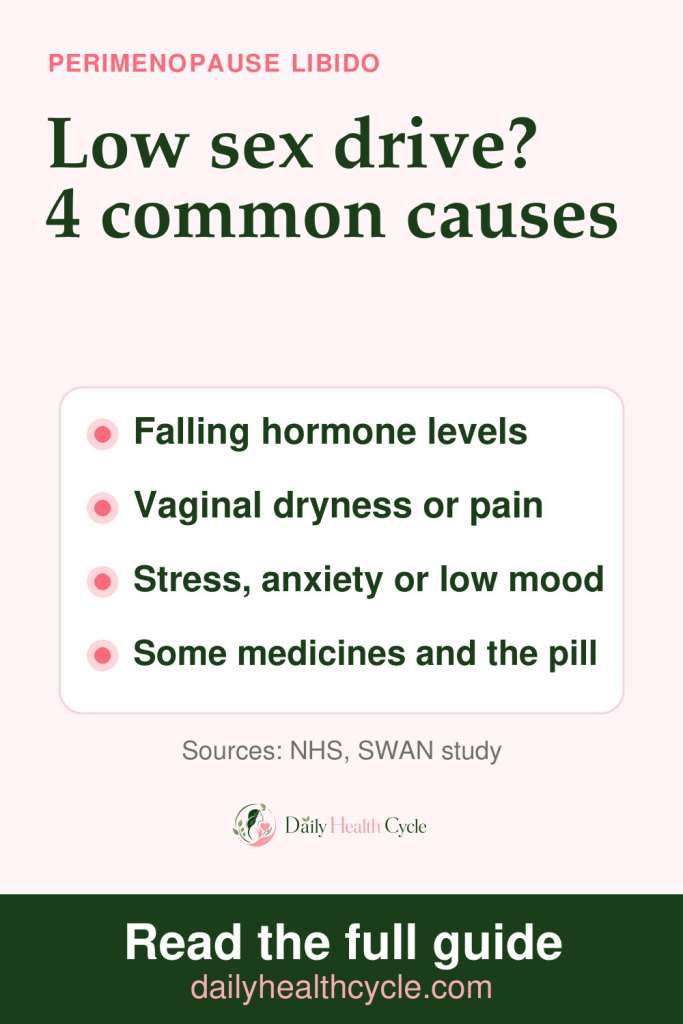
The NHS lists these common causes of a low sex drive (NHS):
- Lower hormone levels with age, particularly around menopause
- Sexual problems such as vaginal dryness, which can make sex uncomfortable
- Stress, anxiety or depression
- Relationship problems
- Some medicines, such as those for high blood pressure and antidepressants, and hormonal contraception such as the pill, patch or implant
- Drinking too much alcohol
- Long-term conditions, including heart disease, diabetes, an underactive thyroid and cancer
Perimenopause makes several of these more likely at once. Night sweats disturb sleep, mood can dip, and dryness can make sex painful, which understandably makes it less appealing. Our guides to vaginal dryness, perimenopause anxiety and constant fatigue cover those in more detail.
What Helps
Mayo Clinic says most women benefit from an approach that tackles the many causes behind low desire, and that healthy lifestyle changes can make a big difference (Mayo Clinic):
- Treat dryness first. Vaginal moisturizers and lubricants can ease the dryness of menopause, and with regular use they might work about as well as estrogen therapy.
- Exercise. Regular aerobic exercise and strength training can increase stamina, improve body image, lift your mood and boost libido.
- Manage stress. Journaling or meditation can help with stress from work, money and daily hassles.
- Talk with your partner, openly and about sex too, including what you like and don’t.
- Set aside time for intimacy. It may feel contrived, but it can help put desire back on track.
- Watch alcohol and smoking, which can dampen sex drive.
Talking with a sex therapist or a couples counselor can also help, Mayo Clinic notes, both with understanding how desire works and with relationship issues that affect intimacy.
A word on “libido boosters.” Herbal supplements for low libido aren’t regulated, often aren’t well studied, and can have side effects or change how other medicines work, Mayo Clinic warns. Talk to a healthcare professional before trying one.
Medical Treatments
Reviewing your medicines
Some antidepressants, particularly SSRIs, can lower sex drive. If yours might be the cause, Mayo Clinic says your doctor may suggest adjusting the dose, switching to a different type, or adding another medicine. Don’t stop or change an antidepressant on your own. Hormonal contraception can also be a factor (NHS).
Estrogen and HRT
The NHS lists HRT as a treatment when menopause is behind a low sex drive. Mayo Clinic explains that estrogen, including low-dose vaginal estrogen, can make sex more comfortable by easing dryness, which can in turn boost desire, though estrogen doesn’t treat low desire itself. Our guide to HRT in perimenopause explains the benefits and risks.
Testosterone
Testosterone gets a lot of attention online. A 2019 global consensus statement, endorsed by The Menopause Society and many other medical societies, concluded that the only evidence-based use of testosterone in women is for postmenopausal women diagnosed with hypoactive sexual desire disorder (low desire that causes distress) after a full assessment. It found insufficient evidence to recommend testosterone for women who haven’t reached menopause, or for mood, energy or memory (Davis et al., Journal of Clinical Endocrinology & Metabolism, 2019).
In the US, testosterone isn’t FDA-approved for sexual problems in women, though it’s sometimes prescribed. Mayo Clinic says testosterone through the skin may help after menopause, can be tried for up to six months, and can cause acne, extra body hair and mood changes. The NHS also notes that testosterone gel or cream can help low libido for some women and may be prescribed by a menopause specialist (NHS).
Prescription medicines for low desire
Two medicines are approved in the US for low sexual desire: flibanserin (Addyi), a daily pill, and bremelanotide (Vyleesi), an injection used before sex. Both are for women who haven’t yet reached menopause, and neither is approved for use after menopause (Mayo Clinic; FDA label for Vyleesi). Side effects include low blood pressure, dizziness and drowsiness with flibanserin, especially with alcohol, and nausea and flushing with bremelanotide.
When to See a Doctor
The NHS suggests seeing a doctor if you’re worried about your low sex drive, or if you think a medicine or hormonal contraception may be affecting it (NHS). Your doctor may ask about your medical and sexual history, examine you for physical changes such as thinning vaginal tissue or dryness, and suggest blood tests for hormone levels, thyroid problems, diabetes and cholesterol (Mayo Clinic). If mood is part of the picture, our guide to hormonal imbalance symptoms explains which conditions overlap with perimenopause.
Low Libido FAQ
Is low libido normal in perimenopause?
It’s common. The NHS lists reduced sex drive among the symptoms of perimenopause and menopause, and in the SWAN study of 3,302 women, sexual desire tended to decrease by late perimenopause. Low desire is only a problem if it bothers you, and if it does, there’s plenty that can help.
Can HRT increase libido?
Indirectly, for some women. The NHS lists HRT as a treatment when menopause is behind a low sex drive, and Mayo Clinic says estrogen can make sex more comfortable by easing vaginal dryness, which may boost desire. But estrogen doesn’t treat low desire itself.
Does testosterone help low libido in women?
For one specific group, yes. A 2019 global consensus statement found that the only evidence-based use of testosterone in women is for postmenopausal women diagnosed with hypoactive sexual desire disorder. There isn’t enough evidence for women who haven’t reached menopause, and it isn’t FDA-approved for women in the US.
Do libido supplements work?
There’s little good evidence. Mayo Clinic warns that herbal supplements for low libido aren’t regulated, often aren’t well studied, and can have side effects or change how other medicines work. Talk to a healthcare professional before taking one.
Can my antidepressant or birth control lower my sex drive?
Yes. The NHS lists antidepressants and hormonal contraception such as the pill, patch or implant among the causes of a low sex drive. If you think one is affecting you, talk to your doctor about adjusting or switching it rather than stopping it on your own.
Your Next Step
Start with what’s easiest to change: treat any dryness, look at your sleep and stress, and talk with your partner. If low desire bothers you, book an appointment and bring a list of your medicines. Not sure your symptoms are perimenopause? Take our free perimenopause test, and see our guide to perimenopause treatment options for the bigger picture.
Free printable
Perimenopause symptom & cycle tracker
Track your periods, sleep, hot flashes and mood on one page, then bring it to your appointment. Enter your email to download it.
About the author: Jessica Bordo writes Daily Health Cycle out of personal interest in women’s health, not as a clinician. Each article summarizes what sources such as the NHS, Mayo Clinic, the FDA and published research say, and links to them so you can check the claims yourself. Use these guides to prepare questions for your own clinician, not to replace their advice. Our editorial standards explain how we source and check articles.
This article is for general education and isn’t medical advice. See our full disclaimer and talk with a qualified clinician about your own care.