

Last updated October 21, 2026. Educational information, not medical advice: see our Medical Disclaimer.
If you never used to get bladder infections and now seem to have one every few months, you’re not imagining it. The NHS lists having been through the menopause as one of the things that make urinary tract infections (UTIs) more likely (NHS). Repeated infections are draining: the burning, the constant trips to the bathroom, and course after course of antibiotics.
The good news is that there’s a well-studied fix that many women are never offered. This guide explains why UTIs become more common after menopause, what counts as “recurrent,” which prevention options have real evidence behind them (and which don’t), and when to get help fast.
Key Takeaways
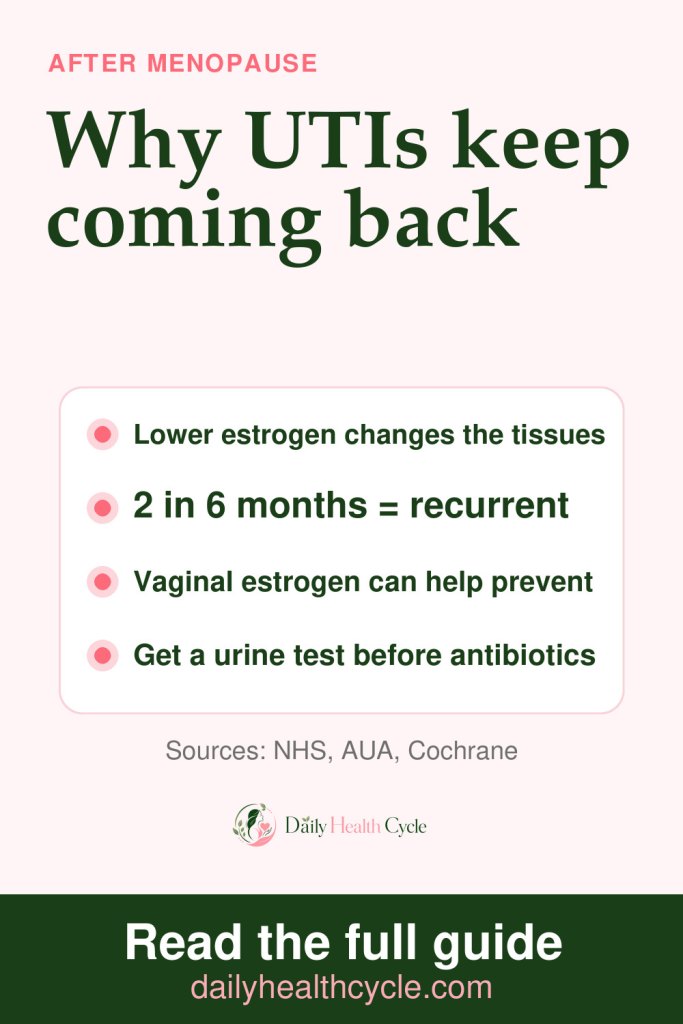
- Lower estrogen after menopause changes the vagina and urinary tract, and the NHS lists menopause as a risk factor for UTIs.
- UTIs are usually called recurrent if you have 2 in 6 months or 3 in 12 months.
- For women in perimenopause or after menopause, vaginal estrogen is recommended by both the NHS and the American Urological Association to help prevent repeat infections. Estrogen pills didn’t help in trials.
- Cranberry products probably cut the risk modestly. D-mannose didn’t beat a placebo in a large 2024 trial. Methenamine hippurate is a non-antibiotic option that did about as well as daily antibiotics in a UK trial.
- Get help the same day for a fever, pain in your back under the ribs, blood in your urine, or confusion.
In this article:
- Why UTIs Become More Common After Menopause
- UTI Symptoms (and Lookalikes)
- What Counts as Recurrent UTIs
- Vaginal Estrogen: The Most Overlooked Option
- Other Prevention Options, Ranked by Evidence
- When to See a Doctor
- Frequent UTIs FAQ
Why UTIs Become More Common After Menopause
Estrogen doesn’t just affect your periods. It helps keep the tissues of the vagina, urethra and bladder healthy. As levels fall, the vaginal lining gets thinner and drier, and Cleveland Clinic explains that lower estrogen also changes the acid balance in the vagina. Doctors call this group of changes genitourinary syndrome of menopause (GSM), and Cleveland Clinic lists frequent UTIs, painful urination and incontinence among its urinary symptoms (Cleveland Clinic). The Menopause Society estimates GSM affects about 27% to 84% of postmenopausal women (The Menopause Society).
A Cochrane review adds that the main factors linked to recurrent UTIs after menopause, including a prolapsed bladder, urine left in the bladder after you pee and urinary incontinence, are all associated with lower estrogen (Cochrane). Other things that raise the risk at any age include poorly controlled diabetes, not drinking enough fluids, a urinary catheter and spermicide (NHS). If your blood sugar has been creeping up, our guide to insulin resistance symptoms in women explains what to test.
UTI Symptoms (and Lookalikes)
The NHS lists these common UTI symptoms (NHS):
- pain or burning when you pee
- needing to pee more often than usual
- cloudy urine or blood in your urine
- pain low in your tummy, or in your back just under the ribs
- a high temperature, feeling shivery, or feeling tired or weak
In older women, a UTI can show up differently: new confusion or agitation, leaking urine more than usual, or new shivering or shaking.
Not every burning feeling is an infection. GSM itself can cause painful urination, urgency and frequent trips to the bathroom (Cleveland Clinic). That’s why a urine test before antibiotics is so useful when symptoms keep coming back: it shows whether there really is an infection and which antibiotic will work. If you also have dryness or pain during sex, read our guide to vaginal dryness in perimenopause.
The reverse matters too. Bacteria often show up in the urine of older women who have no symptoms at all. The Infectious Diseases Society of America advises against treating this “asymptomatic bacteriuria” in healthy women, older women and people with diabetes, because antibiotics don’t help and can cause harm (IDSA).
What Counts as Recurrent UTIs
Both the NHS and the American Urological Association (AUA) use the same definition: 2 infections within 6 months, or 3 within 12 months (NHS; AUA guideline). The NHS advises seeing a GP rather than just a pharmacist if you keep getting UTIs. It’s also worth keeping a simple log of each episode: the date, your symptoms, whether a urine test confirmed it, and which antibiotic you took. That record makes it much easier for your doctor to choose the right prevention plan.
Vaginal Estrogen: The Most Overlooked Option
If you’re in perimenopause or past menopause, the NHS lists vaginal estrogen (a cream, gel, tablet, pessary or ring) as a treatment for recurrent UTIs (NHS). The AUA guideline also recommends that clinicians offer vaginal estrogen to peri- and postmenopausal women with recurrent UTIs, if there’s no reason they can’t use it (AUA guideline), and its 2025 update kept that recommendation.
What the research shows, from a Cochrane review of 9 trials in postmenopausal women with recurrent UTIs (Cochrane):
- Vaginal estrogen reduced UTIs compared with placebo in two small trials. In one, the risk fell by about three quarters; in the other, by about a third.
- Estrogen pills did not. Four trials with 2,798 women found no reduction in UTIs. So if you take systemic HRT and still get infections, adding vaginal estrogen is a separate conversation to have with your doctor.
- Side effects reported with vaginal estrogen included breast tenderness, spotting, discharge, and vaginal irritation or itching.
Vaginal estrogen uses a low dose that acts mainly where it’s applied. Our guide to vaginal dryness explains the different forms, and our guide to HRT in perimenopause covers systemic hormone therapy. If you’ve had breast cancer, talk with your oncologist before starting any estrogen product.
Other Prevention Options, Ranked by Evidence
Low-dose antibiotics. The NHS says your doctor may prescribe a low-dose antibiotic to take for up to 6 months, or a different antibiotic if infections keep returning (NHS). They work, but they carry a risk of side effects and antibiotic resistance, so it’s worth asking about the non-antibiotic options below too.
Methenamine hippurate. This is a daily tablet that makes urine less friendly to bacteria without being an antibiotic. In the UK ALTAR trial of 240 women, it was “not inferior” to daily low-dose antibiotics: 1.38 treated UTIs per year compared with 0.89 on antibiotics, a difference within the margin the researchers set in advance (BMJ, 2022). It’s a prescription medicine, so ask your doctor whether it suits you.
Cranberry products. A 2023 Cochrane review found cranberry products probably reduce repeat UTIs in women with recurrent infections, by about a quarter (Cochrane, 2023). The effect is modest, and the same review found little or no benefit in older people living in care homes. Cranberry is for prevention only: the NHS says there’s no evidence cranberry drinks ease symptoms once an infection has started, and to avoid cranberry products if you take warfarin.
D-mannose. It’s popular online, but the most rigorous trial so far is disappointing. In a UK study of 598 women with recurrent UTIs, 51% of those taking 2 g of D-mannose a day had another UTI within 6 months, compared with 56% taking a placebo, a difference that could be due to chance (JAMA Internal Medicine, 2024). The authors concluded it shouldn’t be recommended for this.
Everyday habits. The NHS advises drinking enough fluids, peeing soon after sex, wiping from front to back and keeping the genital area clean and dry (NHS). If you leak urine or feel you can’t fully empty your bladder, mention it: these problems are linked to repeat infections and are often treatable.
When to See a Doctor
The NHS advises an urgent GP appointment (or calling 111 in the UK) if (NHS):
- you’re 65 or older, have diabetes or a weakened immune system
- there’s blood in your urine
- symptoms get worse quickly or don’t improve within 48 hours
- you keep getting UTIs
A high temperature, shivering, or pain in your back or side under the ribs can mean the infection has reached the kidneys and needs prompt treatment. Get emergency help if someone is confused, very drowsy or has difficulty speaking.
Frequent UTIs FAQ
Why do I keep getting UTIs after menopause?
Lower estrogen changes the tissues of the vagina and urinary tract, and the NHS lists having been through the menopause as a risk factor for UTIs. A Cochrane review notes that problems linked to repeat infections after menopause, such as a prolapsed bladder, incomplete emptying and incontinence, are all associated with lower estrogen.
How many UTIs a year is too many?
UTIs are usually called recurrent if you have 2 within 6 months or 3 within 12 months (NHS, American Urological Association). At that point, see a doctor rather than just treating each infection as it comes, so you can discuss prevention.
Does vaginal estrogen prevent UTIs?
It can. In a Cochrane review, vaginal estrogen reduced UTIs compared with placebo in two trials of postmenopausal women with recurrent infections, while estrogen pills did not. The NHS and the American Urological Association both list vaginal estrogen as an option for women in perimenopause or after menopause who keep getting UTIs.
Does cranberry juice or D-mannose prevent UTIs?
Cranberry products probably reduce repeat UTIs modestly in women with recurrent infections, according to a 2023 Cochrane review, but they don’t treat an infection once it has started. D-mannose did no better than a placebo in a 2024 trial of 598 women, and the authors said it shouldn’t be recommended for preventing recurrent UTIs.
When is a UTI an emergency?
Get help the same day if you have a high temperature, shivering, pain in your back or side under the ribs, or blood in your urine, or if symptoms don’t improve within 48 hours (NHS). Seek emergency care for confusion, severe drowsiness or difficulty speaking.
Your Next Step
Start a simple UTI log today and book an appointment if you’ve had 2 infections in 6 months or 3 in a year. Ask specifically about vaginal estrogen and whether a urine culture should be done next time. Want the bigger picture? Our guide to perimenopause treatment options covers every symptom, and our perimenopause symptoms checklist can help you spot what else may be related.
Free printable
Perimenopause symptom & cycle tracker
Track your periods, sleep, hot flashes and mood on one page, then bring it to your appointment. Enter your email to download it.
Sources cited in this article
- NHS: Urinary tract infections utis (nhs.uk)
- Cleveland Clinic: 15500 vaginal atrophy (my.clevelandclinic.org)
- The Menopause Society (pubmed.ncbi.nlm.nih.gov)
- Cochrane (pubmed.ncbi.nlm.nih.gov)
- IDSA (pubmed.ncbi.nlm.nih.gov)
- AUA guideline (pubmed.ncbi.nlm.nih.gov)
- BMJ, 2022 (pubmed.ncbi.nlm.nih.gov)
- Cochrane, 2023 (pubmed.ncbi.nlm.nih.gov)
- JAMA Internal Medicine, 2024 (pubmed.ncbi.nlm.nih.gov)
Last checked October 11, 2026. Spot an outdated source? Tell us.
About the author: Jessica Bordo writes Daily Health Cycle out of personal interest in women’s health, not as a clinician. Each article summarizes what sources such as the NHS, Cochrane reviews, medical society guidelines and published trials say, and links to them so you can check the claims yourself. Use these guides to prepare questions for your own clinician, not to replace their advice. Our editorial standards explain how we research and update articles.
This article is for general education and isn’t medical advice. See our full disclaimer and talk with a qualified clinician about your own care.