
Last updated October 11, 2026. Educational information, not medical advice: see our Medical Disclaimer.
Everyone worries sometimes. But if you’re in your 40s and feeling on edge, restless or dreading things that never used to bother you, perimenopause may be part of the picture. The NHS says it’s common to have mood swings, low mood and anxiety around the time of perimenopause and menopause (NHS). This guide to perimenopause anxiety covers what the research shows, how it differs from an anxiety disorder, which other conditions can look similar, what the NHS and NICE say can help, and when to get support.
Key Takeaways
- Anxiety is a recognized part of the perimenopause picture. The NHS lists it among the mood changes of perimenopause, says symptoms usually last 7 to 9 years and can change, and notes that hot flushes may improve and be replaced by other symptoms such as low mood and anxiety (NHS).
- In the SWAN study, which followed 2,956 women for 10 years, women with low anxiety at the start had roughly 1.6 times the odds of reporting high anxiety in perimenopause and after menopause than before it, even after accounting for hot flashes, upsetting life events and financial strain (Menopause, 2013).
- Poor sleep and night sweats can feed anxiety. The NHS says sleep problems can make you feel irritable, stressed and anxious, and that hot flushes can cause palpitations or anxiety (NHS).
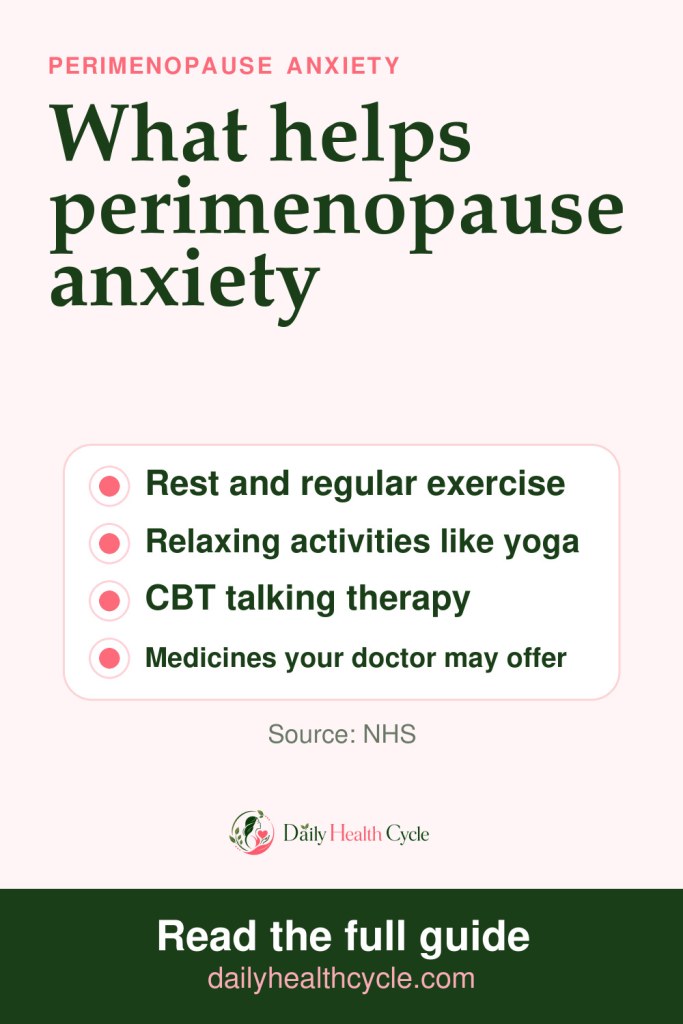
- What helps: the NHS suggests rest, regular exercise and relaxing activities, and says cognitive behavioural therapy (CBT) can help with low mood, feelings of anxiety and sleep problems. It also says antidepressants may be offered, and NICE says to consider HRT and CBT for depressive symptoms that start around the same time as other menopause symptoms (NHS; NICE).
- Anxiety that doesn’t go away or interferes with daily life is worth raising with a clinician, because other conditions such as an overactive thyroid can cause it too (NHS). If you have thoughts of suicide, call or text 988 in the US, or call 911 in an emergency.
Not sure which one this is?
Perimenopause, menopause and PCOS share a lot of overlapping symptoms. Take our free 2-minute self-check for a starting point on what to read next and what to bring up with your doctor.
In this article:
- What Is Perimenopause Anxiety?
- What the Research Shows
- Why It Can Happen
- Perimenopause Anxiety or an Anxiety Disorder?
- Other Causes That Can Look Similar
- What Can Help
- Racing Heart or Panic-Like Episodes
- When to Get Help
- Perimenopause Anxiety FAQ
- Your Next Step
What Is Perimenopause Anxiety?
“Perimenopause anxiety” isn’t a separate medical diagnosis. It’s a way of describing anxiety that starts or gets worse during the years leading up to menopause. The NHS lists anxiety alongside mood swings, low mood, memory problems and brain fog among the mood-related symptoms of perimenopause (NHS).
The National Institute of Mental Health (NIMH) describes anxiety symptoms that include feeling irritable or “on edge,” feeling restless, having a hard time concentrating and having trouble falling or staying asleep (NIMH). Several of these also appear on the NHS perimenopause symptom list, which is one reason the two are easy to confuse. Our perimenopause symptoms checklist can help you see the wider pattern.
What the Research Shows
The best-known data come from SWAN, the Study of Women’s Health Across the Nation. Researchers followed 2,956 women, aged 42 to 52 at the start, for 10 years and tracked how often they had four anxiety symptoms. Women who had low anxiety at the start had roughly 1.6 times the odds (odds ratio 1.56 to 1.61) of reporting high anxiety in early or late perimenopause or after menopause than before it. That held after the researchers accounted for upsetting life events, financial strain, fair or poor perceived health and hot flashes (Menopause, 2013).
Women who already had high anxiety before perimenopause tended to stay high throughout, with no extra jump at a particular stage. The authors concluded that women with low anxiety before the transition may be more susceptible to high anxiety during and after it (same study).
Low mood is affected too. The authors of a JAMA Psychiatry trial note that the menopause transition and early postmenopause are associated with a 2- to 4-fold increased risk of clinically significant depressive symptoms (JAMA Psychiatry, 2018).
These studies show an association, not the exact reason. They also can’t tell you whether your own anxiety is linked to perimenopause, which is why a clinician’s assessment matters.
Why It Can Happen
Researchers haven’t pinned down a single cause. Here is what the sources describe:
- Disrupted sleep. The NHS says being unable to get to sleep or stay asleep can make you feel irritable, stressed and anxious, and can be worse if you also have night sweats. It adds that mood changes and memory or concentration problems may feel worse if you have sleep problems and feel very tired (NHS).
- Hot flushes. They can make you sweat a lot, feel dizzy and cause palpitations or anxiety (NHS). Our guide to how to stop hot flashes covers what works.
- More than hot flashes and stress. In SWAN, the rise in high anxiety remained after adjusting for hot flashes, life events and financial strain, so those factors don’t fully explain it (Menopause, 2013).
- General anxiety risk factors. For anxiety disorders, the NIMH says research points to a mix of genetics, brain chemistry, biology and environment, and that experiencing a traumatic event or a stressful environment may raise risk (NIMH).
Shifting hormone levels are the obvious suspect, but the sources reviewed for this article don’t establish exactly how, so be cautious about any single-cause explanation.
Perimenopause Anxiety or an Anxiety Disorder?
They can overlap, and you can have both. The NIMH describes generalized anxiety disorder (GAD) as extreme worry or nervousness that happens more often or more intensely than the situation calls for, and that can last for months or even years. To be diagnosed, a person must find it difficult to control worry on most days for at least 6 months and have at least three of these: feeling restless or “on edge,” fatigue, trouble concentrating, irritability, muscle tension or problems with sleep (NIMH).
Only a clinician can tell which applies. The NIMH says a provider may ask when your symptoms began, how long they have lasted, how often they occur and how they affect your life, and may do a physical exam to check that an unrelated physical problem isn’t causing them (NIMH). Before your visit, it helps to write down:
- When the anxiety started, and whether it lined up with changes in your periods, sleep or hot flashes.
- How long it has lasted and how often it happens.
- How much it affects your work, sleep, relationships or daily routine.
- Any past anxiety or depression, so your clinician can see the full picture.
Other Causes That Can Look Similar
Anxiety-like symptoms have other possible causes, which is why it’s worth getting checked rather than assuming.
Overactive thyroid
The NHS lists nervousness, anxiety and irritability, mood swings, difficulty sleeping, persistent tiredness, sensitivity to heat, a fast or irregular heartbeat and trembling among the symptoms of an overactive thyroid. It’s about 10 times more common in women than men, and a GP can arrange a blood test to check how well your thyroid is working (NHS). Our guide to hormonal imbalance symptoms covers thyroid and other hormone-related conditions. If a racing or pounding heart is one of your symptoms, our guide to perimenopause heart palpitations covers the other causes and when to get help.
Depression
Anxiety and depression often occur together. The NIMH lists depression among the conditions that can co-occur with GAD (NIMH), and the NHS lists low mood and depression among the mood changes of perimenopause (NHS). Low mood that lingers is worth raising as well.
Exhaustion
The NHS says mood and concentration symptoms may feel worse when you have sleep problems and feel very tired (NHS). If tiredness is a big part of your picture, see our guide to the causes of constant fatigue in women for what to check.
What Can Help
Options fall into a few groups. Which suits you depends on your symptoms, health history and preferences, so treat this as a list of things to discuss, not a prescription.
Everyday steps the NHS suggests
The NHS lists these steps for menopause and perimenopause symptoms, including mood changes (NHS):
- Get as much rest as you can and keep to regular sleep routines.
- Exercise regularly.
- Try relaxing activities such as yoga, tai chi or meditation.
- Talk to other people going through the same thing, such as family, friends or colleagues.
- Don’t smoke, which can make symptoms worse, and try not to drink more than the recommended alcohol limit, which may affect your symptoms.
Cognitive behavioural therapy (CBT)
The NHS describes CBT as a talking therapy that can help with low mood and feelings of anxiety, and says it can also help with sleep problems (NHS). The NIMH calls CBT a research-supported therapy that is commonly used to treat GAD and the “gold standard” choice for psychotherapy (NIMH). NICE says clinicians should explain CBT, including menopause-specific CBT, and discuss options such as face-to-face or remote sessions, individual or group sessions and self-help. It also says to consider CBT for depressive symptoms and for sleep problems that come with hot flushes (NICE).
Hormone therapy (HRT)
The NHS says oestrogen is the main type of HRT and can help manage perimenopause symptoms (NHS). NICE says to consider HRT for depressive symptoms, not meeting the criteria for depression, that start around the same time as other menopause symptoms. The recommendations chapter of NICE’s menopause guideline doesn’t mention anxiety by name, so whether HRT could help your anxiety is a question for your clinician (NICE).
The trial evidence reviewed here is about depressive symptoms rather than anxiety. In a placebo-controlled trial of 172 women aged 45 to 60 who had no depressive symptoms at the start, 12 months of transdermal estradiol plus intermittent micronized progesterone lowered the share who developed clinically significant depressive symptoms (17.3% vs 32.3% on placebo). The benefit showed up in the early menopause transition but not in the late transition or after menopause (JAMA Psychiatry, 2018). HRT also has risks and isn’t right for everyone: see our guide to perimenopause treatment options.
Antidepressants and other medicines
The NHS says that if you have low mood, depression or anxiety caused by perimenopause or menopause, you may be offered antidepressants (NHS). For GAD, the NIMH says treatment typically involves psychotherapy, medication or both, and that finding the right plan can take trial and error (NIMH).
Herbal remedies and supplements
Red clover and black cohosh are sometimes sold for menopause symptoms, but the NHS says there is very little evidence on how well they work or how safe they are, and some herbal remedies can cause serious side effects when taken with other medicines (NHS). Talk to a doctor before taking any.
Racing Heart or Panic-Like Episodes
Hot flushes can cause palpitations or anxiety, and the NHS lists a faster, slower or more noticeable heartbeat among perimenopause symptoms (NHS). But it also says to contact your GP if you have symptoms like a fast heartbeat (NHS), so don’t assume it’s “just anxiety.”
Some symptoms need emergency care. The CDC lists chest pain or discomfort, feeling weak, light-headed or faint, breaking into a cold sweat, pain in the jaw, neck, back, arms or shoulders and shortness of breath among the major heart attack symptoms, and says to call 9-1-1 immediately if you notice them. It adds that women are more likely to have other symptoms such as unusual or unexplained tiredness and nausea or vomiting (CDC).
When to Get Help
Consider booking a visit if:
- Anxiety doesn’t go away or starts to interfere with your daily activities (NIMH).
- You have a fast heartbeat or other palpitations (NHS).
- You think you have perimenopause symptoms and want to know your options (NHS).
- Your low mood is lasting, or you feel hopeless.
The NIMH suggests starting with a primary care doctor, psychiatrist, psychologist or clinical social worker (NIMH). Our appointment steps explain what to bring and what to ask.
If you’re struggling or having thoughts of suicide, call or text the 988 Suicide & Crisis Lifeline at 988 in the US, or call 911 in a life-threatening situation (NIMH). In the UK and Ireland, Samaritans is free to call on 116 123.
Perimenopause Anxiety FAQ
Can perimenopause cause anxiety for the first time?
It can. In SWAN, women who had low anxiety at the start were more likely to report high anxiety in perimenopause and afterward than before (Menopause, 2013), and the NHS lists anxiety among the mood changes of perimenopause (NHS). Perimenopause isn’t the only possible cause, though, so it’s worth getting checked.
How long does perimenopause anxiety last?
There’s no fixed timeline for anxiety specifically. The NHS says perimenopause and menopause symptoms usually last 7 to 9 years, sometimes longer, and can change over that time. Hot flushes and night sweats may improve and be replaced by other symptoms such as low mood and anxiety (NHS). See our guide to how long perimenopause lasts.
Is it anxiety or perimenopause?
It can be both. Only a clinician can tell, using the pattern, timing and impact of your symptoms and, where needed, a physical check (NIMH). A GAD diagnosis requires worry that is hard to control on most days for at least 6 months, plus at least three specific symptoms.
Does HRT help anxiety?
The guidance reviewed here doesn’t make an anxiety-specific recommendation for HRT. NICE says to consider it for depressive symptoms that start around the same time as other menopause symptoms (NICE), and the NHS says antidepressants may be offered for anxiety caused by perimenopause or menopause (NHS). Talk through the options with your clinician.
Can black cohosh or other supplements help?
The NHS says herbal remedies sold for menopause symptoms, such as red clover and black cohosh, have very little evidence on how well they work or how safe they are, and some can interact with other medicines (NHS). Check with a doctor or pharmacist first.
Can perimenopause cause anxiety and heart palpitations?
It can. The NHS lists a faster, slower or more noticeable heartbeat among perimenopause symptoms, and hot flushes can bring on palpitations or anxiety. Still, the NHS says to contact your GP about symptoms like a fast heartbeat, and you should call 911 for chest pain, fainting or shortness of breath.
Can perimenopause make existing anxiety worse?
Research suggests the biggest change is in women who had little anxiety before. In the SWAN study, which followed 2,956 women for 10 years, women with low anxiety at the start had about 1.6 times the odds of high anxiety during and after the transition. Women who already had high anxiety tended to stay high, without an extra jump at any particular stage. If your anxiety is getting worse, it’s worth getting help either way.
Your Next Step
For two weeks, note when anxiety shows up, how you’re sleeping, any hot flashes or night sweats and changes in your periods. Then book a visit and bring your notes. For related reading, see our perimenopause symptoms checklist, our guides to irregular periods in perimenopause, how to stop hot flashes and perimenopause treatment options, and our complete perimenopause and menopause guide.
Sources: Symptoms of menopause and perimenopause — NHS · Treatment for menopause and perimenopause — NHS · Things you can do to help menopause and perimenopause symptoms — NHS · Overactive thyroid — NHS · Menopause: identification and management (NG23) — NICE · Does risk for anxiety increase during the menopausal transition? SWAN — Menopause, 2013 · Transdermal estradiol and progesterone and depressive symptoms in the menopause transition — JAMA Psychiatry, 2018 · Generalized anxiety disorder — NIMH · About heart attack — CDC
Free printable
Perimenopause symptom & cycle tracker
Track your periods, sleep, hot flashes and mood on one page, then bring it to your appointment. Enter your email to download it.
About the author: Jessica Bordo writes Daily Health Cycle out of personal interest in women’s health, not as a clinician. She summarizes what sources such as the NHS, ACOG, CDC and The Menopause Society say and links to them so you can check the claims yourself. Use these guides to prepare questions for your own clinician, not to replace their advice. Our authors page explains how we source and check articles.
This article is for general education and isn’t medical advice. Read our Medical Disclaimer and talk with a qualified clinician about your own care.