

Last updated October 11, 2026. Educational information, not medical advice: see our Medical Disclaimer. Statistics are linked to their sources below.
Key Takeaways
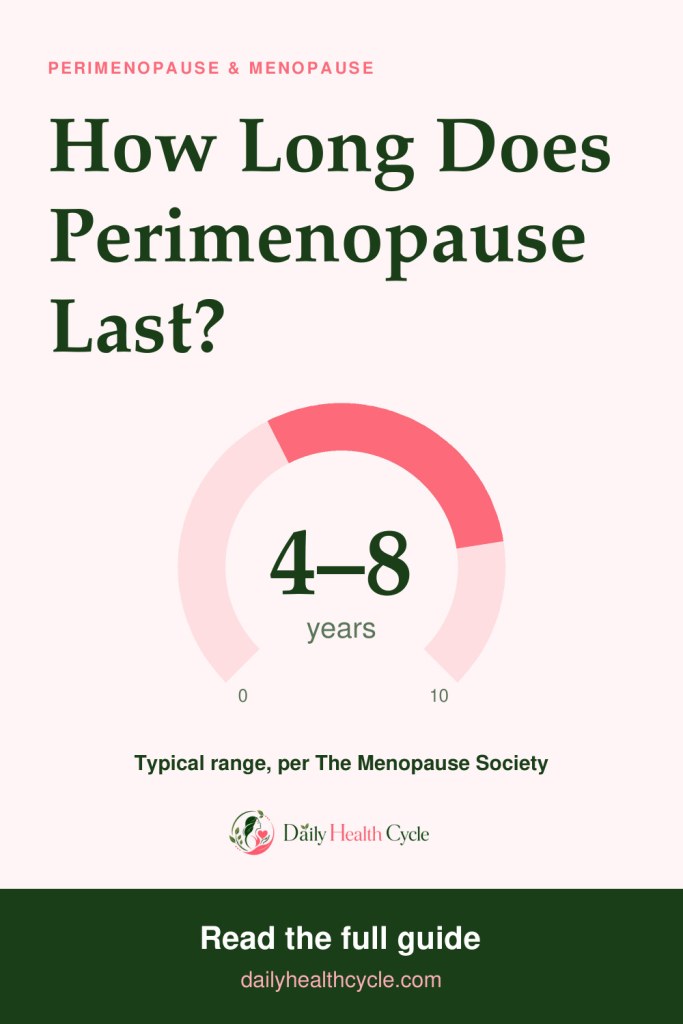
- The Menopause Society estimates women remain in perimenopause for roughly 4 to 8 years, and it usually begins in the mid-40s, though onset varies widely.
- It ends when you reach menopause — 12 consecutive months without a period.
- Starting earlier tends to mean a longer transition: in the SWAN study, the median ranged from about 4.4 years in women who started latest to about 8.6 years in those who started earliest.
- No single test tells you exactly how much longer you have left.
How long does perimenopause last? If you’re wondering how much longer this lasts, the honest answer is a range, not a number. The Menopause Society estimates that women remain in perimenopause for roughly 4 to 8 years — but the largest study of the transition, the Study of Women’s Health Across the Nation (SWAN), found the median ranged from about 4½ years to nearly 9 years depending on when it started. For the full picture — stages, symptoms and treatment — see our complete perimenopause & menopause guide.
The Average Timeline
Most women enter perimenopause in their mid-40s, though hormone changes can begin in the 30s (ACOG). From there, it typically runs roughly 4 to 8 years before reaching menopause — the point marking 12 full months without a period. The average age of natural menopause in the U.S. is 51, and the NHS says it usually happens between 45 and 55 (NHS), which gives you a rough sense of the window depending on when your own symptoms started.
Because perimenopause is defined by its end point (menopause) rather than a fixed start date, it’s really only possible to know how long yours lasted in hindsight. If you’re still working out which stage you’re in, our guide to perimenopause vs menopause explains the difference.
What Can Affect Your Timeline
There’s no way to predict your exact timeline in advance, but research points to a few factors:
- Age at onset — this has the strongest evidence. In SWAN, which followed about 1,100 women through the transition, the median duration was roughly 8.6 years for women who started youngest, compared with about 4.4 years for those who started oldest.
- Smoking — smoking is associated with reaching menopause at an earlier age, which brings the end of the transition forward.
- Family history — women with a family history of early or premature menopause are more likely to experience it themselves.
- Surgery and cancer treatment — surgery that removes both ovaries brings on menopause right away rather than gradually, and chemotherapy or pelvic radiation can damage the ovaries and stop periods, sometimes permanently.
These are patterns across large groups of women, not predictions for any one person.
Early vs. Late Perimenopause
Clinicians often divide the transition into two stages using a staging system called STRAW+10:
- Early perimenopause — your cycle length starts varying, with a persistent difference of 7 days or more between one cycle and the next.
- Late perimenopause — you start skipping periods, with stretches of 60 days or more without one.
Late perimenopause is the stage that leads directly into your final period. Menopause is confirmed once 12 months have passed without another. For a symptom-by-symptom list, see our perimenopause symptoms checklist. For what’s normal and what to get checked, see our guide to irregular periods in perimenopause.
Signs Perimenopause Is Near Its End
There’s no single definitive signal, but a pattern that often shows up in the final stretch:
- Periods become widely spaced — gaps of 60 days or more mark the late stage.
- Hot flashes and night sweats tend to be reported most often in late perimenopause, so symptoms may feel strongest before they ease.
- You’re approaching the 12-month mark since your last period — at which point you’ve reached menopause, not just the end of perimenopause.
How Long Do Hot Flashes and Night Sweats Last?
Frequent hot flashes and night sweats lasted a median of 7.4 years in total in the Study of Women’s Health Across the Nation (SWAN), a long-running U.S. study. The analysis covered 1,449 participants who reported frequent symptoms. About 4.5 years of that time typically continued after the final period (Avis et al., JAMA Internal Medicine, 2015). The Menopause Society’s 2023 statement similarly puts the mean duration at 7 to 9 years, with more than 10 years in about a third of women (Menopause Society, 2023).
Timing and background matter. Women whose frequent hot flashes started while still premenopausal or in early perimenopause had the longest duration, with a median above 11.8 years. Duration also varied by race and ethnicity:
These are group medians, and the study doesn’t explain the differences, so treat them as a reminder that timelines vary rather than a prediction for you. For what helps, see our guide to how to stop hot flashes.
When to See a Doctor
Talk to a doctor if:
- Your periods stop for 12+ months and then bleeding restarts (this needs evaluation, not just tracking)
- You’re under 40 and experiencing perimenopause-like symptoms (possible premature ovarian insufficiency)
- Symptoms are severe enough to disrupt sleep, work, or daily life for an extended period
- You’ve gone more than a year without a period and are unsure whether you’ve reached menopause
Free printable
Perimenopause symptom & cycle tracker
Track your periods, sleep, hot flashes and mood on one page, then bring it to your appointment. Enter your email to download it.
Frequently Asked Questions
Can perimenopause last 10 years or more?
It can. Estimates run roughly 4–8 years, but in the SWAN study the median for women who started earliest was about 8.6 years — meaning half of that group went longer. If yours is stretching on, it’s worth talking to a doctor about managing your symptoms.
Does perimenopause get worse before it ends?
For many women, hot flashes and night sweats are reported most often in late perimenopause, in the stretch before periods stop entirely, and then ease afterward.
How do I know if I’m in early or late perimenopause?
Cycle length is the best clue. Cycles that vary by 7 or more days from one to the next suggest early perimenopause; stretches of 60 or more days without a period suggest late perimenopause. See our guide to irregular periods in perimenopause for what these cycle changes look like. For cycles that come about every two weeks, see period every 2 weeks in perimenopause.
Is there a test to tell me how much time I have left?
No single test reliably predicts this. Hormone levels such as FSH swing widely during the late transition, so one reading isn’t a dependable clock.
Do hot flashes stop when perimenopause ends?
Not always right away. In SWAN, hot flashes and night sweats lasted a median of 7.4 years in total and continued for a median of 4.5 years after the final period. For what helps, see our guide to how to stop hot flashes.
How do you know when perimenopause is ending?
There’s no single sign, but near the end periods usually become widely spaced, with gaps of 60 days or more, which marks late perimenopause. Hot flashes and night sweats are often reported most in this stage. Perimenopause ends at menopause, which is confirmed once you’ve gone 12 months in a row without a period.
How long does perimenopause last on average?
It typically runs roughly 4 to 8 years before menopause. Most women start in their mid-40s, though hormone changes can begin in the 30s (ACOG), and the average age of natural menopause in the US is 51. Because perimenopause is defined by its end point, you can only know how long yours lasted in hindsight.
Sources: The Menopause Years — ACOG · Perimenopause duration — The Menopause Society · Duration of the menopausal transition by age at onset — SWAN (Menopause, 2017) · STRAW+10 staging — ASRM · Duration of vasomotor symptoms over the menopause transition — SWAN (JAMA Intern Med, 2015) · Vasomotor symptoms and menopause — SWAN · Early or premature menopause — Office on Women’s Health · Smoking and age at menopause — pooled analysis of 17 studies (PLOS Medicine)
About the author
Jessica Bordo writes Daily Health Cycle out of personal interest in women’s health, not as a clinician. She shares practical, source-linked content to help women feel more confident in their bodies, make informed choices, and build healthier everyday habits. More about Jessica
This article is for educational purposes only and isn’t a substitute for professional medical advice, diagnosis, or treatment. Read our medical disclaimer.