
Last updated November 18, 2026. Educational information, not medical advice: see our Medical Disclaimer.
HRT is the most effective treatment for hot flashes, but it isn’t right for everyone. You may have had breast cancer or a blood clot, you may have been told HRT isn’t safe for you, or you may simply prefer not to take hormones. The good news is that there are now several non-hormonal options with strong evidence behind them, including two newer medicines designed specifically for hot flashes.
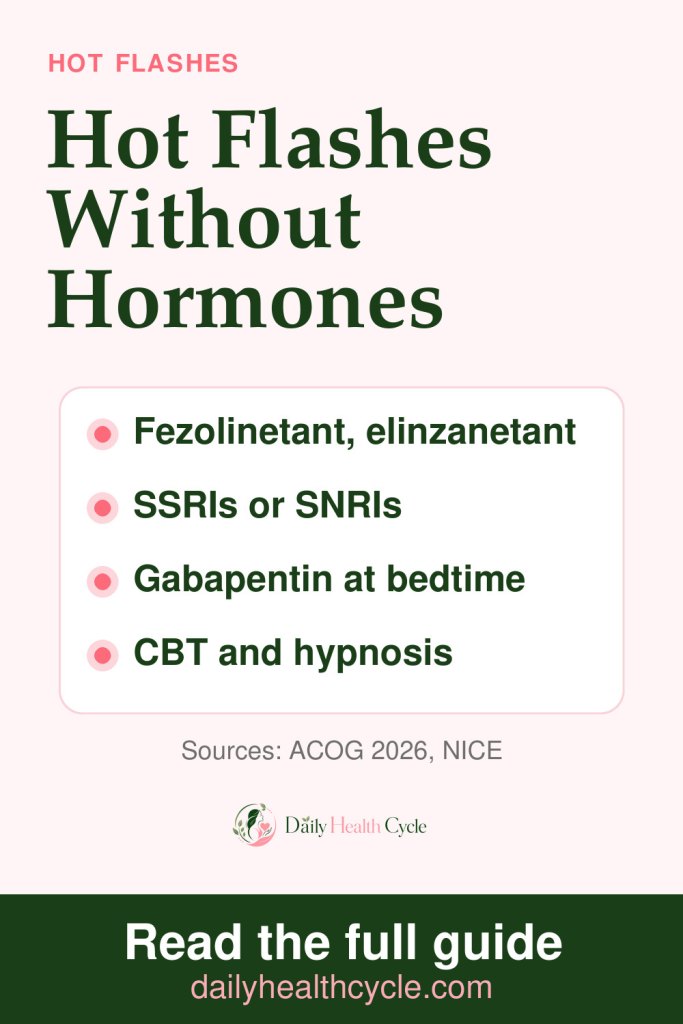
Quick answer: The best-studied options for non-hormonal treatment for hot flashes are fezolinetant and elinzanetant, a newer class of medicine, plus certain antidepressants (SSRIs and SNRIs), gabapentin, cognitive behavioural therapy (CBT) and clinical hypnosis. ACOG’s 2026 guideline strongly recommends SSRIs, SNRIs and the newer medicines for women who can’t or don’t want to take hormones. Herbal supplements aren’t supported by the evidence.
Key Takeaways
- For women who can’t or don’t want hormones, ACOG’s 2026 guideline strongly recommends SSRIs or SNRIs and the neurokinin receptor blockers fezolinetant and elinzanetant.
- Fezolinetant needs liver blood tests: the FDA added a boxed warning about rare but serious liver injury in December 2024. NICE recommends it when HRT is unsuitable.
- Elinzanetant was approved by the FDA in October 2025 for moderate to severe hot flashes.
- Gabapentin, oxybutynin, CBT and clinical hypnosis also have good evidence (The Menopause Society, 2023).
- Herbal supplements and phytoestrogens aren’t supported by the evidence (ACOG, 2026).
Who Needs a Non-Hormonal Option?
The UK’s NICE guideline says to offer HRT first for hot flashes and night sweats. But HRT may not be suitable if you’ve had a hormone-sensitive cancer such as breast cancer, or certain other conditions, and some women prefer not to take hormones. Your doctor will go through your own history with you. See HRT in perimenopause for who it suits.
Here’s what the main guidelines recommend instead, and how the options compare.
Fezolinetant and Elinzanetant: The Newer Medicines
These medicines are called neurokinin receptor antagonists. They work on the part of the brain that controls body temperature, which becomes over-sensitive when estrogen falls. They were developed specifically for menopausal hot flashes, and the 2026 ACOG guideline strongly recommends them for hot flashes and the sleep problems they cause (Contemporary OB/GYN summary).
- Fezolinetant (Veozah) is a once-daily pill. In December 2024, the FDA added a boxed warning, its most serious type, about rare but serious liver injury (MDedge). You’ll need liver blood tests before you start and regularly in the first months, and you should stop it and seek help straight away if you develop signs of liver problems, such as yellowing skin or eyes, dark urine or pain in the upper right of your belly. NICE recommends fezolinetant as an option when HRT is unsuitable.
- Elinzanetant (Lynkuet) is a once-daily pill approved by the FDA in October 2025 for moderate to severe hot flashes. In its main trials, it reduced both how often and how severe hot flashes were compared with a placebo (Contemporary OB/GYN).
SSRIs and SNRIs
Some antidepressants, at doses often lower than those used for depression, reduce hot flashes. The 2026 ACOG guideline strongly recommends SSRIs and SNRIs for hot flashes, and for low mood, in women who don’t take hormone therapy. They can be a good fit if you also have low mood or anxiety.
One important caution: ACOG says fluoxetine and paroxetine are generally avoided in women taking tamoxifen for breast cancer, because they can interfere with how tamoxifen works. If you take tamoxifen, make sure your doctor knows before you start any antidepressant.
The UK’s NICE guideline takes a more cautious line: it says not to routinely offer SSRIs, SNRIs or clonidine as first-line treatment for hot flashes alone. In practice, that means they’re usually considered after other options, or when they also help another symptom.
Gabapentin and Oxybutynin
- Gabapentin is a nerve medicine that can reduce hot flashes. ACOG suggests it when other non-hormonal options haven’t worked or aren’t tolerated, and advises taking it at bedtime, which can also help with night sweats. It can cause drowsiness and dizziness.
- Oxybutynin, a bladder medicine, also reduces hot flashes. The Menopause Society notes its most common side effects are dry mouth and difficulty passing urine, and that long-term use of this type of medicine may be linked to memory problems in older people (The Menopause Society, 2023).
CBT and Clinical Hypnosis
Not every option is a pill. The Menopause Society rates both of these at its strongest level of evidence:
- Cognitive behavioural therapy (CBT) reduces how much hot flashes bother you. In two trials, 65% to 78% of women who had CBT reached a clinically significant improvement, more than with usual care. NICE recommends considering menopause-specific CBT, either alongside HRT or for women who can’t or don’t want to take it.
- Clinical hypnosis reduced self-reported hot flashes by 74% in one trial, compared with 17% in the comparison group.
These options have no medication side effects, and CBT can also help with sleep and mood. Ask your doctor whether menopause-specific CBT is available where you live.
What Doesn’t Have Good Evidence
Many supplements are marketed for hot flashes, but the 2026 ACOG guideline found that phytoestrogens and herbal supplements aren’t supported by the evidence. Supplements also aren’t checked like medicines, so their quality and dose can vary. Comfort steps such as a fan, a cool bedroom and avoiding triggers are still worth trying, but they’re not treatments on their own. Our guide on how to stop hot flashes covers these.
How to Choose
The right option depends on your health, other medicines and what matters most to you. Questions worth asking your doctor:
- Is HRT really unsuitable for me, or is a lower-risk form, such as a patch, an option?
- Would fezolinetant or elinzanetant suit me, and how will my liver be monitored?
- Could an SSRI or SNRI help both my hot flashes and my mood? Is it safe with my other medicines?
- Is gabapentin at bedtime worth trying for my night sweats?
- Can I be referred for menopause-specific CBT?
Tracking your hot flashes for a couple of weeks before and after starting a treatment shows whether it’s working. Our free symptom tracker makes this easy. If night sweats are your main problem, see our guide to perimenopause night sweats.
Non-Hormonal Treatment FAQ
What is the best non-hormonal treatment for hot flashes?
There isn’t one best option for everyone. ACOG’s 2026 guideline strongly recommends SSRIs or SNRIs and the newer medicines fezolinetant and elinzanetant. CBT and clinical hypnosis also have strong evidence. The right choice depends on your health and other medicines.
Is fezolinetant safe?
It’s effective, but in December 2024 the FDA added a boxed warning about rare but serious liver injury. You need liver blood tests before starting and regularly in the first months, and you should stop it and get medical help if you notice signs of liver problems, such as yellow skin or eyes or dark urine.
Can I take antidepressants for hot flashes if I’ve had breast cancer?
Often yes, but some need to be avoided. ACOG says fluoxetine and paroxetine are generally avoided in women taking tamoxifen, because they can interfere with it. Your oncologist or doctor can choose a suitable option.
Do herbal supplements work for hot flashes?
The evidence doesn’t support them. ACOG’s 2026 guideline found phytoestrogens and herbal supplements aren’t supported for hot flashes, and supplement quality varies because they aren’t regulated like medicines.
Does CBT really help hot flashes?
Yes. The Menopause Society rates CBT at its strongest evidence level, and in trials 65% to 78% of women who had CBT reached a clinically significant improvement. It mainly reduces how much hot flashes bother you, and NICE recommends considering it.
Your Next Step
If you can’t or don’t want to take HRT, you still have effective choices. Book an appointment, bring a two-week record of your hot flashes, and ask which of these options fits your health and your other medicines.
Sources
- NICE NG23: Menopause: identification and management
- Contemporary OB/GYN summary: ACOG guideline expands menopause VMS, sleep, and mood recommendations
- MDedge: FDA Adds Boxed Warning for Liver Injury to Fezolinetant
- Contemporary OB/GYN: FDA approves elinzanetant (Lynkuet) for vasomotor menopausal symptoms
- The Menopause Society: 2023 nonhormone therapy position statement
Free printable PDF
Perimenopause symptom & cycle tracker
A one-page PDF to print and fill in by hand: periods, sleep, hot flashes and mood, ready to bring to your appointment. Enter your email and the download link appears right away.
Prefer to track on your phone? Use our online symptom tracker, no email needed.
Sources cited in this article
- NICE guideline: Recommendations (nice.org.uk)
- Contemporary OB/GYN summary: Acog guideline expands menopause vms sleep and mood recommendations (contemporaryobgyn.net)
- MDedge: Fda adds boxed warning liver injury fezolinetant (mdedge.com)
- Contemporary OB/GYN: Fda approves elinzanetant lynkuet for vasomotor menopausal symptoms (contemporaryobgyn.net)
- The Menopause Society, 2023: 2023 nonhormone therapy position statement (menopause.org)
Last checked November 18, 2026. Spot an outdated source? Tell us.
About the author: Jessica Bordo writes Daily Health Cycle out of personal interest in women’s health, not as a clinician. Each article summarizes what sources such as the NHS, NICE and published studies say, and links to them so you can check the claims yourself. Use these guides to prepare questions for your own clinician, not to replace their advice. Our editorial standards explain how we research and update articles.
This article is for general education and isn’t medical advice. See our full disclaimer and talk with a qualified clinician about your own care.