
Last updated November 13, 2026. Educational information, not medical advice: see our Medical Disclaimer.
Most women reach menopause somewhere between 45 and 55. When periods stop earlier than that, it can come as a shock, especially if you were still thinking about having children. Early menopause is more than an early end to periods: it also affects your long-term bone and heart health, which is why getting it diagnosed and treated matters.
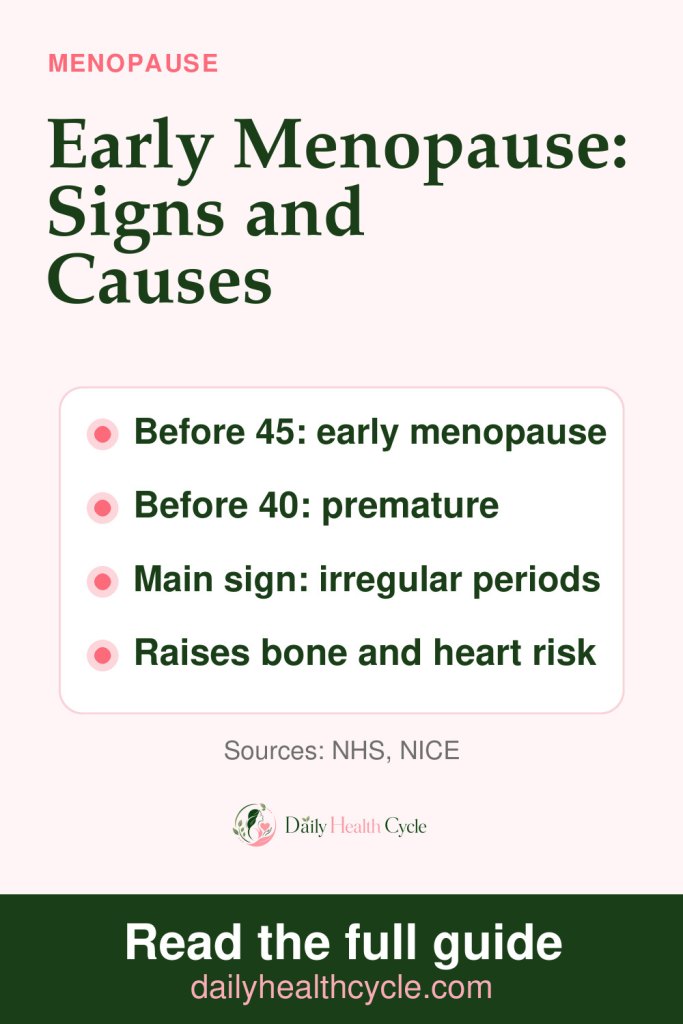
Quick answer: Early menopause is when your periods stop before 45, and premature menopause is when they stop before 40 (NHS). The main sign is periods becoming irregular or stopping, often with hot flashes or night sweats. Causes include family history, smoking, cancer treatment and surgery to remove the ovaries. Hormone treatment is usually recommended until the typical age of menopause, to protect your bones and heart.
Key Takeaways
- Early menopause means periods stop before 45. Premature menopause means before 40 (NHS). Under 40, doctors call the underlying condition premature ovarian insufficiency (POI).
- It’s more likely if it runs in your family, you smoke, you’re underweight or you started your periods early, and it can follow chemotherapy, radiotherapy or surgery to remove the ovaries (NHS).
- It raises the chance of osteoporosis and heart disease, and can make it harder to get pregnant (NHS).
- Under 40, NICE says POI is diagnosed from symptoms plus raised FSH on two blood tests 4 to 6 weeks apart.
- NICE recommends HRT or a combined hormonal contraceptive for POI, continued until at least the usual age of menopause unless there’s a reason not to.
Early vs Premature Menopause
The NHS uses two terms:
- Early menopause: you stop having regular periods before the age of 45.
- Premature menopause: this happens before the age of 40.
When the ovaries stop working normally before 40, doctors call it premature ovarian insufficiency (POI). The word “insufficiency” matters: with POI, the ovaries may still work on and off, and the 2024 international guideline on POI notes that some women have intermittent ovarian function and may still conceive naturally (ESHRE, ASRM and IMS, 2024).
For comparison, the NHS says menopause usually happens between 45 and 55. See what age perimenopause starts for the typical timeline.
Signs of Early Menopause
The NHS says the main symptom is not having your period regularly. Periods may become less frequent, more irregular, or stop altogether. Many women also notice the usual menopause symptoms, such as:
- Hot flashes and night sweats
- Trouble sleeping
- Low mood, anxiety or brain fog
- Vaginal dryness and a lower sex drive
Missed periods have other causes too, including pregnancy, stress, weight changes, thyroid problems and PCOS, so it’s important to get checked rather than assume.
What Causes It
Often there’s no clear cause. The NHS says early or premature menopause is more likely if:
- It runs in your family
- You started your periods early
- You smoke
- You’re underweight
It can also be brought on by treatment for other conditions, including radiotherapy or chemotherapy, certain hormone medicines, and surgery to remove the ovaries. NICE also notes that people from some ethnic minority backgrounds and people with some lifelong conditions may reach menopause at a younger age (NICE NG23).
How It’s Diagnosed
If you’re under 45 and have menopause symptoms, a GP may do blood tests (NHS). The NICE guideline, updated in 2026, sets out the approach by age:
- Aged 40 to 45: an FSH blood test may be considered if you have menopause symptoms, including a change in your cycle.
- Under 40: POI is diagnosed from symptoms, such as no or infrequent periods, plus raised FSH on two blood samples taken 4 to 6 weeks apart. NICE says it should never be diagnosed on a single blood test, and AMH shouldn’t be used routinely to diagnose it.
Your doctor will also consider your medical and family history, and may refer you to a specialist if the diagnosis isn’t clear. Our guide to the FSH test explains why a single result can be misleading.
Why It Matters for Your Health
Estrogen helps protect your bones and heart. Losing it earlier means more years without that protection. The NHS says early or premature menopause gives you a higher chance of developing osteoporosis and cardiovascular disease, and that it can affect both your physical and mental health.
That’s the main reason treatment is recommended even if your symptoms are mild: it’s about protecting your long-term health, not only easing hot flashes.
Treatment
The NHS says the main treatments are hormone medicines, such as the combined contraceptive pill or HRT, because of the higher chance of problems with your bones and heart. For premature ovarian insufficiency, NICE recommends offering either HRT or a combined hormonal contraceptive, unless there’s a reason you can’t take it, such as a hormone-sensitive cancer. NICE advises explaining that:
- Treatment should continue until at least the age of natural menopause.
- The baseline risk of breast cancer and heart disease is very low under 40, and rises with age.
- Both HRT and combined contraceptives protect the bones.
- HRT may have a better effect on blood pressure than a combined pill.
- HRT is not a contraceptive.
If you can’t take hormones, NICE recommends advice on bone and heart health and on managing symptoms. See our guides to HRT and other treatment options.
Fertility and Emotional Support
The NHS says early or premature menopause can make it harder to get pregnant, but some women can have children through IVF using their own frozen eggs or donor eggs. Our guide to IVF success rates explains what the numbers mean, including with donor eggs.
An unexpected diagnosis can be hard to take in. NICE recommends offering psychological support to people with early menopause or POI. In the UK, the NHS says you can refer yourself to NHS talking therapies without seeing a GP first, and the Daisy Network is a charity for women with premature menopause.
When to See a Doctor
- Your periods become irregular or stop and you’re under 45 (and you’re not pregnant)
- You have hot flashes, night sweats or other menopause symptoms before 45
- You’ve had cancer treatment or ovarian surgery and your periods have changed
- You want to talk about fertility options
Keeping a record of your periods and symptoms helps your appointment. Our free symptom tracker lets you print a 30-day summary.
Early Menopause FAQ
What age is considered early menopause?
The NHS calls it early menopause if your periods stop before 45, and premature menopause if they stop before 40. Menopause usually happens between 45 and 55.
Can you still get pregnant with early menopause?
It can be harder, but it isn’t always impossible. With premature ovarian insufficiency the ovaries may still work on and off, and the NHS says some women can have children through IVF using their own frozen eggs or donor eggs. Talk to a doctor about contraception and fertility options.
Why is early menopause treated even if symptoms are mild?
Because losing estrogen early raises the chance of osteoporosis and heart disease, according to the NHS. Hormone treatment, such as HRT or a combined contraceptive, is usually recommended until at least the typical age of menopause to protect your bones and heart.
How is premature ovarian insufficiency diagnosed?
NICE says it’s diagnosed in people under 40 from symptoms, such as no or infrequent periods, plus raised FSH on two blood samples taken 4 to 6 weeks apart. It should never be diagnosed on a single blood test.
Is HRT safe if I go through menopause early?
For premature ovarian insufficiency, NICE recommends HRT or a combined hormonal contraceptive unless there’s a reason you can’t take it, such as a hormone-sensitive cancer. It notes that the baseline risk of breast cancer and heart disease is very low under 40. Discuss your own history with your doctor.
Your Next Step
If you’re under 45 and your periods have changed or stopped, book a GP appointment rather than waiting. Early diagnosis means you can start treatment that protects your bones and heart, and discuss your fertility options while you still have choices.
Free printable PDF
Perimenopause symptom & cycle tracker
A one-page PDF to print and fill in by hand: periods, sleep, hot flashes and mood, ready to bring to your appointment. Enter your email and the download link appears right away.
Prefer to track on your phone? Use our online symptom tracker, no email needed.
Sources cited in this article
- NHS: Early menopause (nhs.uk)
- ESHRE, ASRM and IMS, 2024 (ncbi.nlm.nih.gov)
- NICE NG23: Recommendations (nice.org.uk)
- Daisy Network (daisynetwork.org)
Last checked November 12, 2026. Spot an outdated source? Tell us.
About the author: Jessica Bordo writes Daily Health Cycle out of personal interest in women’s health, not as a clinician. Each article summarizes what sources such as the NHS, NICE and published studies say, and links to them so you can check the claims yourself. Use these guides to prepare questions for your own clinician, not to replace their advice. Our editorial standards explain how we research and update articles.
This article is for general education and isn’t medical advice. See our full disclaimer and talk with a qualified clinician about your own care.