

Last updated December 8, 2026. Educational information, not medical advice: see our Medical Disclaimer.
GLP-1 medicines such as semaglutide (Wegovy, Ozempic) and tirzepatide (Mounjaro) have changed weight management for many women. But almost everyone who starts one wants to know the same thing: what will the side effects be like, and which ones matter? This guide covers the common ones, the rare but serious ones, and a few points that matter especially for women, including contraception and pregnancy.
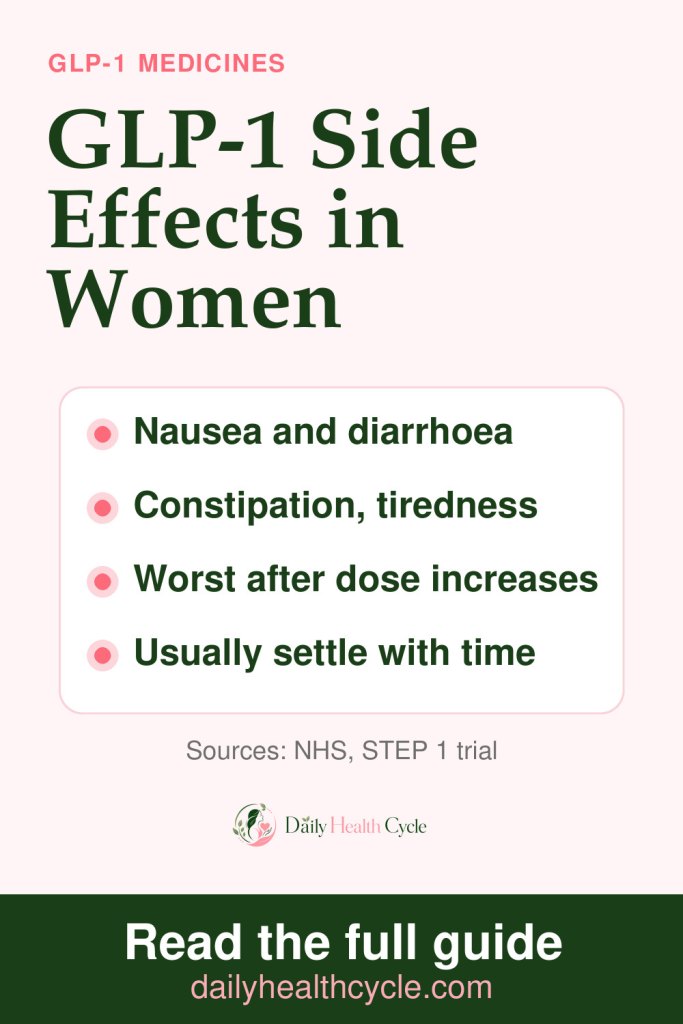
Quick answer: The most common GLP-1 side effects in women are nausea, vomiting, diarrhoea, constipation and tiredness. They’re usually worst when you start or increase the dose and tend to settle with time. Rare but serious side effects include pancreatitis (severe stomach pain spreading to the back) and gallbladder problems. Women should use effective contraception, because these medicines aren’t used in pregnancy, and tirzepatide can make the pill less reliable.
Key Takeaways
- Nausea and diarrhoea were the most common side effects in the main semaglutide weight-loss trial, and were usually mild to moderate and temporary.
- Side effects tend to be worst after starting or increasing the dose.
- Severe stomach pain that spreads to your back and doesn’t go away needs urgent medical help (MHRA).
- GLP-1 medicines aren’t used in pregnancy or breastfeeding. Use effective contraception (MHRA).
- On tirzepatide, the pill may work less well: add condoms or another barrier method for 4 weeks after starting and after each dose increase (NHS).
Common Side Effects
The NHS lists these common side effects of semaglutide. The NHS page on tirzepatide lists very similar ones, plus stomach pain:
- Feeling sick (nausea) or being sick
- Diarrhoea or constipation
- Feeling tired
- Itchy or red skin where you inject
- Hair loss
In the STEP 1 trial, which followed adults with overweight or obesity for 68 weeks on weekly semaglutide, nausea and diarrhoea were the most common side effects. They were typically temporary, mild to moderate and eased with time. Still, 4.5% of people on semaglutide stopped treatment because of digestive side effects, compared with 0.8% on placebo.
Easing nausea and digestive side effects
The NHS advises keeping to a healthy, balanced diet and avoiding alcohol, which can make feeling and being sick worse. If side effects bother you or don’t go away, talk to your pharmacist or doctor rather than stopping on your own.
What about hair loss?
Hair loss is listed as a common side effect on both NHS pages. If you’re in your 40s or 50s, it can be hard to tell apart from hair changes caused by hormones, stress or low iron. Our guide to perimenopause hair loss covers the other causes worth checking.
Serious Side Effects: When to Get Help
Serious side effects are rare, but you should know the warning signs. Call NHS 111, or your local urgent care line, if you think you have one:
- Pancreatitis: severe pain in your stomach or back that doesn’t go away. The MHRA says to seek immediate medical help.
- Gallstones or an inflamed gallbladder: severe tummy pain (listed for tirzepatide).
- A serious allergic reaction: a swollen throat or tongue, a raised itchy rash or difficulty breathing. Call 999 or your emergency number.
- Low blood sugar: sweating, shaking, palpitations or dizziness. This is more likely if you also take other diabetes medicines.
- Vision changes, including sudden loss of vision, usually in one eye.
What Women Especially Need to Know
Pregnancy, trying to conceive and breastfeeding
In June 2025 the UK medicines regulator, the MHRA, warned that GLP-1 medicines must not be used in pregnancy, while trying to get pregnant or while breastfeeding, because there isn’t enough safety data. If you could become pregnant, use effective contraception. The NHS says to stop semaglutide at least 2 months before trying to conceive, and tirzepatide at least 4 weeks before. If you become pregnant while taking one, speak to your doctor and stop as soon as possible.
Tirzepatide and the pill
Tirzepatide (Mounjaro) may make the contraceptive pill less effective, especially in women who are overweight. The NHS advises using an extra barrier method, such as condoms, a diaphragm or a cap, for 4 weeks after starting tirzepatide and for 4 weeks after each dose increase. The MHRA’s simple summary is not to rely on the pill alone. The MHRA lists non-oral methods, such as the implant or coil, as effective options, so it’s worth discussing them with your prescriber.
Midlife and menopause
Some symptoms of perimenopause, such as tiredness, constipation and hair thinning, overlap with GLP-1 side effects, so keep a note of when symptoms started compared with your doses. Our guide to GLP-1 medicines in perimenopause and menopause covers how these medicines fit into midlife health.
Buy Only From a Legitimate Pharmacy
The MHRA warns against buying “weight loss jabs” from beauty salons, social media or other unregulated sellers. The only way to be sure a product is genuine is to get it on prescription from a legitimate pharmacy. In the UK, you can report side effects or suspected fakes through the Yellow Card scheme.
GLP-1 Side Effects FAQ
What are the most common GLP-1 side effects in women?
Nausea, vomiting, diarrhoea, constipation and tiredness are the most common. Itchy or red skin where you inject and hair loss are also listed by the NHS. Digestive side effects are usually worst when starting or increasing the dose.
How long does GLP-1 nausea last?
In the STEP 1 semaglutide trial, nausea and diarrhoea were typically mild to moderate and eased with time. If they bother you or don’t go away, speak to your pharmacist or doctor rather than stopping on your own.
Can I take the pill while on Mounjaro (tirzepatide)?
Tirzepatide may make the pill less effective. The NHS advises adding a barrier method, such as condoms, for 4 weeks after starting and for 4 weeks after each dose increase. Ask your prescriber about the best contraception for you.
How long before trying to get pregnant should I stop a GLP-1?
The NHS says to stop semaglutide at least 2 months before trying to conceive and tirzepatide at least 4 weeks before. GLP-1 medicines aren’t used in pregnancy or while breastfeeding.
What GLP-1 side effects are serious?
Get urgent help for severe stomach pain that spreads to your back and doesn’t go away (possible pancreatitis), severe tummy pain from gallbladder problems, signs of a serious allergic reaction, or sudden changes in vision.
Your Next Step
Before your next review, write down any side effects, when they started and how they relate to dose changes, plus your contraception method. Ask your prescriber whether your dose plan, your contraception and any other medicines you take all fit together safely. If weight around the middle is your main concern, our guide to perimenopause weight gain covers what else helps.
Free printable
Perimenopause symptom & cycle tracker
Track your periods, sleep, hot flashes and mood on one page, then bring it to your appointment. Enter your email to download it.
Sources cited in this article
- NHS: Semaglutide (nhs.uk)
- NHS page on tirzepatide (nhs.uk)
- STEP 1 trial (pubmed.ncbi.nlm.nih.gov)
- MHRA (gov.uk)
- Yellow Card scheme (yellowcard.mhra.gov.uk)
Last checked November 4, 2026. Spot an outdated source? Tell us.
About the author: Jessica Bordo writes Daily Health Cycle out of personal interest in women’s health, not as a clinician. Each article summarizes what sources such as the NHS, NICE and published studies say, and links to them so you can check the claims yourself. Use these guides to prepare questions for your own clinician, not to replace their advice. Our editorial standards explain how we research and update articles.
This article is for general education and isn’t medical advice. See our full disclaimer and talk with a qualified clinician about your own care.