

Last updated November 22, 2026. Educational information, not medical advice: see our Medical Disclaimer.
Prediabetes is one of the most common health conditions most people have never been tested for. It usually causes no symptoms, so many women only find out by chance from a routine blood test. That’s a missed opportunity, because prediabetes is the stage where type 2 diabetes can most often be prevented, and some women’s health factors, such as PCOS, gestational diabetes and midlife, raise the risk.
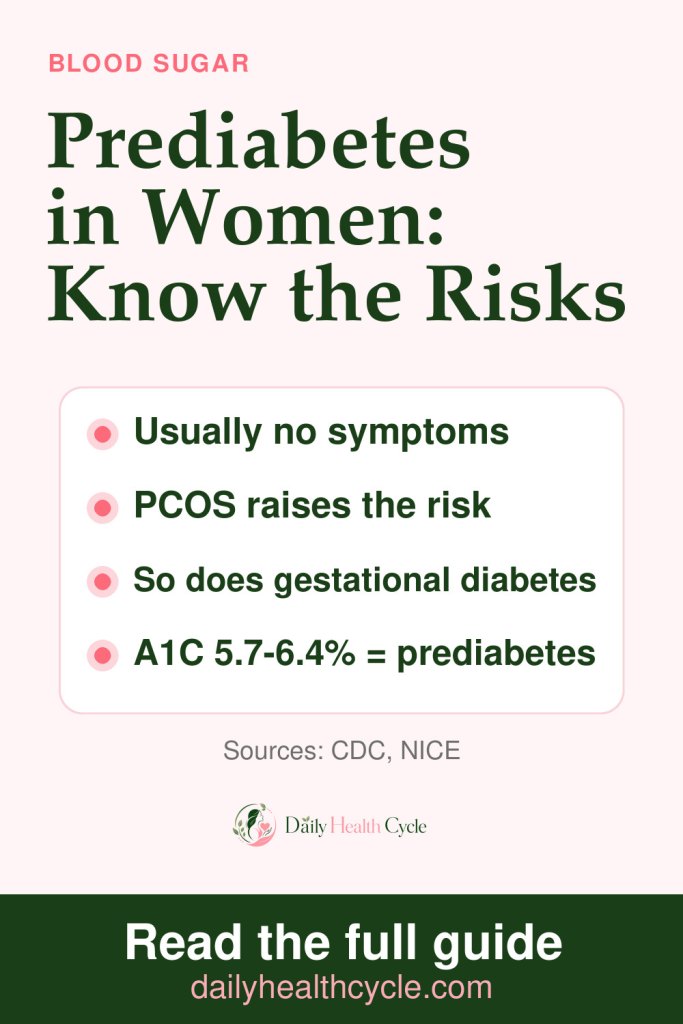
Quick answer: Prediabetes in women means your blood sugar is higher than normal but not yet in the diabetes range. It usually has no symptoms. Your risk is higher if you’re 45 or over, overweight, have PCOS or have had gestational diabetes. A simple blood test checks it (an A1C of 5.7% to 6.4%), and a lifestyle program can cut your risk of type 2 diabetes by 58% (CDC).
Key Takeaways
- An estimated 115.2 million US adults have prediabetes, more than 2 in 5 (CDC).
- It usually causes no symptoms. A blood test is the only way to know.
- Women-specific risk factors include PCOS, a history of gestational diabetes, and having had a baby over 9 pounds (CDC).
- An A1C of 5.7% to 6.4% means prediabetes in the US (CDC). In the UK, an HbA1c of 42 to 47 mmol/mol is called non-diabetic hyperglycaemia (NICE).
- A structured lifestyle program can lower the risk of type 2 diabetes by 58%, or 71% in people over 60 (CDC).
What Is Prediabetes?
The CDC defines prediabetes as blood sugar that is higher than normal, but not high enough for a type 2 diabetes diagnosis. It’s very common: the CDC estimates 115.2 million US adults have it.
Prediabetes is usually driven by insulin resistance, where your body’s cells don’t respond well to insulin, so your pancreas has to make more of it to keep blood sugar in range. Over time, it may not be able to keep up, and blood sugar rises.
Signs and Symptoms
Most women with prediabetes have no symptoms at all, which is why testing matters. Some notice signs linked to insulin resistance, such as dark, velvety patches of skin on the neck or in the armpits, or extra weight around the waist. If you develop symptoms of diabetes, such as feeling very thirsty, peeing more often, feeling very tired or losing weight without trying, see a doctor promptly.
Risk Factors for Women
The CDC lists these risk factors for prediabetes:
- Being 45 or older
- Being overweight
- Having a parent, brother or sister with type 2 diabetes
- Being physically active fewer than 3 times a week
- Having had gestational diabetes, or giving birth to a baby who weighed over 9 pounds
- Having polycystic ovary syndrome (PCOS)
- Being African American, Hispanic or Latino, American Indian, Alaska Native, Pacific Islander or of some Asian American backgrounds
PCOS is a particularly important one. The 2023 international PCOS guideline says women with PCOS have a higher risk of prediabetes and type 2 diabetes regardless of age or weight. See PCOS and insulin resistance. Midlife matters too: the menopause transition brings more fat around the middle, which is linked to insulin resistance. See menopause belly fat.
How It’s Tested
A simple blood test can show whether you have prediabetes. The most common is the A1C (HbA1c) test, which reflects your average blood sugar over the past two to three months. The CDC uses these ranges:
- Normal: below 5.7%
- Prediabetes: 5.7% to 6.4%
- Diabetes: 6.5% or above
In the UK, the term used is non-diabetic hyperglycaemia, defined as an HbA1c of 42 to 47 mmol/mol (about 6.0% to 6.4%) or a fasting blood glucose of 5.5 to 6.9 mmol/l (NICE). Thresholds differ slightly between countries, so ask your doctor to explain your result.
If you have any of the risk factors above, ask your doctor whether you should be tested, and how often.
Can Prediabetes Be Reversed?
Often, yes, or at least delayed. NICE says progression to type 2 diabetes may be prevented or delayed through lifestyle changes focusing on diet, weight and exercise. The CDC’s National Diabetes Prevention Program, a structured lifestyle program, can lower the risk of developing type 2 diabetes by 58%, and by 71% in people over 60. In the UK, the NHS offers a similar program, the NHS Diabetes Prevention Programme, for people with non-diabetic hyperglycaemia.
What Helps
- Move more. Aim for at least 150 minutes of moderate activity a week, such as brisk walking, plus strength training twice a week (CDC).
- Lose a modest amount of weight if you’re overweight. You don’t need to reach an “ideal” weight to lower your risk.
- Eat more fibre and fewer refined carbs. Vegetables, beans, whole grains and fruit help, while sugary drinks and white bread raise blood sugar quickly.
- Sleep well. Short sleep makes weight and blood sugar harder to manage.
- Join a structured program if one is available to you. These have the strongest evidence.
Some women with prediabetes may also be offered metformin, particularly those with PCOS. Your doctor can tell you whether it fits your situation.
When to See a Doctor
- You have one or more risk factors and haven’t had a blood sugar test recently
- You’ve had gestational diabetes or have PCOS
- You have dark, velvety skin patches or your waist is more than half your height
- You have symptoms such as thirst, peeing more, tiredness or unexplained weight loss
Prediabetes FAQ
What are the signs of prediabetes in women?
Usually there are none, which is why a blood test matters. Some women notice signs linked to insulin resistance, such as dark, velvety skin patches on the neck or armpits, or extra weight around the waist.
What A1C level is prediabetes?
In the US, the CDC defines prediabetes as an A1C of 5.7% to 6.4%. In the UK, an HbA1c of 42 to 47 mmol/mol is called non-diabetic hyperglycaemia. An A1C of 6.5% or above is in the diabetes range.
Can prediabetes be reversed?
Often it can be reversed or delayed. The CDC says its structured lifestyle program can lower the risk of type 2 diabetes by 58%, and by 71% in people over 60, through healthier eating, more activity and modest weight loss.
Does PCOS increase the risk of prediabetes?
Yes. The CDC lists PCOS as a risk factor, and the 2023 international PCOS guideline says women with PCOS have a higher risk of prediabetes and type 2 diabetes regardless of age or weight, so regular blood sugar checks are recommended.
Should I be tested for prediabetes after gestational diabetes?
Yes. Having had gestational diabetes is a risk factor for prediabetes and type 2 diabetes, according to the CDC. Ask your doctor how often you should have your blood sugar checked.
Your Next Step
If you have any risk factors, ask your doctor for an A1C test at your next appointment. If it shows prediabetes, treat it as good news: you’ve caught it at the stage where your actions make the biggest difference.
Sources
- CDC: Prediabetes and preventing type 2 diabetes
- CDC: Diabetes data and research
- CDC: The A1C test and prediabetes
- NICE IND171: Non-diabetic hyperglycaemia and the Diabetes Prevention Programme
- CDC: Physical activity guidelines for adults
Sources last checked: November 19, 2026.
Free printable PDF
Perimenopause symptom & cycle tracker
A one-page PDF to print and fill in by hand: periods, sleep, hot flashes and mood, ready to bring to your appointment. Enter your email and the download link appears right away.
Prefer to track on your phone? Use our online symptom tracker, no email needed.
This article is for general education and isn’t medical advice. See our full disclaimer and talk with a qualified clinician about your own care.
Sources cited in this article
- CDC: Prediabetes prevent type 2 (cdc.gov)
- 115.2 million US adults: Data research (cdc.gov)
- CDC: Prediabetes a1c test (cdc.gov)
- NICE: Indicator (nice.org.uk)
- CDC: Adults (cdc.gov)
- LinkedIn: Emma bordo a679ba450 (linkedin.com)
Last checked November 19, 2026. Spot an outdated source? Tell us.