
Last updated November 4, 2026. Educational information, not medical advice: see our Medical Disclaimer.
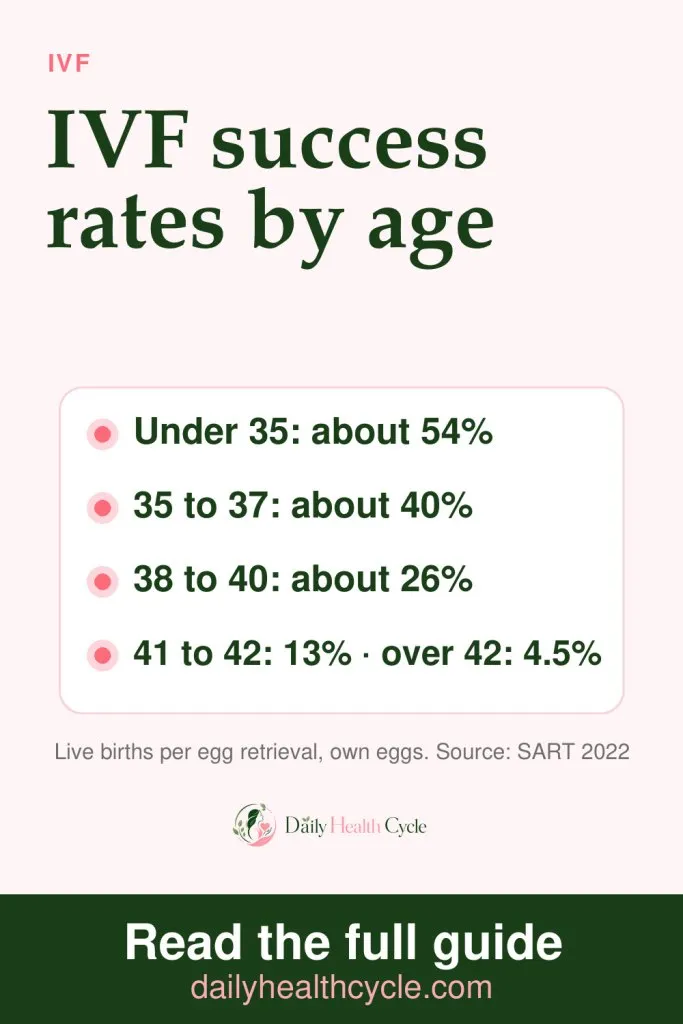
Age is the single biggest factor in whether IVF works. In the US in 2022, women under 35 using their own eggs had a 53.5% chance of a live birth from one egg retrieval (counting all the embryo transfers from it). For women over 42, it was 4.5% (SART, 2022).
Those numbers can feel stark, so this guide explains what they actually mean, why age matters so much, how your chances add up over several cycles, how donor eggs change the picture, and what to ask a clinic.
Quick answer: IVF success rates by age fall steadily. In the US in 2022, live births per egg retrieval with your own eggs were about 54% under 35, 40% at 35 to 37, 26% at 38 to 40, 13% at 41 to 42 and 4.5% over 42. Chances add up over several cycles.
Key Takeaways
- US live birth rates per egg retrieval (own eggs, all transfers, 2022): about 54% under 35, 40% at 35 to 37, 26% at 38 to 40, 13% at 41 to 42 and 4.5% over 42.
- Chances add up over several cycles. In a UK study of nearly 157,000 women, 65% had a baby by the sixth cycle.
- What matters most is the age of the eggs. With donor eggs, the same study found no difference in success by the recipient’s age.
- Most clinics now transfer one embryo at a time, which has brought multiple births down to about 3% to 4%.
- Compare clinics using results for your own age group, and ask about the chance of a baby per egg retrieval, not just pregnancy rates.
In this article:
- IVF Success Rates by Age
- Why Age Matters So Much
- Your Chances Over Several Cycles
- Donor Eggs and Frozen Eggs
- Other Factors That Affect Success
- Risks to Know About
- Questions to Ask a Clinic
- IVF Success Rates FAQ
IVF Success Rates by Age
These are the final 2022 US national figures from the Society for Assisted Reproductive Technology (SART), for women using their own eggs. They show the chance that one egg retrieval leads to a baby, either from the first embryo transfer or from all the embryos transferred from that retrieval, including frozen ones (SART, 2022).
| Age | Live birth, first transfer | Live birth, all transfers |
|---|---|---|
| Under 35 | 39.4% | 53.5% |
| 35 to 37 | 30.6% | 39.8% |
| 38 to 40 | 20.9% | 25.6% |
| 41 to 42 | 11.2% | 13.0% |
| Over 42 | 3.9% | 4.5% |
UK figures, which are reported differently, show the same pattern. In 2023, the birth rate per fresh embryo transferred was 35% for patients aged 18 to 34 and 5% for those aged 43 to 44, according to the UK fertility regulator (HFEA). These recent UK figures are preliminary.
A note on reading statistics: clinics may quote rates per embryo transfer, per cycle started or per egg retrieval, and “pregnancy rate” is always higher than “live birth rate.” Always compare like with like, and look for live births.
Why Age Matters So Much
As women get older, they have fewer eggs, and a growing share of them aren’t healthy enough to develop into a baby. IVF can collect several eggs in one cycle, but it can’t make them younger. The HFEA notes that for frozen embryo transfers, pregnancy and birth rates are largely related to the patient’s age when the eggs were collected (HFEA).
This is also why tests like AMH can’t answer the age question on their own: AMH estimates how many eggs you have, not their quality. Our guide to the AMH test explains what it can and can’t tell you, and our guide to pregnancy after 35 covers natural fertility and age.
Your Chances Over Several Cycles
One cycle’s success rate can be discouraging, but many people need more than one. A UK study followed 156,947 women through 257,398 IVF cycles (Smith et al., JAMA 2015):
- All women: 29.5% had a baby from the first cycle, and the chance stayed above 20% per cycle up to the fourth. By the sixth cycle, an estimated 65.3% had a baby.
- Under 40, own eggs: 32.3% from the first cycle, and an estimated 68.4% after six.
- Aged 40 to 42: 12.3% from the first cycle, and an estimated 31.5% after six.
- Over 42: less than 4% per cycle.
These estimates come from treatment in 2003 to 2010, and success rates have improved since, but the message holds: for women under 40, it’s often worth continuing beyond the first or second cycle if your clinic thinks your chances are reasonable.
Donor Eggs and Frozen Eggs
Because egg age drives success, using eggs donated by a younger woman changes the picture. In the UK study above, there was no age difference in success among women using donor eggs (Smith et al., 2015). For women in their 40s, clinics often discuss donor eggs as an option when success with their own eggs is low.
The same logic applies to freezing: for frozen embryos, the HFEA says success is largely related to the age when the eggs were collected, which is why freezing earlier tends to give better chances later. If you’re thinking about freezing eggs, an AMH test and ultrasound can help a clinic estimate how many eggs you might collect.
Other Factors That Affect Success
Besides age, the NHS lists (NHS):
- The cause of infertility, such as blocked tubes, low sperm count, ovulation problems like PCOS, or endometriosis
- Body mass index (BMI)
- Lifestyle factors such as smoking and drinking alcohol
Some of these you can change before treatment starts, such as stopping smoking, cutting down on alcohol and working toward a healthy weight. Ask your clinic what would make the biggest difference in your case.
Risks to Know About
- Ovarian hyperstimulation syndrome (OHSS): a small chance that too many eggs develop, making the ovaries large and painful; treatment may need to stop (NHS).
- Multiple pregnancy: twins or more carry higher risks for mother and babies. Transferring one embryo at a time has made this much rarer: single embryo transfers were 88% of UK IVF cycles in 2023, with a multiple birth rate of 3.4% (HFEA).
- Ectopic pregnancy, where the embryo implants outside the womb (NHS).
Questions to Ask a Clinic
- What’s your live birth rate per egg retrieval for women my age, counting all embryo transfers?
- How do your results compare with the national average for my age group? In the US, clinic results are published by SART; in the UK, by the HFEA.
- Based on my tests, what are my chances, and how many cycles would you suggest?
- Do you recommend single embryo transfer for me?
- Which “add-on” treatments do you offer, what evidence supports them, and what do they cost?
- What’s the full cost per cycle, including medication and frozen transfers?
In the UK, NHS IVF may be available if you’re 42 or under and meet local criteria: up to 3 full cycles if you’re under 40, and 1 cycle between 40 and 42 if you haven’t had IVF before (NHS). Local funding rules vary.
IVF Success Rates FAQ
What is the IVF success rate at 40?
In the US in 2022, women aged 38 to 40 using their own eggs had a 25.6% chance of a live birth per egg retrieval, counting all embryo transfers, and women aged 41 to 42 had 13.0% (SART). Results vary by clinic and individual, so ask your clinic for rates for your age group.
What is the IVF success rate under 35?
In the 2022 US national data, women under 35 using their own eggs had a 53.5% chance of a live birth per egg retrieval when all embryo transfers from it were counted, and 39.4% from the first transfer alone (SART).
How many IVF cycles does it take to have a baby?
Often more than one. In a UK study of nearly 157,000 women, 29.5% had a baby from the first cycle, and an estimated 65.3% had one by the sixth cycle. For women under 40 using their own eggs, it was 68.4% by the sixth cycle (Smith et al., JAMA 2015).
Do donor eggs improve IVF success after 40?
Yes, because success depends mainly on the age of the eggs. In the same UK study, there was no difference in success by age among women using donor eggs. Clinics often discuss donor eggs with women in their 40s when success with their own eggs is low.
What is the IVF success rate over 42?
Low with your own eggs. In the 2022 US data, women over 42 had a 4.5% chance of a live birth per egg retrieval, counting all transfers (SART), and the UK study found rates below 4% per cycle. Donor eggs give much higher chances at this age.
Your Next Step
If you’re 35 or older and have been trying for 6 months, or under 35 and trying for a year, ask for a fertility evaluation now rather than waiting. Time matters more for IVF success than almost anything else. Before your appointment, our guide to knowing when you’re ovulating can help you bring useful cycle information.
Free printable
Perimenopause symptom & cycle tracker
Track your periods, sleep, hot flashes and mood on one page, then bring it to your appointment. Enter your email to download it.
Sources cited in this article
- SART, 2022: PublicSnapshotReport (sartcorsonline.com)
- HFEA: Fertility treatment 2023 trends and figures (hfea.gov.uk)
- Smith et al., JAMA 2015 (pubmed.ncbi.nlm.nih.gov)
- NHS: Ivf (nhs.uk)
Last checked October 26, 2026. Spot an outdated source? Tell us.
About the author: Jessica Bordo writes Daily Health Cycle out of personal interest in women’s health, not as a clinician. Each article summarizes what sources such as national fertility registries, the NHS and published research say, and links to them so you can check the claims yourself. Use these guides to prepare questions for your own clinician, not to replace their advice. Our editorial standards explain how we research and update articles.
This article is for general education and isn’t medical advice. See our full disclaimer and talk with a qualified clinician about your own care.