

Educational information, not medical advice: see our Medical Disclaimer.
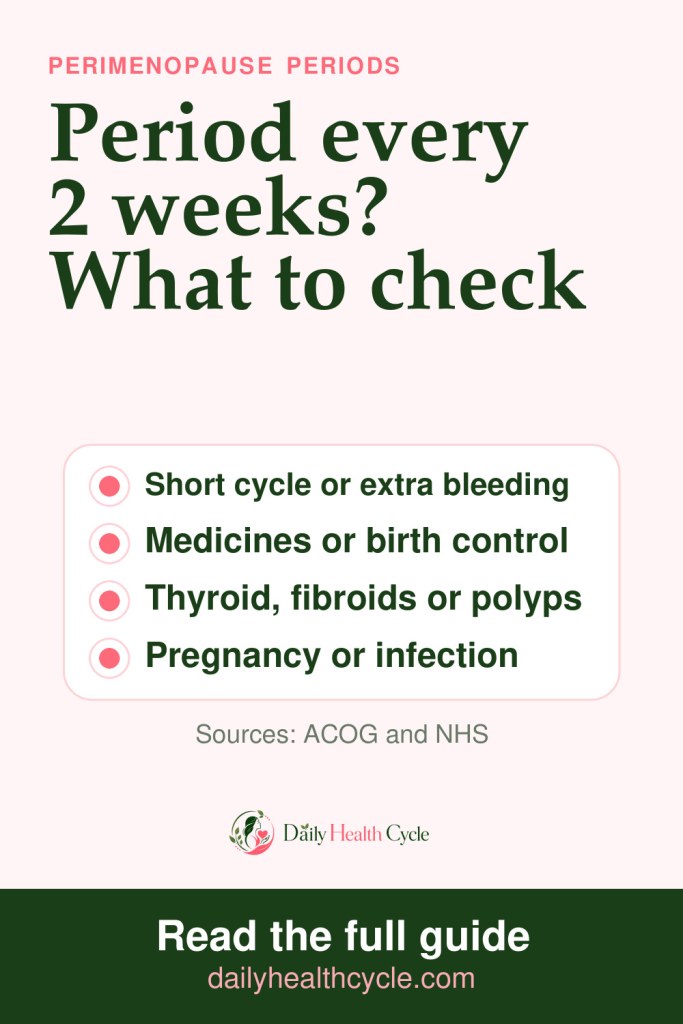
A period every 2 weeks in perimenopause can be alarming, and it’s one of the most common reasons women start searching for answers. It can be a sign that your cycle is changing, but it can also point to bleeding that needs checking. The NHS counts a gap of fewer than 21 days between periods as irregular (NHS), and a period every two weeks is well under that. This guide explains what could be behind it, how to tell a short cycle from extra bleeding, what a doctor may check and when to get help.
Key Takeaways
- The NHS says the average gap between periods is around 28 days, and that periods are irregular if the gap is less than 21 days or more than 35 days. A period every 2 weeks is roughly a 14-day gap (NHS).
- The Menopause Society says that early in perimenopause it’s common for cycles to become a little shorter than usual (The Menopause Society). ACOG counts cycles shorter than 21 days as abnormal uterine bleeding and advises talking with an ob-gyn about it (ACOG).
- It may be a short cycle, or a period plus bleeding or spotting in between. ACOG lists bleeding or spotting between periods as abnormal, and a calendar can help you tell the two apart (ACOG).
- Other causes include fibroids and polyps, hormonal birth control and other medicines, thyroid problems, pregnancy-related causes and infection. ACOG also says abnormal bleeding can be an early sign of endometrial cancer, which is one reason to get it checked (ACOG).
- Get emergency care if you’re changing pads or tampons every hour for more than 2 hours in a row and also have chest pain, shortness of breath, or feel lightheaded or dizzy (ACOG).
In this article:
- What Counts as a “Period Every 2 Weeks”?
- Can Shorter Cycles Be Part of Perimenopause?
- Other Causes to Rule Out
- When to See a Doctor
- What a Doctor May Do
- Treatment Options
- How to Track Your Bleeding
- Can You Still Get Pregnant?
- Period Every 2 Weeks FAQ
- Your Next Step
What Counts as a “Period Every 2 Weeks”?
The first step is working out what is actually happening. The NHS says the menstrual cycle is counted from the first day of one period to the day before the next, and that the average is around 28 days (NHS). ACOG describes a normal cycle as typically 21 to 35 days, with a period that generally lasts up to 7 days (ACOG).
“A period every 2 weeks” usually means one of two things:
- A true short cycle: a full period starts about every 14 days.
- A period plus extra bleeding: you have a regular-looking period, then bleeding or spotting about two weeks later. ACOG lists bleeding or spotting between periods as abnormal uterine bleeding (ACOG).
They can feel identical but may have different causes, so a bleeding calendar (see below) is the most useful thing to bring to a doctor.
Can Shorter Cycles Be Part of Perimenopause?
They can. The Menopause Society says the change in periods is caused by the ovaries’ erratic production of hormones and less-frequent release of an egg. In the beginning of perimenopause the changes are often subtle, and it’s common for cycles to become a little shorter than usual. As perimenopause progresses, cycle length may vary by 7 days or more, and in the late transition periods may be skipped for 60 days or more (The Menopause Society).
ACOG adds that problems with ovulation can cause irregular, sometimes heavy, bleeding. If you don’t ovulate for several cycles, areas of the uterine lining can become too thick, which can happen during perimenopause (ACOG).
There is an important difference between a cycle that is “a little shorter” and a period every two weeks. ACOG counts cycles shorter than 21 days as abnormal, and says that even though changes around perimenopause may be expected, you should talk with your ob-gyn about any abnormal uterine bleeding (ACOG). So a 14-day pattern is worth getting checked rather than assumed to be perimenopause. Our guide to irregular periods in perimenopause explains which cycle changes are typical.
Other Causes to Rule Out
Perimenopause isn’t the only possible explanation. These are among the causes the sources list for irregular, frequent or unexpected bleeding:
| Cause | What to know | Source |
|---|---|---|
| Ovulation problems, PCOS and thyroid problems | Lack of ovulation can cause irregular, sometimes heavy, bleeding. ACOG lists PCOS and an underactive thyroid (hypothyroidism) among conditions where this can happen, and the NHS lists PMOS (the new name for PCOS) and thyroid problems among the conditions that can cause irregular periods. | ACOG; NHS |
| Fibroids and polyps | Noncancerous growths that can cause irregular or heavy bleeding. | ACOG |
| Adenomyosis | The lining of the uterus grows into the uterine wall. It can cause heavy bleeding and period pain that gets worse with age. | ACOG |
| Hormonal birth control and other medicines | Hormonal birth control can cause breakthrough bleeding, which is bleeding at a time other than your period. The NHS lists the progestogen-only pill, contraceptive injection and hormonal coil (IUS) among causes of irregular periods. Blood thinners and aspirin can cause heavy bleeding, and a copper IUD can cause heavier periods, especially in the first year. | ACOG; NHS |
| Pregnancy and related causes | The NHS says a missed period is often an early sign of pregnancy. ACOG lists pregnancy-related causes such as ectopic pregnancy and miscarriage. | NHS; ACOG |
| Infection | ACOG lists pelvic inflammatory disease (PID) as a possible cause and says tests for sexually transmitted infections may be part of the work-up. | ACOG |
| Stress, weight change and exercise | The NHS lists stress and anxiety, losing or gaining a lot of weight, and exercising too much among the common causes of irregular periods. | NHS |
| Thickened uterine lining and cancer | ACOG says abnormal bleeding can be an early sign of endometrial cancer. Most cases occur in women in their mid-60s who are past menopause, and it is usually diagnosed at an early stage, when treatment is most effective. A condition that can lead to it, endometrial intraepithelial neoplasia (EIN), also causes abnormal bleeding, and treating it can prevent endometrial cancer. | ACOG |
Sometimes there is more than one cause at the same time (ACOG), which is another reason a doctor’s assessment matters.
When to See a Doctor
The NHS says to see a GP if your periods are irregular, last longer than 7 days, or you have bleeding between periods (NHS). ACOG says any abnormal uterine bleeding is worth discussing with your ob-gyn, and lists these as abnormal (ACOG):
- Bleeding or spotting between periods
- Bleeding or spotting after sex
- Bleeding that soaks through one or more tampons or pads every hour
- Bleeding that lasts more than 7 days
- Menstrual cycles shorter than 21 days or longer than 35 days
- Not having a period for 3 to 6 months
- Bleeding after menopause. The NHS says any bleeding after 12 months without a period needs checking, even if it happens only once or is only a small amount (NHS). Not sure which stage you are in? See perimenopause vs menopause.
The NHS lists heavy periods as a common cause of iron deficiency anemia, which can cause tiredness (NHS). If your bleeding is heavy and you feel drained, mention both. Our guide to the causes of constant fatigue in women explains what a doctor may check.
Get emergency care right away if you’re changing pads or tampons every hour for more than 2 hours in a row and you also have chest pain, shortness of breath, or feel lightheaded or dizzy (ACOG).
What a Doctor May Do
ACOG says your ob-gyn should ask about your health and family history, pregnancy history, medicines (including over-the-counter ones) and birth control method, and about when the bleeding occurs and how heavy it is. It advises keeping track for several weeks before your visit. Tests may include (ACOG):
- A physical exam, including a pelvic exam
- A complete blood count (CBC), which can help show anemia or infection
- A pregnancy test and tests for sexually transmitted infections
- Depending on your symptoms and age, other tests such as an ultrasound, a hysteroscopy or an endometrial biopsy
You may wonder whether a hormone blood test will confirm perimenopause. NICE says that in otherwise healthy people aged 45 or over with menopause-associated symptoms, perimenopause can be identified without laboratory tests, based on recently started vasomotor symptoms (such as hot flushes) and any change in the menstrual cycle. It advises against using tests such as anti-Müllerian hormone, inhibin, oestradiol or antral follicle count for this purpose (NICE). That is separate from investigating bleeding that isn’t explained by perimenopause, where ACOG describes the tests above.
Treatment Options
Treatment depends on the cause. The NHS says treatment is not always needed for irregular periods (NHS). When it is, ACOG says medicines are often tried first (ACOG):
- Hormonal birth control. Combined pills, the patch and the vaginal ring contain estrogen and progestin and can lighten flow and help make periods more regular. Progestin-only options, including the hormonal IUD, pills and injection, may also reduce bleeding.
- Hormone therapy. ACOG says it can help with heavy bleeding during perimenopause and with other symptoms such as hot flashes. You may still have periods, but they are usually lighter and more predictable. It has risks, so the benefits and risks need weighing with your clinician.
- Other medicines. Tranexamic acid and NSAIDs such as ibuprofen may help control heavy bleeding, and an infection may be treated with antibiotics.
- Procedures. If medicines don’t reduce the bleeding, ACOG describes procedures such as endometrial ablation and treatments for fibroids.
If you start HRT in perimenopause, the NHS says it can make periods more regular. You may have some irregular bleeding or spotting, but this should settle within 6 months, and the NHS says to talk to your GP if it hasn’t settled after 6 months (NHS). Our guide to perimenopause treatment options covers the wider picture.
How to Track Your Bleeding
A calendar is the most useful thing to bring to an appointment. The NHS says day 1 of your cycle is the first day of your period (NHS). ACOG suggests noting the dates, length and type of bleeding (light, medium, heavy or spotting) for several weeks before your visit (ACOG), and The Menopause Society says a calendar or smartphone app works (The Menopause Society). Each time you bleed, write down:
- The date it started and the date it stopped
- The type: spotting, light, medium or heavy
- Whether it soaked through a pad or tampon in an hour
- Any changes to medicines, birth control or an IUD, and anything unusual such as stress, illness or travel
- Other symptoms, such as hot flashes, pain or tiredness (our perimenopause symptoms checklist lists them)
Can You Still Get Pregnant?
Yes. The NHS says it’s possible to get pregnant during perimenopause, and that you still need contraception for 1 year after your final period if you’re 50 or over, or 2 years if you’re aged 40 to 49 (NHS). A missed or changed period can also be an early sign of pregnancy (NHS), so if you’re sexually active and your pattern changes, take a pregnancy test.
Period Every 2 Weeks FAQ
Is it normal to have a period every 2 weeks in perimenopause?
It can happen, but it isn’t something to assume is normal. The Menopause Society says it’s common for cycles to become a little shorter early in perimenopause (The Menopause Society), but a cycle shorter than 21 days is outside ACOG’s normal range (ACOG), so it’s worth having checked, especially if it keeps happening.
Is it a period or spotting?
Only a calendar can tell you. ACOG lists both bleeding or spotting between periods and cycles shorter than 21 days as abnormal uterine bleeding (ACOG), so either pattern is worth mentioning to a doctor.
Can stress cause a period every 2 weeks?
Stress can affect periods. The NHS lists stress and anxiety, big weight changes and too much exercise among the common causes of irregular periods (NHS). That doesn’t rule out other causes, so still get frequent bleeding checked. If anxiety is part of your picture, see our guide to perimenopause anxiety.
Will it stop by itself?
It depends on the cause, and no source can tell you what will happen in your case. The NHS says perimenopause and menopause symptoms usually last 7 to 9 years and can change over that time (NHS), and The Menopause Society says cycle length can keep varying as perimenopause progresses (The Menopause Society). See how long perimenopause lasts. If your periods are frequent enough to affect daily life, ask about options.
Can birth control or HRT make periods regular?
They can help for some people. ACOG says combined hormonal birth control can help make periods more regular, and that hormone therapy can make periods lighter and more predictable (ACOG). Which is right for you depends on your health and on whether you need contraception, so it’s a question for your clinician.
Your Next Step
For the next cycle or two, note every day you bleed, including spotting, then book a visit and bring your calendar. For related reading, see our guides to irregular periods in perimenopause, the perimenopause symptoms checklist, perimenopause treatment options and perimenopause anxiety, and our complete perimenopause and menopause guide.
Sources: Irregular periods — NHS · Abnormal uterine bleeding — ACOG · Perimenopause — The Menopause Society · Symptoms of menopause and perimenopause — NHS · Menopause: identification and management (NG23) — NICE · Iron deficiency anaemia — NHS
About the author: Jessica Bordo writes Daily Health Cycle, where she shares practical, evidence-based women’s health information. Articles are informed by sources such as the NHS, CDC and Mayo Clinic, and we link to our main sources. No medical reviewer is listed for this article, so use it to prepare questions for your own clinician, not to replace their advice. Our authors page explains how we approach accuracy and disclaimers.
This article is for general education and isn’t medical advice. Read our Medical Disclaimer and talk with a qualified clinician about your own care.