
Last updated October 31, 2026. Educational information, not medical advice: see our Medical Disclaimer.
“Day 14” is the ovulation rule most of us learned, and for most women it’s wrong. In a landmark study that tracked daily hormone levels, only about 30% of women had their fertile window entirely within days 10 to 17 of their cycle, even when their periods were regular (Wilcox et al., BMJ 2000).
If you’re trying to get pregnant, knowing when you actually ovulate can make a real difference. Here’s how to know when you’re ovulating. This guide explains the fertile window, the body signs to watch for, how well apps, ovulation tests and temperature charts work, and when to see a doctor.
Quick answer: Ovulation usually happens 10 to 16 days before your next period (NHS). To know when you're ovulating, look for clear, stretchy cervical mucus and a slight rise in resting temperature afterward, or use urine ovulation tests. Your fertile window is about 6 days, with the best chances in the last 2 to 3.
Key Takeaways
- Ovulation usually happens 10 to 16 days before your next period, not on a fixed day after your last one (NHS).
- The fertile window is about 6 days: the 5 days before ovulation plus ovulation day. The chance of conceiving is highest in the last 2 to 3 of those days.
- Signs include clear, stretchy “egg white” cervical mucus, a slight rise in resting temperature after ovulation, and sometimes a one-sided twinge.
- Urine ovulation tests probably increase the chance of pregnancy compared with not tracking, according to a 2023 Cochrane review. Calendar apps that only use period dates are the least reliable method.
- See a doctor after 12 months of trying if you’re under 35, after 6 months if you’re 35 or over, and sooner if you’re over 40 or your periods are irregular.
In this article:
- When Does Ovulation Happen?
- Your Fertile Window
- Signs You’re Ovulating
- Ways to Track Ovulation, Compared
- If Your Cycles Are Irregular
- When to See a Doctor
- Ovulation FAQ
When Does Ovulation Happen?
Ovulation is when one of your ovaries releases an egg. The NHS says that in most women it happens around 10 to 16 days before the next period (NHS). The second half of the cycle, from ovulation to your period, is fairly stable. The first half varies much more, which is why ovulation moves around.
A study of more than 600,000 cycles logged in a fertility app found the average cycle was 29.3 days, and the average time from period to ovulation was 16.9 days, not 14 (Bull et al., 2019). Cycles also got slightly shorter with age, by about 0.18 days for each year between 25 and 45, mainly because the first half of the cycle shortened. Note that the study was run by the company that makes the app.
So if your cycle is 32 days, you’re more likely to ovulate around day 16 to 22 than on day 14. And even with regular periods, the timing can shift from month to month. Researchers found women had at least a 10% chance of being in their fertile window on every day between days 6 and 21 (Wilcox et al., 2000).
Your Fertile Window
Sperm can survive in the fallopian tubes for up to 7 days (NHS), but conception is only possible up to several hours after ovulation (Cochrane). That’s why the days before ovulation matter most. In a study of 625 cycles in women trying to conceive, pregnancy happened only when sex took place in a 6-day window ending on the day of ovulation (Wilcox et al., NEJM 1995). The chance of conceiving in a cycle rose from about 10% when sex was 5 days before ovulation to about 33% on ovulation day.
The NHS keeps it simple: if you have sex without contraception every 2 to 3 days, you’re likely to get pregnant within a year if you’re 39 or under, without needing to pinpoint ovulation at all (NHS). Tracking helps most if you can’t have sex that often, or if months of trying haven’t worked.
Signs You’re Ovulating
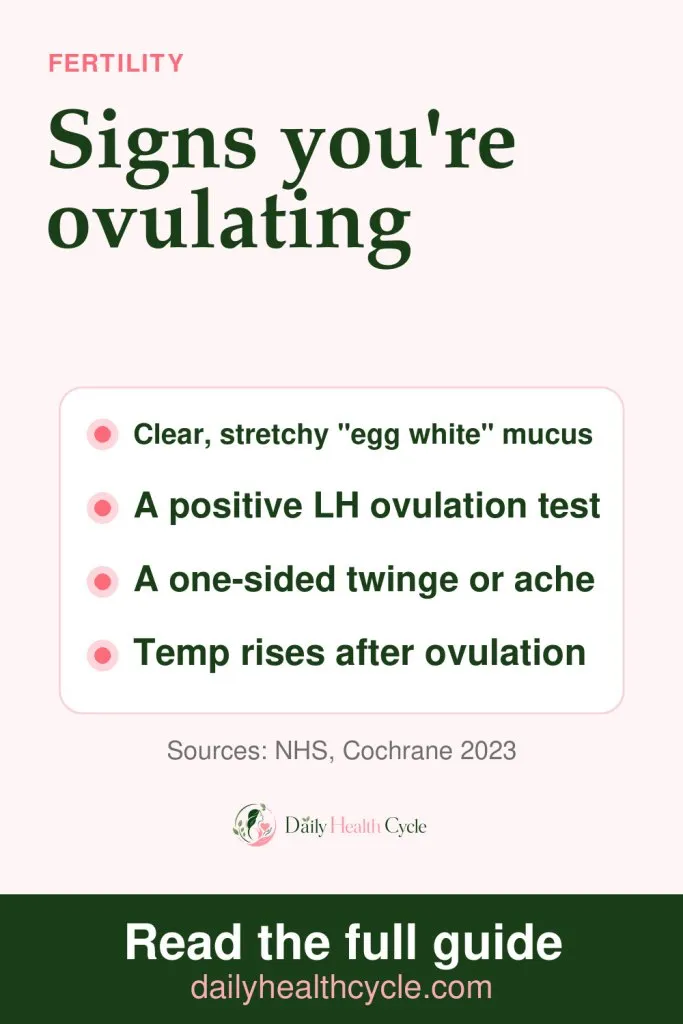
- Cervical mucus changes. Around ovulation, vaginal secretions become thinner, clearer and stretchy, a bit like raw egg white (NHS). This is one of the best day-to-day clues that your fertile days have arrived.
- A small rise in resting temperature. Your basal body temperature goes up slightly after ovulation and stays higher until your period. It confirms ovulation has already happened, so it’s more useful for learning your pattern over a few cycles than for timing sex this month.
- Ovulation pain. Some women feel a dull ache or sharp twinges on one side of the lower tummy, lasting from a few minutes to a day or two, sometimes with a little spotting (NHS).
- A positive ovulation test. Urine tests detect the surge of luteinizing hormone (LH) that triggers ovulation, so a positive result means your most fertile days are now.
Ways to Track Ovulation, Compared
| Method | What it tells you | Good to know |
|---|---|---|
| Calendar or app (period dates only) | An estimate based on past cycles | Least reliable, because ovulation day varies even in regular cycles |
| Urine ovulation (LH) tests | That ovulation is about to happen | Best evidence for improving pregnancy chances; costs add up over many cycles |
| Cervical mucus | That your fertile days are starting | Free; takes a cycle or two to learn |
| Basal body temperature | That ovulation has already happened | Free; take it at the same time every morning before getting up |
A 2023 Cochrane review of 7 randomized trials found that timing sex with urine ovulation tests probably increases the chance of a live birth compared with not tracking. In the best trial, if 16% of couples had a baby without tests, 16% to 28% would with them (Cochrane, 2023). For fertility-awareness methods such as mucus and temperature charting, the evidence was too limited to say whether they change the chance of pregnancy. The review also couldn’t tell whether timed sex adds stress, which is worth keeping in mind: if tracking starts to feel like a chore, regular sex every 2 to 3 days works too.
If Your Cycles Are Irregular
Cycles between 21 and 35 days are considered normal (NHS). If yours are often shorter, longer or unpredictable, you may not be ovulating every month, and calendar methods won’t work. Common causes include:
- PCOS, one of the most common causes of irregular ovulation. See our guide to PCOS symptoms.
- Perimenopause, when cycles often become shorter, longer or unpredictable in your 40s. Our guide to irregular periods in perimenopause explains what’s normal.
- Thyroid problems, high prolactin, big weight changes or intense exercise, which your doctor can check with simple tests.
If you have irregular periods and are trying to conceive, don’t wait a full year to get checked.
When to See a Doctor
The American Society for Reproductive Medicine defines infertility as not getting pregnant after 12 months of regular unprotected sex, and recommends an evaluation after 6 months if you’re 35 or older, and right away if you’re over 40 (ASRM, 2023). The NHS advises seeing a GP after a year of trying, or sooner if it’s taking longer than expected (NHS). Also get checked earlier if:
- your periods are irregular, very far apart or have stopped
- you have very painful periods, which can be a sign of endometriosis
- you’ve had pelvic infections, surgery or cancer treatment
- ovulation pain is severe, keeps coming back or doesn’t ease with painkillers (NHS)
Age matters too. Our guide to pregnancy after 35 explains how fertility changes with age and what to expect.
Ovulation FAQ
How do I know exactly when I’m ovulating?
You can’t know to the hour at home, but you can get close. Clear, stretchy ‘egg white’ cervical mucus and a positive urine ovulation (LH) test show your most fertile days have arrived, and a rise in resting temperature confirms ovulation afterwards. The NHS says ovulation usually happens 10 to 16 days before your next period.
Is ovulation always on day 14?
No. In a study tracking daily hormones, only about 30% of women had their fertile window entirely within days 10 to 17, even with regular cycles (Wilcox et al., 2000). A study of over 600,000 app-tracked cycles found the average time from period to ovulation was 16.9 days.
How many days a month can you get pregnant?
About 6. In a classic NEJM study, pregnancy happened only when sex took place in the 6 days ending on ovulation day, with the chance rising from about 10% five days before to about 33% on ovulation day (Wilcox et al., 1995). Sperm can survive up to 7 days, so sex before ovulation counts.
Do ovulation tests work?
They probably help. A 2023 Cochrane review found that timing sex with urine ovulation tests probably increases the chance of a live birth compared with not tracking: in the main trial, from 16% to between 16% and 28%. Evidence for mucus and temperature charting was too limited to judge.
When should I see a doctor if I’m not getting pregnant?
The American Society for Reproductive Medicine recommends an evaluation after 12 months of trying if you’re under 35, after 6 months if you’re 35 or older, and right away if you’re over 40. Go sooner if your periods are irregular or very painful.
Your Next Step
For your next cycle, note your period dates and check your cervical mucus each day. If you want more certainty, add urine ovulation tests starting a few days before you expect to ovulate. After 2 to 3 cycles, you’ll have a much clearer picture of your own pattern, which is also useful to bring to a doctor’s appointment.
Free printable
Perimenopause symptom & cycle tracker
Track your periods, sleep, hot flashes and mood on one page, then bring it to your appointment. Enter your email to download it.
Sources cited in this article
- Wilcox et al., BMJ 2000 (pubmed.ncbi.nlm.nih.gov)
- NHS: Fertility in the menstrual cycle (nhs.uk)
- Bull et al., 2019 (pubmed.ncbi.nlm.nih.gov)
- Cochrane (pubmed.ncbi.nlm.nih.gov)
- Wilcox et al., NEJM 1995 (pubmed.ncbi.nlm.nih.gov)
- NHS: Trying to get pregnant (nhs.uk)
- NHS: Ovulation pain (nhs.uk)
- Cochrane 2023 (pubmed.ncbi.nlm.nih.gov)
- ASRM, 2023 (pubmed.ncbi.nlm.nih.gov)
Last checked October 27, 2026. Spot an outdated source? Tell us.
About the author: Jessica Bordo writes Daily Health Cycle out of personal interest in women’s health, not as a clinician. Each article summarizes what sources such as the NHS, Cochrane reviews, medical society guidelines and published studies say, and links to them so you can check the claims yourself. Use these guides to prepare questions for your own clinician, not to replace their advice. Our editorial standards explain how we research and update articles.
This article is for general education and isn’t medical advice. See our full disclaimer and talk with a qualified clinician about your own care.