
Last updated November 24, 2026. Educational information, not medical advice: see our Medical Disclaimer.
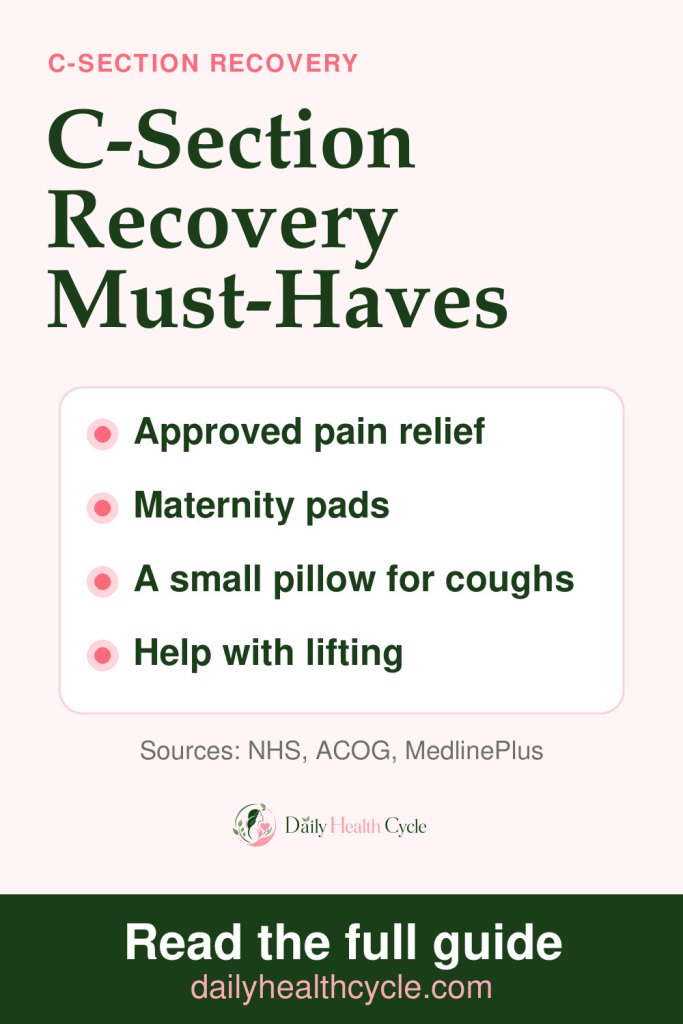
Quick answer: You need less than most lists suggest. The things medical sources actually mention are pain relief your care team has approved, maternity pads, loose clothes and cotton underwear, a small pillow or rolled towel to support the wound, something for constipation, and help with lifting. A belly binder and a heating pad are optional comforts. Products that promise to flatten your tummy or erase the scar are the ones to skip.
Search for C-section recovery must-haves and you will find lists of thirty products, most of them with a shop link attached. We went the other way. We looked at what the NHS, ACOG, Mayo Clinic, Cleveland Clinic and MedlinePlus actually tell women to use after a caesarean, and built the list from that. It names no brands and contains no shop links. For what recovery itself looks like, see our week-by-week C-section recovery guide.
The short list
| What | Why you need it | Who says so |
|---|---|---|
| Pain relief approved by your care team | The incision may be sore for the first few weeks | ACOG, NHS |
| Maternity pads | You bleed after a caesarean too, for up to six weeks | MedlinePlus, Cleveland Clinic |
| Loose clothes and cotton underwear | Nothing should rub or press on the wound | NHS |
| A small pillow or rolled towel | To support the stitches when you cough or sneeze | Bedfordshire Hospitals NHS Trust |
| Water, fibre and, if needed, a stool softener | Bowel movements can be hard for a few days after delivery | ACOG, MedlinePlus |
| Pillows for feeding | To keep pressure off the incision | Mayo Clinic, ACOG |
| Another adult | No lifting anything heavier than your baby for six to eight weeks | MedlinePlus, NHS |
1. Pain relief, sorted before you go home
ACOG says the incision may be sore for the first few weeks, and that there are pain medicines you can take even if you are breastfeeding. Its advice is to talk through your options before you leave hospital. Do that, and go home with a supply.
What that usually means in practice:
- Ibuprofen or paracetamol. ACOG says ibuprofen is usually the preferred first step while breastfeeding, because little of it passes into breast milk, and that acetaminophen (called paracetamol in the UK) is also safe. The NHS names the same two medicines.
- Not aspirin or codeine, as a rule. The NHS says these are not usually recommended if you are breastfeeding. Stronger pain relief is sometimes prescribed for a short time, so follow what your own doctor tells you.
- Ask before you combine medicines. ACOG advises talking to your doctor before taking two or more pain medicines together.
MedlinePlus says pain medicine is often needed for the first few days and up to two weeks. Writing down what you took and when helps on broken sleep.
2. Maternity pads and the right underwear
You bleed after a caesarean as well as after a vaginal birth. MedlinePlus says it can last up to six weeks, changing from red to pink to yellow or white. Cleveland Clinic advises using pads or disposable underwear, and nothing inside the vagina, including tampons, for at least six weeks.
For clothes, the NHS advice is simple: loose, comfortable clothes and cotton underwear. A high waist is worth adding to that, because a caesarean scar sits low and a waistband that lands on it will rub. Buy one size up. Our postpartum underwear guide compares the types.
3. A small pillow or rolled towel
Coughing and sneezing can hurt in the first days. The physiotherapy advice from Bedfordshire Hospitals NHS Trust is to lean forwards and support your stitches with your hands, a rolled-up towel or a small pillow. Keep one cushion where you sit and one by the bed.
The same leaflet explains how to get out of bed without a sit-up movement: bend your knees, roll onto your side and push yourself up with your arm. Our recovery guide has more on sleeping and getting out of bed.
4. Pillows for feeding and for sleep
Feeding is where most of the day goes, so set up for it. Mayo Clinic suggests two positions after a caesarean: the football hold, with a pillow along your side for the baby to rest on, and the side-lying hold. ACOG gives the reason, which is to choose a position that puts less pressure on your incision. It also suggests a pillow to support your arms, which spares your neck and shoulders.
An ordinary bed pillow does the job, and a shaped nursing pillow is optional. For sleep, Healthline’s medically reviewed guide suggests a pillow under your knees when you lie on your back, or pillows to raise your upper body.
5. Water, fibre and a stool softener
ACOG warns that it may be hard to have a bowel movement for a few days after delivery. Its advice is to drink plenty of fluids, take short walks as soon as you can, eat foods high in fibre and ask about a stool softener or laxative if you need one. MedlinePlus puts a number on the fluids: about 2 litres (8 cups) of water a day.
So the list is a water bottle you can reach from the bed, plenty of fruit, vegetables and wholegrain foods, and a stool softener only if your doctor, midwife or pharmacist suggests one.
6. Wound-care basics
Your hospital will tell you how to look after the wound, and its instructions come first. The general advice is not complicated. The NHS says to gently clean and dry the wound every day. MedlinePlus adds:
- If you have a dressing, change it once a day, or sooner if it gets dirty or wet.
- If the wound was closed with stitches, staples or glue, you can shower. Wash with mild soap and water, let the water run over the wound and pat it dry.
- Do not soak in a bath or hot tub, or go swimming, until your care team says you can. That is usually about three weeks.
- Leave adhesive strips alone. They usually fall off in about a week.
What to have at home: mild soap, a clean soft towel kept for the wound, and spare dressings only if you have been told to keep it covered.
7. Help with lifting and housework
The most useful must-have is not a product. MedlinePlus says not to lift anything heavier than your baby for six to eight weeks. The Bedfordshire leaflet says to avoid vacuuming, standing for long periods and carrying toddlers in the first few weeks. Cleveland Clinic calls a support system key to recovery.
Make it practical:
- Agree before the birth who does the lifting, the laundry, the shopping and the school run.
- Set up a changing place at waist height. The NHS advises changing nappies on a raised surface to look after your back.
- Keep water, snacks, pain relief, your phone and nappies within reach of where you feed.
Optional extras that help some women
A belly binder. ACOG lists an abdominal binder, which is a compression belt, alongside a heating pad as something that may relieve incision pain. In one small trial, women who wore a binder after a planned caesarean walked further and reported less pain at their first walk. It is a comfort aid and will not flatten your tummy. See our guide to belly wraps and binders.
A heating pad. ACOG says a heating pad may help with incision pain, and that applying one to your abdomen eases the cramps known as afterpains. Ask your midwife or nurse how to use it safely near the wound.
Scar care, later on. Once the wound has fully healed, the NHS says a pharmacist can recommend silicone dressings or gels to improve how a scar looks, and that massaging it with a water-based cream a few times a day, for up to 10 minutes each time, can help. It also advises keeping a scar covered in the sun for at least a year. Scars can take two years or more to fade. Our article on the C-section shelf covers scar massage.
Support underwear or shapewear, once healed. Wait until the scar has closed and your doctor or midwife agrees. Our guide to shapewear after a C-section explains when and how.
What you can skip
- Products that promise to flatten your tummy. Cleveland Clinic ob-gyn Dr. Erica Newlin says a belly band will not make your waist smaller or help you lose weight.
- Creams that promise to erase the scar. The NHS is plain about this: you cannot get rid of a scar, although it fades with time.
- Tampons and menstrual cups, for now. Use pads for at least the first six weeks.
- Bath soaks, for now. No soaking until your care team says the wound is ready.
- Ab-training gadgets and sit-ups. MedlinePlus says not to do sit-ups while you recover.
- A ready-made recovery kit, unless you want the convenience. Everything on the short list can be bought separately, and your hospital may send you home with some of it.
A simple C-section recovery kit
- Two packs of maternity pads.
- Five or six pairs of high-waisted cotton briefs, one size up.
- A small cushion or a rolled towel.
- Two or three ordinary pillows for feeding and sleeping.
- A water bottle you can drink from lying down.
- High-fibre snacks.
- Mild soap and a soft towel kept for the wound.
- Loose, soft trousers or nightwear with a high or drawstring waist.
- Pain relief, and only what your doctor or pharmacist has approved.
If you are putting a kit together as a gift, leave out the medicines and add an offer of practical help with a date attached: a meal, a load of laundry or a school run. If you are still pregnant, our hospital bag checklist has a section on extra items for a planned C-section.
When a product is not the answer
No purchase fixes a problem with healing. MedlinePlus says to call your doctor or midwife if the wound becomes red, warm or swollen, starts to drain or opens; if your tummy pain is getting worse; if bleeding is still very heavy after four days or you pass large clots; or if one leg becomes swollen, warm, red or painful. ACOG says to call emergency services for chest pain, coughing or gasping for air, or thoughts of hurting yourself or your baby. Our recovery guide has the full list of warning signs.
Frequently asked questions
What do I need for C-section recovery at home?
Pain relief your care team has approved, maternity pads, loose clothes and cotton underwear, a small pillow or rolled towel to support the wound, water and high-fibre food, and another adult to do the lifting.
Do I need a belly binder after a C-section?
No, it is optional. ACOG lists an abdominal binder as one thing that may ease incision pain, and some hospitals provide one. It will not make your waist smaller.
What should be in a C-section recovery kit?
Maternity pads, high-waisted cotton underwear one size up, a small cushion, a water bottle, high-fibre snacks and mild soap cover most needs. Add pain relief only if your doctor or pharmacist has approved it.
Does a heating pad help after a C-section?
ACOG lists a heating pad among the things that may relieve incision pain and afterpains. Ask your midwife or nurse how to use one safely near the wound.
What should I not use after a C-section?
Avoid tampons and menstrual cups for at least six weeks, and do not soak in a bath, hot tub or pool until your care team says the wound is ready. Skip sit-ups and products that promise to flatten your tummy.
Keep reading
- C-section recovery week by week
- Postpartum recovery timeline: what to expect week by week
- Postpartum underwear: what to wear after birth
- Postpartum belly wrap vs belly band vs shapewear
- Shapewear after a C-section: when and how to wear it
- C-section shelf: why it happens and what helps
- Hospital bag checklist
- All postpartum guides
This article is general information, not medical advice. Always follow the guidance of your surgeon, doctor or midwife after a caesarean.
Sources
- NHS: Caesarean section recovery
- ACOG: Postpartum pain management
- MedlinePlus: Going home after a C-section
- Mayo Clinic: C-section recovery
- Bedfordshire Hospitals NHS Trust: Physiotherapy advice and exercises following a caesarean section
- Cleveland Clinic: C-section recovery timeline and aftercare
- Cleveland Clinic: Lochia (postpartum bleeding)
- Cleveland Clinic: Postpartum belly wraps
- Karaca et al. (2019): Abdominal binder use after cesarean delivery, randomised trial (PMC)
- NHS: Scars, treatment
- NHS: Your post-pregnancy body
- Healthline: How to sleep after a C-section
Sources last checked: November 19, 2026.
Free printable PDF
Perimenopause symptom & cycle tracker
A one-page PDF to print and fill in by hand: periods, sleep, hot flashes and mood, ready to bring to your appointment. Enter your email and the download link appears right away.
Prefer to track on your phone? Use our online symptom tracker, no email needed.
This article is for general education and isn’t medical advice. See our full disclaimer and talk with a qualified clinician about your own care.
Sources cited in this article
- ACOG: Postpartum pain management (acog.org)
- NHS: Recovery (nhs.uk)
- MedlinePlus (medlineplus.gov)
- Cleveland Clinic: 22485 lochia (my.clevelandclinic.org)
- Bedfordshire Hospitals NHS Trust: Physiotherapy advice and exercises following a caesarean section (bedfordshirehospitals.nhs.uk)
- Mayo Clinic: Art 20047310 (mayoclinic.org)
- Healthline’s medically reviewed guide (healthline.com)
- Cleveland Clinic: C section recovery (health.clevelandclinic.org)
- NHS: Your post pregnancy body (nhs.uk)
- NHS: Treatment (nhs.uk)
- Cleveland Clinic: Postpartum belly wrap (health.clevelandclinic.org)
- Karaca et al. (2019): Abdominal binder use after cesarean delivery, randomised trial (PMC) (pmc.ncbi.nlm.nih.gov)
- LinkedIn: Emma bordo a679ba450 (linkedin.com)
Last checked November 19, 2026. Spot an outdated source? Tell us.