

Last updated October 10, 2026. Educational information, not medical advice: see our Medical Disclaimer.
A sudden flutter, a pounding beat as you lie down at night, or a moment where your heart seems to skip: perimenopause heart palpitations can be unsettling, especially when they appear out of nowhere in your 40s. The NHS lists a faster, slower or more noticeable heartbeat among the symptoms of perimenopause and menopause (NHS), and says palpitations can sometimes be a sign you’re going through the menopause (NHS).
This guide explains why hormone changes can affect your heartbeat, what research shows about how common palpitations are around menopause, which other causes are worth checking, what helps, and the warning signs that mean you should get help straight away. If you’re still working out whether you’re in perimenopause, our perimenopause symptoms checklist is a good place to start.
Key Takeaways
- Palpitations are a recognized perimenopause symptom. Mayo Clinic lists hormone changes linked to menstruation, pregnancy or menopause among their common causes, and says palpitations are usually harmless.
- They’re common. In the SWAN study of 3,276 women, about half had a moderate or high chance of palpitations during perimenopause and early postmenopause, and these usually eased later on.
- In that study, palpitations were not linked to signs of early artery disease. Women with frequent palpitations were more likely to also have hot flashes, stress, sleep problems and higher blood pressure.
- Other causes matter: caffeine, alcohol, nicotine, stress, low iron from heavy periods and thyroid problems can all trigger palpitations, and an irregular heart rhythm needs ruling out.
- Call 911 if palpitations come with chest pain, fainting, severe shortness of breath or severe dizziness, or if they don’t go away.
In this article:
- Can Perimenopause Cause Heart Palpitations?
- What Palpitations Feel Like
- At Night, Lying Down, After Eating or Before Your Period
- Other Causes and Triggers
- How to Ease Perimenopause Palpitations
- Tests Your Doctor May Suggest
- When to Get Help
- Perimenopause Palpitations FAQ
- Your Next Step
Can Perimenopause Cause Heart Palpitations?
Yes. Mayo Clinic lists hormone changes associated with menstruation, pregnancy or menopause among the common causes of palpitations, alongside stress, exercise, stimulants and fever. It also notes that palpitations are usually harmless, and that often no specific cause is found (Mayo Clinic).
The best long-term data come from the Study of Women’s Health Across the Nation (SWAN), which followed 3,276 women through the menopause transition. Researchers found three patterns:
- 15.9% had a high chance of palpitations from perimenopause into early postmenopause, easing in later postmenopause.
- 34.3% had a moderate chance over the same years, also easing later.
- 49.8% had a consistently low chance.
Women in the high group were more likely to have started perimenopause early and to report hot flashes, poorer overall health, more depressive symptoms, higher stress, more sleep problems and higher blood pressure. Reassuringly, palpitation patterns were not linked to atherosclerosis or artery stiffness measured later (Carpenter et al., Menopause, 2023).
The link with hot flashes is worth noticing. Mayo Clinic describes a rapid heartbeat as part of a hot flash (Mayo Clinic), and our guide on how to stop hot flashes covers the treatments with the best evidence.
What Palpitations Feel Like
Palpitations can make your heart feel like it’s racing, pounding, fluttering, flip-flopping or skipping beats. You may feel them in your chest, throat or neck, at rest or during activity, and they can last seconds, minutes or longer (NHS; Mayo Clinic).
Most palpitations are brief. What matters is how often they happen, how long they last and whether anything else comes with them, which is covered in When to Get Help below.
At Night, Lying Down, After Eating or Before Your Period
Palpitations often follow a pattern. Spotting yours can point to the trigger.
At night
Night-time palpitations are usually just like daytime ones; you notice them more at night because you’re not busy or distracted (Cleveland Clinic). In perimenopause, night sweats can add to them. A small 2025 pilot study fitted 30 midlife women, 15 with palpitations and 15 without, with a heart-monitoring patch for 14 to 28 days. Half of the women with palpitations felt them on at least a third of nights, on nearly half of days, or at least once every 24 hours. Symptoms happened both during changes in heart rhythm and during a normal rhythm, and the normal-rhythm episodes seemed more common at night. Reporting palpitations was linked to having hot flashes and diabetes, not to anxiety. With only 30 women, the authors stress that a larger study is needed (Carpenter et al., Menopause, 2025).
When lying down
Your position can matter too. Cleveland Clinic notes that sleeping on your side may increase pressure in your body, which can cause palpitations. If they start as you turn onto one side, try changing position.
After eating or drinking
Spicy or rich foods can cause palpitations, and so can caffeinated drinks and alcohol. Dehydration is another possible trigger (Cleveland Clinic). If palpitations follow meals, note what you ate and drank.
Before or during your period
Mayo Clinic lists hormone changes linked to menstruation, as well as menopause, among the causes of palpitations (Mayo Clinic). If yours cluster around your period, note it in a diary. If your periods are also heavy, ask about low iron, which is covered below.
All day or every day
Palpitations that keep coming back, happen more often or last longer than a few minutes should be checked by a doctor, and palpitations that don’t go away need urgent care (NHS). Don’t assume constant palpitations are just hormones.
Other Causes and Triggers
Because perimenopause is such a busy time for your body, it’s easy to put every new symptom down to hormones. These causes can look the same and are worth thinking about:
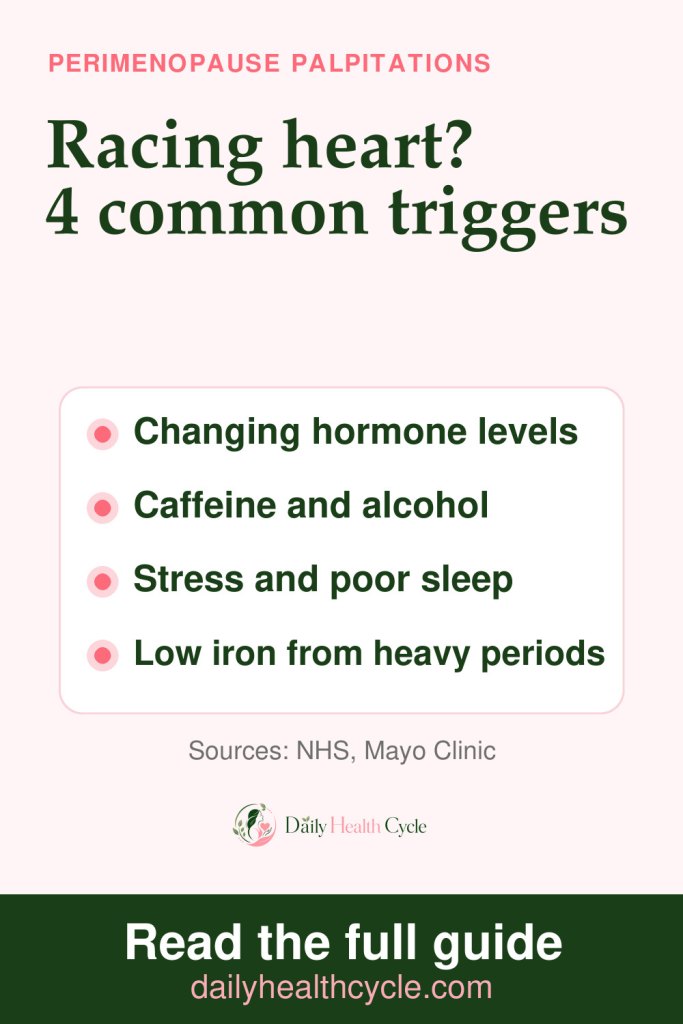
- Stimulants and lifestyle. Caffeine, alcohol, nicotine, strenuous exercise and lack of sleep can all bring on palpitations (NHS). So can some cold and cough medicines containing pseudoephedrine, and energy drinks (Mayo Clinic).
- Stress, anxiety and panic. Strong emotions are one of the most common triggers. Our guide to perimenopause anxiety explains why anxiety often rises in these years and what helps.
- Low iron. Noticeable heartbeats are one of the main symptoms of iron deficiency anaemia, and heavy periods are a very common cause of it (NHS). If your periods have become heavier, see our guide to irregular periods in perimenopause.
- Thyroid problems. Too much or too little thyroid hormone can cause palpitations (Mayo Clinic). Our guide to hormonal imbalance symptoms explains how thyroid problems overlap with perimenopause.
- Medicines. Check the leaflet of anything you take (NHS).
- Heart conditions. Rarely, palpitations are a sign of an irregular heart rhythm (arrhythmia) or another heart problem, such as heart valve disease, which needs treatment (NHS).
Midlife is also when heart health deserves extra attention. The CDC says heart disease is the leading cause of death for women in the United States, and that after menopause women are at higher risk of coronary heart disease because of hormonal changes. In some women, palpitations can be among the first signs of heart disease (CDC). That’s not a reason to panic, but it is a reason not to dismiss new palpitations without a check.
How to Ease Perimenopause Palpitations
Unless a heart condition is behind them, palpitations rarely need treatment, Mayo Clinic says. The main approach is to find and avoid your triggers (Mayo Clinic).
Cut back on stimulants
Caffeine, nicotine, energy drinks and some cold medicines can make the heart beat too fast or irregularly. Avoiding triggers such as caffeine, alcohol and smoking can help if a health condition isn’t the cause (NHS). Try swapping afternoon coffee for decaf and see whether night-time palpitations ease.
Calm your stress response
Mayo Clinic suggests relaxation techniques such as meditation, yoga or deep breathing to reduce stress-related palpitations. If stress or anxiety is the trigger, Cleveland Clinic says calming activities such as a breathing-focused mindfulness exercise may help you control them (Cleveland Clinic).
Drink enough water
Dehydration can trigger palpitations (Cleveland Clinic), and night sweats and hot flashes make you lose more fluid than usual. Keep water by the bed.
Treat hot flashes and protect your sleep
Because palpitations track so closely with hot flashes and poor sleep in the research above, treating those may help. Lack of sleep is itself a trigger (NHS).
What about hormone therapy?
A 2022 systematic review looked at 37 studies of menopause treatments that measured palpitations. Most were small, and the authors concluded that no treatment can be fully recommended for palpitations yet. Only some hormonal treatments, such as estradiol, could be recommended with caution, based on some evidence that they reduce how often or how severely palpitations happen. The evidence for supplements such as isoflavones and sage, for cognitive behavioral therapy and for acupressure wasn’t strong enough to recommend them for palpitations (Sheng et al., Climacteric, 2022).
That also answers the “natural remedies” question: so far, no supplement has good evidence for menopause palpitations, so check with a doctor or pharmacist before trying one. If palpitations come with other troublesome menopause symptoms, it’s worth asking whether hormone therapy is an option for you. Our guide to perimenopause treatment options explains how the benefits and risks are weighed up.
Keep a palpitations diary
Note when each episode happens, how long it lasts, what it feels like and what you were doing, along with coffee, alcohol, sleep, hot flashes and where you are in your cycle. Your doctor is likely to ask whether palpitations come and go, start and stop suddenly, happen at the same time each day or with certain activities, and whether anything makes them better or worse (Mayo Clinic). A diary answers all of that.
Tests Your Doctor May Suggest
Your doctor will examine you, listen to your heart and ask about your medical and family history. If a heart rhythm problem is suspected, tests may include (Mayo Clinic):
- An electrocardiogram (ECG or EKG), a quick, painless test of your heart’s electrical activity using sticky patches on your chest.
- A Holter monitor, a portable ECG worn for a day or more to catch palpitations during normal life.
- An event recorder, worn for up to 30 days, where you press a button when symptoms happen.
- An echocardiogram, an ultrasound scan that shows your heart’s structure and blood flow.
Your doctor may also suggest blood tests to check your thyroid and iron levels, since both can cause palpitations. If needed, you may be referred to a heart specialist (cardiologist) for further tests (NHS).
When to Get Help
| Situation | What to do |
|---|---|
| Brief and infrequent, lasting a few seconds, and you feel well | Usually doesn’t need checking (Mayo Clinic). Cut back on triggers and keep a diary. |
| Keep coming back, happening more often or lasting longer than a few minutes | Book a doctor’s appointment (NHS). |
| You have a heart condition or a family history of heart problems | Book a doctor’s appointment (NHS). |
| They don’t go away, or come with chest pain, fainting, severe shortness of breath or severe dizziness | Call 911 or go to the emergency room (NHS; Mayo Clinic). |
Call 911 or go to the emergency room if palpitations don’t go away, or if they come with chest pain or discomfort, fainting, severe shortness of breath or severe dizziness (NHS; Mayo Clinic). Don’t drive yourself. The CDC also lists pain in the jaw, neck, back, arms or shoulders, feeling weak or light-headed, and a cold sweat as possible heart attack symptoms (CDC).
Book a doctor’s appointment if you feel well but your palpitations (NHS):
- keep coming back or are happening more often
- last longer than a few minutes
- happen and you already have a heart condition
- happen and there’s a history of heart problems in your family
Mayo Clinic notes that palpitations which are infrequent and last only a few seconds usually don’t need to be checked. If you’re unsure, it’s always reasonable to ask.
Perimenopause Palpitations FAQ
Are perimenopause heart palpitations dangerous?
Usually not. Mayo Clinic says palpitations are usually harmless, and in the SWAN study of 3,276 women, palpitations around menopause were not linked to signs of early artery disease. Rarely, they’re caused by an irregular heart rhythm, so get them checked if they keep coming back, last more than a few minutes, or you have a heart condition or a family history of one (NHS).
Why are perimenopause palpitations worse at night?
Night-time palpitations are common in perimenopause. In a small 2025 study that monitored 30 midlife women for 14 to 28 days, palpitations during a normal heart rhythm seemed more common at night, and reporting palpitations was linked to hot flashes. Night sweats, poor sleep, and caffeine or alcohol later in the day can all play a part.
Do palpitations go away after menopause?
For most women they ease with time. In the SWAN study, women with a high or moderate chance of palpitations had them mainly from perimenopause into early postmenopause, and the chance fell in later postmenopause. About half of the women had a consistently low chance throughout.
Can HRT help with heart palpitations?
Possibly, but the evidence is limited. A 2022 systematic review of 37 studies found that no treatment can be fully recommended for menopause-related palpitations yet. Only some hormonal treatments, such as estradiol, could be recommended with caution. Ask your doctor whether hormone therapy makes sense for your overall symptoms.
Can perimenopause cause palpitations and dizziness?
Palpitations are a recognized perimenopause symptom, and low iron from heavy periods can cause both noticeable heartbeats and tiredness. But palpitations with severe dizziness, fainting, chest pain or severe shortness of breath need emergency care, so call 911 rather than waiting to see if it’s hormonal (NHS; Mayo Clinic).
Why do I get palpitations before my period?
Mayo Clinic lists hormone changes linked to menstruation and menopause among the causes of palpitations, so some women notice them at certain points in their cycle. Keep a diary of when they happen. If your periods are heavy, ask about a blood test for low iron, which can also cause palpitations.
Can low iron cause heart palpitations?
Yes. The NHS lists noticeable heartbeats (heart palpitations) among the main symptoms of iron deficiency anaemia, along with tiredness, shortness of breath and pale skin. Heavy periods are a very common cause of low iron, and periods can get heavier in perimenopause, so a simple blood test is worth asking about.
Your Next Step
Start a two-week palpitations diary and bring it to your appointment, along with a list of your medicines and supplements and any family history of heart problems. Our free printable perimenopause symptom and cycle tracker has room for your cycle, sleep and hot flashes alongside it. Not sure your symptoms are perimenopause at all? Take our free perimenopause test.
Free printable
Perimenopause symptom & cycle tracker
Track your periods, sleep, hot flashes and mood on one page, then bring it to your appointment. Enter your email to download it.
About the author: Jessica Bordo writes Daily Health Cycle out of personal interest in women’s health, not as a clinician. Each article summarizes what sources such as the NHS, Mayo Clinic, the CDC and published research say, and links to them so you can check the claims yourself. No medical reviewer is listed for this article, so use it to prepare questions for your own clinician, not to replace their advice. Our editorial standards explain how we source and check articles.
This article is for general education and isn’t medical advice. See our full disclaimer and talk with a qualified clinician about your own care.