

Last updated October 27, 2026. Educational information, not medical advice: see our Medical Disclaimer.
Search “PCOS diet” and you’ll find strict rules everywhere: no dairy, no gluten, no carbs, plus a cabinet of supplements to buy. The research is much calmer than that. The 2023 international PCOS guideline, the most comprehensive review of the evidence so far, found no evidence that any one type of diet is better than another for PCOS (International PCOS Guideline). The NHS now calls PCOS polyendocrine metabolic ovarian syndrome (PMOS); this guide uses the more familiar name.
That doesn’t mean food doesn’t matter. It means the best PCOS diet is a healthy one you can actually keep up. This guide covers what the evidence supports, which eating patterns show some benefit, and an honest look at popular supplements: inositol, vitamin D, omega-3, probiotics, curcumin and berberine. For the metabolic side of PCOS, read our guide to PCOS and insulin resistance.
Quick answer: There's no single best PCOS diet. Any healthy eating pattern you can stick with helps, and lifestyle changes bring benefits even without weight loss. Inositol, vitamin D, omega-3 and other supplements improved some blood tests in studies, but none has strong evidence for changing symptoms like weight, hair growth or periods.
Key Takeaways
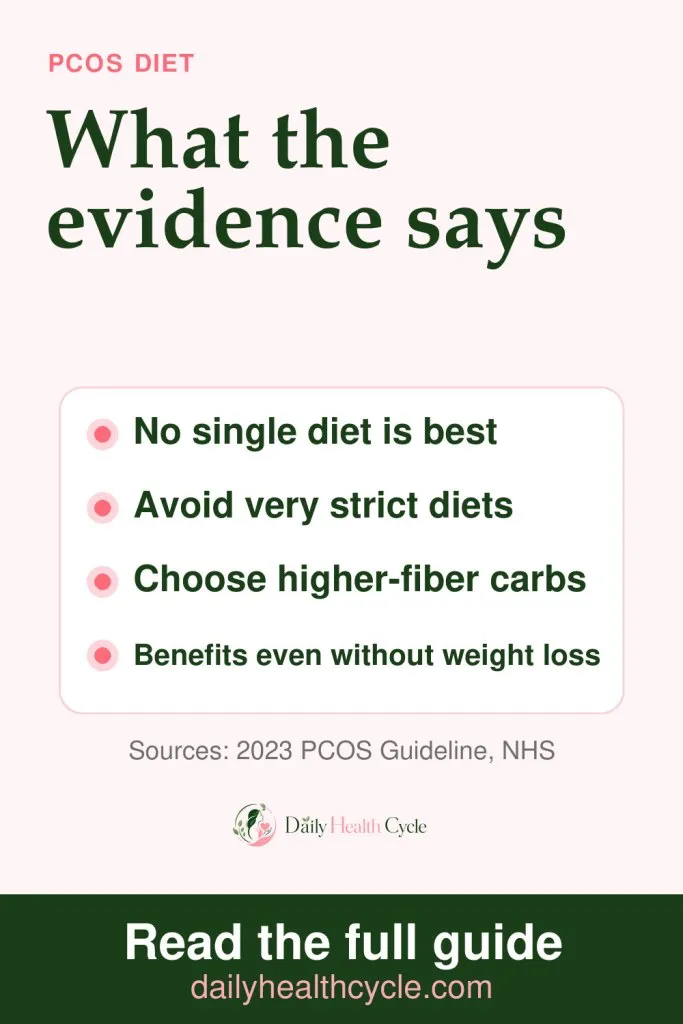
- No single diet has been shown to be best for PCOS. Any healthy eating pattern in line with general guidelines helps, and very restrictive diets are discouraged.
- A healthy lifestyle has benefits even if you don’t lose weight. If you do have higher weight, weight management can bring significant clinical improvements.
- Lower-carb, lower-glycemic-index and DASH-style diets improved some measures in trials, but the certainty of the evidence is low.
- Inositol, vitamin D, omega-3, probiotics and curcumin improved some blood test results in meta-analyses. None has strong evidence for changing symptoms such as weight, hair growth or periods.
- Supplements aren’t checked by regulators like medicines are, so quality varies. Tell your doctor what you take, especially if you’re trying to get pregnant.
In this article:
- Is There a Best Diet for PCOS?
- Eating Patterns With Some Evidence
- A Practical PCOS Plate
- PCOS Supplements: What the Evidence Says
- Buying and Using Supplements Safely
- PCOS Diet FAQ
Is There a Best Diet for PCOS?
No. Here’s what the 2023 international guideline says about diet and lifestyle (International PCOS Guideline):
- Healthy eating and physical activity are recommended for all women with PCOS, to improve general health, quality of life, body composition and weight management.
- No diet type wins. There’s no evidence that any particular mix of carbs, fat and protein works better than another. Any healthy eating pattern in line with general guidelines will have benefits.
- Avoid extremes. The guideline advises tailoring changes to your food preferences and avoiding unduly restrictive and nutritionally unbalanced diets.
- Weight isn’t the only goal. There are benefits to a healthy lifestyle even without weight loss. For women with higher weight, weight management can bring significant clinical improvements, and the focus is on preventing further gain as well as losing weight.
The NHS gives the same simple advice: eat a healthy, balanced diet, exercise regularly and try to lose weight if you’re overweight (NHS). The guideline also asks doctors to watch for disordered eating, so if food rules are taking over your life, say so. Strict rules that make you anxious around food aren’t required for PCOS.
Eating Patterns With Some Evidence
A 2023 umbrella review pulled together 28 meta-analyses of randomized trials on diet and supplements in PCOS (Nutrition Reviews, 2023). It found that:
- Lower-carbohydrate diets, lower-glycemic-index or glycemic-load diets and the DASH diet (rich in vegetables, fruit, whole grains and low-fat dairy) improved some body measurements and metabolic markers.
- But the certainty of that evidence was very low to low, and there was no high-certainty evidence that any diet alone improved health or fertility outcomes.
In practice, these patterns overlap a lot: more vegetables, legumes and whole grains, fewer refined carbs and sugary drinks. If one of them suits your tastes, it’s a reasonable choice. If it doesn’t, a general healthy diet is just as well supported.
A Practical PCOS Plate
Pulling the evidence together, a sustainable approach looks like this:
- Half the plate vegetables or salad, for fiber and volume.
- A quarter protein: fish, eggs, poultry, beans, lentils, tofu or yogurt.
- A quarter higher-fiber carbs: whole grains, oats, brown rice, whole-grain bread or potatoes with skin, rather than white bread and pastries.
- Some healthy fats: olive oil, nuts, seeds, avocado and oily fish.
- Water instead of sugary drinks most of the time.
Pair it with movement. The guideline points to general activity targets: at least 150 to 300 minutes of moderate activity or 75 to 150 minutes of vigorous activity a week, plus muscle-strengthening on 2 days, and more (around 250 minutes of moderate activity) to help with modest weight loss and preventing regain (International PCOS Guideline). Any activity is better than none.
PCOS Supplements: What the Evidence Says
Most supplement research in PCOS is small and short, and it measures blood tests such as fasting insulin rather than the symptoms you notice. Here’s what the best summaries found.
Inositol (myo-inositol, D-chiro-inositol). The most studied PCOS supplement. The 2023 guideline says it could be considered based on personal preference, noting limited harm and possible improvement in metabolic measures, but limited clinical benefits for ovulation, hair growth or weight. It found no specific type, dose or combination can be recommended yet, and says metformin should be considered over inositol for excess hair and belly fat (International PCOS Guideline). The umbrella review found moderate-certainty evidence that inositol lowered fasting insulin and increased ovulation rates in women with PCOS who were trying to conceive (Nutrition Reviews).
Vitamin D, omega-3 and curcumin. In the umbrella review, vitamin D lowered fasting insulin, fish oil and omega-3 lowered fasting insulin, insulin resistance scores and triglycerides, and curcumin lowered fasting glucose and insulin, each with moderate certainty (Nutrition Reviews). These are lab improvements, not proven changes in symptoms. If you’re low in vitamin D, correcting it is worthwhile for general health anyway, so ask for a test rather than guessing.
Probiotics and synbiotics. They lowered fasting glucose, fasting insulin and insulin resistance scores with moderate to high certainty, and possibly lowered total testosterone (Nutrition Reviews). Products and strains varied a lot between trials, so it’s hard to know which one to choose.
Berberine. Often sold as “nature’s metformin.” A meta-analysis of 12 randomized trials found it improved some insulin, cholesterol and testosterone measures, but found no solid evidence that it improved live birth rates or other clinical outcomes, and it led to fewer live births than the fertility drug letrozole (Xie et al., 2019). Don’t use it in place of prescribed treatment, and check with your doctor before taking it, especially if you’re trying to conceive or take other medicines.
Buying and Using Supplements Safely
- Quality varies. The 2023 guideline reminds women that the regulation and quality control of inositol and other supplements differ from medicines, and doses and quality may vary. In the US, the FDA doesn’t approve dietary supplements for safety or effectiveness before they’re sold (FDA). Look for products tested by an independent organization.
- Tell your doctor about every supplement you take. The guideline specifically encourages this.
- Try one thing at a time for about 3 months, so you can tell whether it’s helping.
- Be wary of “PCOS cure” bundles and influencer protocols that promise to reverse PCOS. No supplement does that.
- Don’t stop prescribed treatment. Metformin, the pill or GLP-1 medicines have stronger evidence for many women. Our guide to GLP-1 medicines for women covers the side effects and the effect on birth control.
PCOS Diet FAQ
What is the best diet for PCOS?
There isn’t a single best one. The 2023 international PCOS guideline found no evidence that any type of diet is better than another for PCOS. Any healthy eating pattern consistent with general guidelines has benefits, and the guideline advises against unduly restrictive or nutritionally unbalanced diets.
Should I cut out carbs, dairy or gluten for PCOS?
There’s no strong evidence that you need to. Lower-carb and lower-glycemic-index diets improved some measures in trials, but a 2023 umbrella review rated that evidence very low to low certainty. Choosing higher-fiber carbs over refined ones is a reasonable step without cutting whole food groups.
Does inositol work for PCOS?
It may help a little. The 2023 guideline says inositol could be considered based on personal preference, with possible improvement in metabolic measures but limited clinical benefits for ovulation, hair growth or weight. No specific type or dose can be recommended yet, and metformin has stronger evidence for some outcomes.
Which supplements help PCOS?
In a 2023 umbrella review, inositol, vitamin D, omega-3, probiotics and curcumin improved some blood test results such as fasting insulin, with moderate certainty. None has strong evidence for improving symptoms like weight, hair growth or irregular periods, so treat them as possible add-ons, not a replacement for treatment.
Is berberine safe for PCOS?
A 2019 meta-analysis of 12 trials found berberine improved some insulin, cholesterol and testosterone measures but no solid evidence of better clinical outcomes, and fewer live births than letrozole. Check with your doctor before taking it, especially if you’re trying to get pregnant or take other medicines.
Your Next Step
Pick one change this week, such as swapping sugary drinks for water or adding vegetables to two meals a day, and build from there. If you’re considering inositol or another supplement, take this article to your doctor and ask whether it fits with your current treatment. Still working out whether it’s PCOS? Read our guide to PCOS symptoms.
Free printable
Perimenopause symptom & cycle tracker
Track your periods, sleep, hot flashes and mood on one page, then bring it to your appointment. Enter your email to download it.
Sources cited in this article
- International PCOS Guideline (pubmed.ncbi.nlm.nih.gov)
- NHS: Treatment (nhs.uk)
- Nutrition Reviews, 2023 (pubmed.ncbi.nlm.nih.gov)
- Xie et al., 2019 (pubmed.ncbi.nlm.nih.gov)
- FDA: Dietary supplements (fda.gov)
Last checked October 26, 2026. Spot an outdated source? Tell us.
About the author: Jessica Bordo writes Daily Health Cycle out of personal interest in women’s health, not as a clinician. Each article summarizes what sources such as international medical guidelines, the NHS and published research reviews say, and links to them so you can check the claims yourself. Use these guides to prepare questions for your own clinician, not to replace their advice. Our editorial standards explain how we research and update articles.
This article is for general education and isn’t medical advice. See our full disclaimer and talk with a qualified clinician about your own care.