

Last updated November 2, 2026. Educational information, not medical advice: see our Medical Disclaimer.
The AMH test is often sold as an “egg timer” or a “fertility test” that tells you how long you have left to get pregnant. It’s a real and useful blood test, but it doesn’t do what most of those adverts suggest. In a large US study, women aged 30 to 44 with low AMH were just as likely to conceive naturally within a year as women with normal levels (Steiner et al., JAMA 2017).
This guide explains what AMH measures, what it can and can’t predict, when the test is genuinely helpful, and how to think about a result that worries you.
Quick answer: An AMH test estimates your ovarian reserve, roughly how many eggs you have left, but not their quality. It predicts how many eggs you'd produce in IVF or egg freezing, but not your natural chance of pregnancy: in women aged 30 to 44, low AMH didn't lower pregnancy rates within 12 months.
Key Takeaways
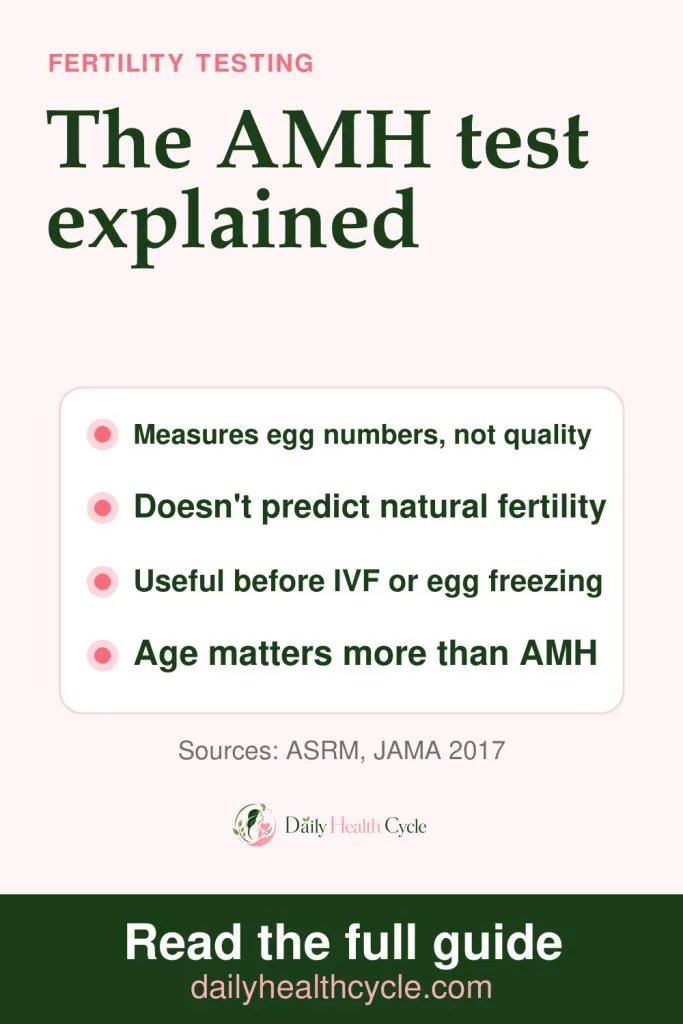
- AMH (anti-Müllerian hormone) reflects your ovarian reserve: roughly how many eggs are left. It says nothing about egg quality.
- It’s a good predictor of how many eggs you’ll produce during IVF or egg freezing, but a poor predictor of natural fertility beyond what your age already tells you (American Society for Reproductive Medicine).
- In women aged 30 to 44 trying to conceive, low AMH didn’t lower the chance of pregnancy within 6 or 12 months.
- Many websites selling AMH tests direct to consumers claim it shows your chance of conceiving, which the evidence doesn’t support.
- AMH is genuinely useful for planning IVF or egg freezing and, in adults, as one part of a PCOS diagnosis.
In this article:
- What Is AMH?
- What AMH Can’t Tell You
- What AMH Can Tell You
- At-Home and Online AMH Tests
- Understanding Your Result
- Better Questions to Ask
- AMH Test FAQ
What Is AMH?
Anti-Müllerian hormone is made by the small follicles in your ovaries, the fluid-filled sacs that each contain an immature egg. The more of these follicles you have, the higher your AMH tends to be. That’s why doctors use it as a marker of ovarian reserve, which the American Society for Reproductive Medicine (ASRM) defines as the number of eggs remaining in the ovary (ASRM, 2020).
Your egg supply falls with age, so AMH falls too. It’s measured with a simple blood test. Doctors sometimes combine it with an antral follicle count, an ultrasound that counts the small follicles directly.
What AMH Can’t Tell You
Here’s the key point: getting pregnant depends on egg quality, not just egg numbers, and egg quality is driven mainly by age. You only need one good egg each cycle. ASRM says ovarian reserve markers are poor predictors of reproductive potential independently of age (ASRM, 2020).
The clearest evidence comes from a study of 750 women aged 30 to 44, with no history of infertility, who had been trying to conceive for 3 months or less (Steiner et al., JAMA 2017):
- Women with low AMH (below 0.7 ng/mL) had a 65% predicted chance of conceiving within 6 cycles, compared with 62% for women with normal AMH.
- Within 12 cycles, it was 84% for low AMH and 75% for normal AMH. The differences weren’t statistically significant.
- High FSH, another ovarian reserve test, didn’t predict lower fertility either.
So a low AMH doesn’t mean you can’t get pregnant naturally, and a normal or high AMH doesn’t mean you can safely wait. Age remains the strongest guide. Our guide to pregnancy after 35 explains how fertility changes with age.
AMH also isn’t a menopause test. NICE advises against using AMH to diagnose perimenopause or menopause in women aged 45 and over; the diagnosis is based on symptoms (NICE). If you’re wondering about that, our perimenopause symptoms checklist is a better starting point.
What AMH Can Tell You
AMH is genuinely useful in a few situations:
- Planning IVF or egg freezing. ASRM says ovarian reserve markers are useful predictors of how many eggs will be collected after ovarian stimulation (ASRM, 2020). Clinics use AMH to choose medication doses and to set realistic expectations about how many eggs one cycle might give.
- Diagnosing PCOS in adults. The 2023 international PCOS guideline says AMH can be used instead of an ultrasound to look for polycystic ovaries in adults. It shouldn’t be used on its own to diagnose PCOS, or in teenagers, and it isn’t needed if you already have irregular periods plus signs of high androgens (International PCOS Guideline). Read more in our guide to PCOS symptoms.
- As part of a full fertility workup, alongside your history, ovulation, tubes and a partner’s semen analysis, when you’ve been trying without success.
At-Home and Online AMH Tests
AMH tests are now sold online, often with a finger-prick kit you post back. A 2023 study analyzed 27 websites selling these tests in 7 countries (JAMA Network Open, 2023):
- 74% said the test indicates your likelihood of conceiving, which the research above doesn’t support
- 41% said it could help you adjust your reproductive timeline
- 30% said it could show whether egg freezing is a viable option
- most promoted convenience, and some used language about “empowerment” and “control”
The risk is false reassurance (delaying pregnancy because AMH looks good) or needless worry (panicking over a low number that may not affect your natural chances). If you do take one, interpret it with a doctor rather than on your own.
Understanding Your Result
- Compare with your age. AMH falls with age, so a “low” result for 30 can be typical for 40. Ask what the normal range is for your age at that lab.
- Check the units. Results come in ng/mL in the US and pmol/L in many other countries, and different lab methods can give different numbers, so don’t compare results across labs or online charts.
- Low AMH: if you’re trying to conceive, it doesn’t mean you can’t conceive naturally. If you’re planning IVF or egg freezing, it suggests you may get fewer eggs per cycle, which is worth discussing with a fertility specialist sooner rather than later.
- High AMH: can simply mean a good egg supply, but very high levels can be linked to PCOS, especially with irregular periods. It doesn’t mean you have more time.
Better Questions to Ask
Instead of “What’s my AMH?”, these questions usually lead to more useful answers:
- Am I ovulating regularly? Your cycle length and signs of ovulation tell you a lot. Our guide to knowing when you’re ovulating explains how to check.
- How long have we been trying, and what’s my age? The American Society for Reproductive Medicine recommends a fertility evaluation after 12 months of trying under 35, after 6 months from 35, and right away over 40 (ASRM, 2023).
- Do I have symptoms of a condition that affects fertility? For example, very painful periods (possible endometriosis) or irregular cycles (possible PCOS).
- Am I thinking about egg freezing or IVF? If yes, AMH is worth doing as part of that conversation.
AMH Test FAQ
What does an AMH test tell you?
AMH reflects your ovarian reserve, roughly how many eggs remain in your ovaries. The American Society for Reproductive Medicine says it’s a useful predictor of how many eggs you’ll produce during IVF or egg freezing, but a poor predictor of your chance of getting pregnant independently of age. It doesn’t measure egg quality.
Can you get pregnant with low AMH?
Yes. In a JAMA study of 750 women aged 30 to 44 trying to conceive, those with low AMH (below 0.7 ng/mL) had a similar chance of conceiving within 6 cycles (65% vs 62%) and within 12 cycles (84% vs 75%) as women with normal AMH. Age matters more than the AMH number.
Does a high AMH mean I can wait to have a baby?
No. AMH reflects egg numbers, not egg quality, and quality declines with age whatever your AMH. Very high AMH can also be linked to PCOS. Use age, not AMH, to guide decisions about when to try, and talk to a doctor if you’re unsure.
Are at-home AMH tests worth it?
Usually not on their own. A 2023 study of 27 websites selling AMH tests found 74% claimed the test shows your likelihood of conceiving, which the evidence doesn’t support. If you’re considering egg freezing or IVF, AMH is better done through a clinic that can interpret it with an ultrasound.
Can AMH predict menopause?
Not for diagnosis. NICE advises against using AMH to diagnose perimenopause or menopause in women aged 45 and over, where the diagnosis is based on symptoms. If you’re wondering whether you’re in perimenopause, tracking your symptoms and cycles over a few months is more useful.
Your Next Step
If you’re trying to conceive, focus on regular sex or tracking ovulation, and see a doctor at 12 months (or 6 months if you’re 35 or older). If you’re thinking about egg freezing or IVF, ask a fertility specialist for an AMH test and an antral follicle count together, and have them explain what the numbers mean for you.
Free printable
Perimenopause symptom & cycle tracker
Track your periods, sleep, hot flashes and mood on one page, then bring it to your appointment. Enter your email to download it.
Sources cited in this article
- Steiner et al., JAMA 2017 (pubmed.ncbi.nlm.nih.gov)
- ASRM, 2020 (pubmed.ncbi.nlm.nih.gov)
- NICE (nice.org.uk)
- International PCOS Guideline (pubmed.ncbi.nlm.nih.gov)
- JAMA Network Open, 2023 (pubmed.ncbi.nlm.nih.gov)
- ASRM, 2023 (pubmed.ncbi.nlm.nih.gov)
Last checked October 26, 2026. Spot an outdated source? Tell us.
About the author: Jessica Bordo writes Daily Health Cycle out of personal interest in women’s health, not as a clinician. Each article summarizes what sources such as medical society guidelines, NICE and published studies say, and links to them so you can check the claims yourself. Use these guides to prepare questions for your own clinician, not to replace their advice. Our editorial standards explain how we research and update articles.
This article is for general education and isn’t medical advice. See our full disclaimer and talk with a qualified clinician about your own care.