

Last updated November 28, 2026. Educational information, not medical advice: see our Medical Disclaimer.
Many women with PCOS wait years for a diagnosis, often after being told their blood tests are “normal” or that an ultrasound “didn’t show cysts”. Part of the confusion is that there’s no single test for PCOS. Instead, doctors look for a combination of signs, and the rules were updated in the 2023 international guideline. Knowing which tests are actually needed can help you get a clear answer faster.
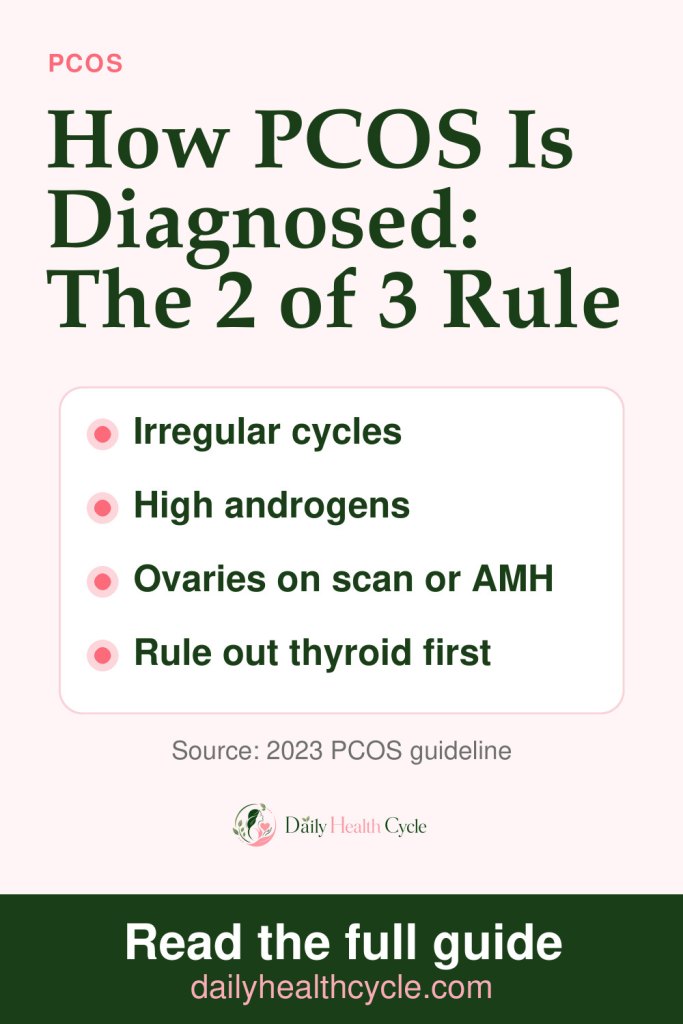
Quick answer: There’s no single PCOS test. Under the 2023 international guideline, PCOS is diagnosed when you have 2 of 3 features: irregular cycles, high androgens (from symptoms or a testosterone blood test), and polycystic ovaries on ultrasound or a high AMH level. If you have both irregular cycles and high androgens, no ultrasound or AMH test is needed. Other conditions, such as thyroid problems, must be ruled out.
Key Takeaways
- PCOS (now also called PMOS) is diagnosed with 2 of 3 features: irregular cycles, high androgens, and polycystic ovaries on ultrasound or a high AMH (2023 international guideline).
- If you have irregular cycles and high androgens, you don’t need an ultrasound or AMH test.
- Androgens are checked with total and free testosterone. AMH should never be used as a single test for PCOS.
- Doctors should rule out other causes with tests such as TSH (thyroid), prolactin and 17-OH progesterone.
- After diagnosis, the guideline recommends a blood sugar test, a cholesterol check, yearly blood pressure, and screening for depression.
The Diagnostic Criteria
The 2023 International Evidence-based Guideline for PCOS, endorsed by major medical societies, says adults are diagnosed when they have at least two of these three features:
- Irregular cycles or ovulation problems. From 3 years after your first period until perimenopause, the guideline defines irregular cycles as shorter than 21 days, longer than 35 days, or fewer than 8 cycles a year.
- High androgens (male-type hormones), either as symptoms, such as excess hair growth (hirsutism), or in a blood test.
- Polycystic ovaries on ultrasound, or a high AMH level.
Importantly, the guideline says that when irregular cycles and high androgens are both present, diagnosis is simplified and an ultrasound or AMH test isn’t needed. In 2026, PCOS was also given a new name, PMOS (polyendocrine metabolic ovarian syndrome). The criteria didn’t change. See PCOS symptoms for the full picture.
Blood Tests for Androgens
The guideline says doctors should use total and free testosterone to check for high androgens. Free testosterone can be estimated with a calculation called the free androgen index. Blood tests matter most when you have few or no visible signs, because:
- Excess hair growth (hirsutism) on its own strongly suggests high androgens.
- Acne and female-pattern hair loss on their own are weaker signs.
If you’re on the combined pill, it lowers androgen levels and can hide PCOS. The guideline says that if a blood test for androgens is essential, the pill should be stopped for at least 3 months first, using another form of contraception in the meantime.
Ultrasound and AMH
When a third feature is needed, doctors can use either:
- An ultrasound. The guideline uses 20 or more follicles in at least one ovary as the threshold for polycystic ovaries in adults, and says a transvaginal scan is the most accurate if you’re comfortable with it. Despite the name, these “cysts” are small follicles, not true cysts.
- An AMH blood test. Since 2023, AMH can be used instead of ultrasound in adults. But the guideline says AMH should not be used as a single test for PCOS. See our guide to the AMH test.
In teenagers, the guideline says ultrasound isn’t recommended for diagnosis, because there are no reliable criteria at that age. Teenagers with features of PCOS who don’t meet the criteria may be considered “at increased risk” and reassessed later, by 8 years after their first period.
Tests to Rule Out Other Conditions
Irregular periods and high androgens can have other causes, so the guideline says these should be excluded, usually with blood tests for:
- TSH, to check for thyroid problems
- Prolactin, a hormone that can stop periods when it’s high
- 17-OH progesterone, to check for a genetic adrenal condition that can look like PCOS
- FSH, and, if clinically indicated, tests for rarer causes such as Cushing’s syndrome or adrenal tumours
Tests After a PCOS Diagnosis
PCOS affects more than your periods, so the guideline recommends ongoing checks for everyone with PCOS, whatever their age or weight:
- Blood sugar: the 75 g oral glucose tolerance test is the most accurate test, regardless of BMI, repeated every 1 to 3 years depending on your risk. Insulin blood tests aren’t recommended in routine care. See PCOS and insulin resistance and prediabetes in women.
- Cholesterol: a full lipid profile at diagnosis.
- Blood pressure: once a year, and when planning a pregnancy.
- Mental health: screening for depression, which is common with PCOS.
How to Prepare for Your Appointment
- Bring a record of your cycle lengths for the last few months
- Note any excess hair growth, acne or hair thinning, and when they started
- Tell your doctor if you’re on hormonal contraception
- Ask: “Do I meet the 2023 criteria? Do I need an ultrasound or AMH, or is it already clear?”
- Ask which follow-up tests you need, such as blood sugar and cholesterol
Once diagnosed, lifestyle changes and the right treatment can make a real difference. See PCOS diet and supplements.
PCOS Tests FAQ
Is there a blood test for PCOS?
u003cpu003eThere’s no single blood test. Blood tests for total and free testosterone help check for high androgens, and AMH can be used instead of an ultrasound in adults, but the 2023 guideline says AMH should never be used as a single test. Diagnosis needs 2 of 3 features.u003c/pu003e
Do I need an ultrasound to diagnose PCOS?
u003cpu003eNot always. The 2023 international guideline says that if you have both irregular cycles and high androgens, an ultrasound or AMH test isn’t needed for diagnosis. In teenagers, ultrasound isn’t recommended for diagnosing PCOS.u003c/pu003e
Can you have PCOS with normal blood tests?
u003cpu003eYes. If you have irregular cycles and polycystic ovaries on ultrasound, or a high AMH, you can meet the criteria even with normal testosterone. Visible signs like excess hair growth also count as high androgens without a blood test.u003c/pu003e
Can I be tested for PCOS while on the pill?
u003cpu003eThe combined pill lowers androgen levels and can hide PCOS. The 2023 guideline says that if an androgen blood test is essential, the pill should be stopped for at least 3 months first, using another contraception method in the meantime.u003c/pu003e
What tests should I have after a PCOS diagnosis?
u003cpu003eThe 2023 guideline recommends a blood sugar test, ideally an oral glucose tolerance test, repeated every 1 to 3 years, a cholesterol check at diagnosis, blood pressure every year, and screening for depression.u003c/pu003e
Your Next Step
If your cycles are irregular and you have signs like excess hair growth, ask your GP to assess you against the 2023 PCOS criteria. You may not need a scan at all. Whatever the result, ask for a blood sugar and cholesterol check, because they matter for your long-term health.
Sources
- Teede HJ, et al. Recommendations from the 2023 International Evidence-based Guideline for the Assessment and Management of Polycystic Ovary Syndrome. J Clin Endocrinol Metab, 2023
- NHS: Polyendocrine metabolic ovarian syndrome (PMOS): diagnosis
- Endocrine Society: Polyendocrine Metabolic Ovarian Syndrome: new name to improve diagnosis and care (2026)
Sources last checked: November 18, 2026.
Free printable PDF
Perimenopause symptom & cycle tracker
A one-page PDF to print and fill in by hand: periods, sleep, hot flashes and mood, ready to bring to your appointment. Enter your email and the download link appears right away.
Prefer to track on your phone? Use our online symptom tracker, no email needed.
This article is for general education and isn’t medical advice. See our full disclaimer and talk with a qualified clinician about your own care.
References & Sources
Sources cited in this article
- 2023 International Evidence-based Guideline for PCOS (pmc.ncbi.nlm.nih.gov)
- NHS: Polyendocrine metabolic ovarian syndrome (PMOS): diagnosis (nhs.uk)
- Endocrine Society: Polyendocrine Metabolic Ovarian Syndrome: new name to improve diagnosis and care (2026) (endocrine.org)
- LinkedIn: Emma bordo a679ba450 (linkedin.com)
- Nih: Diagnosed (nichd.nih.gov)
- Asrm: Pcos diagnosis (asrm.org)
- Endocrine: Diagnosis of pcos (endocrine.org)
Last checked November 28, 2026. Spot an outdated source? Tell us.