Last updated October 6, 2026. Educational information, not medical advice: see our Medical Disclaimer.
Perimenopause hair loss usually creeps up slowly: a wider part, a thinner ponytail, more strands in your brush or the shower drain. You’re not imagining it. The NHS lists “hair thinning or hair loss” among the symptoms of perimenopause and menopause (NHS).
This guide explains why changing hormones affect your hair, how to tell hormone-related thinning apart from shedding caused by low iron, thyroid problems or stress, and which treatments have evidence behind them. It also covers the signs that mean you should see a doctor or dermatologist soon. If you’re still working out whether you’re in perimenopause, our perimenopause symptoms checklist is a good place to start.
Key Takeaways
- The NHS lists hair thinning or hair loss as a perimenopause and menopause symptom. Falling estrogen and a relative rise in androgens affect the hair follicle, which can leave hair less dense and finer.
- The most common pattern is female pattern hair loss: a widening part rather than bald patches. In a 2022 study of 178 women aged 50 to 65 who had been through menopause, 52.2% had it, and most cases were mild.
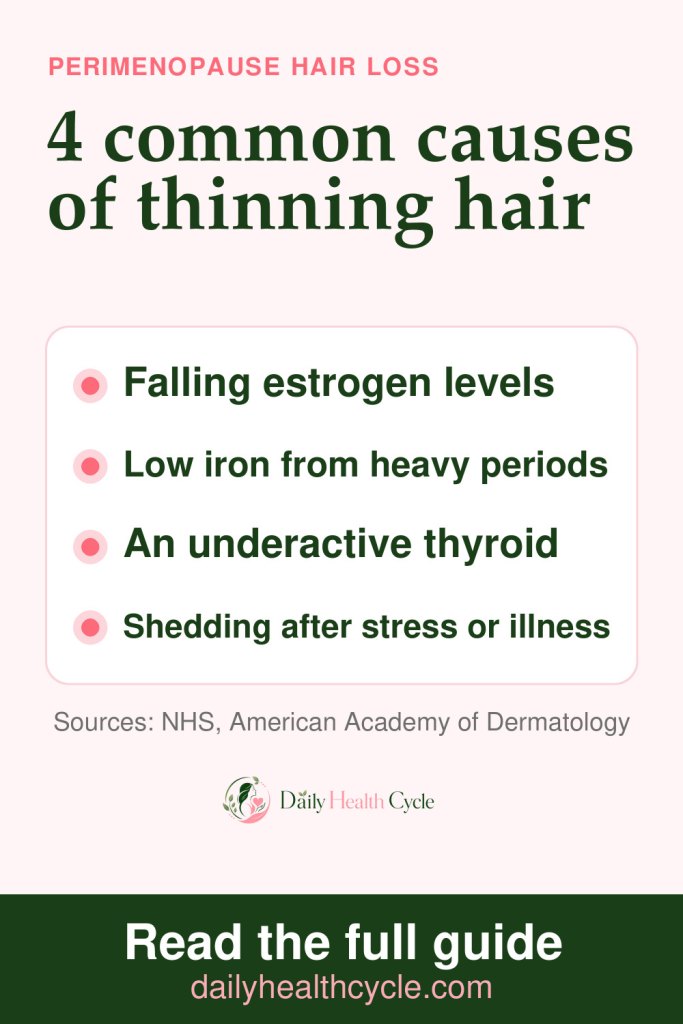
- Hormones aren’t the only cause. Low iron (heavy periods are a very common cause), an underactive thyroid and shedding after stress or illness can look similar, and blood tests can check.
- Minoxidil 2% or 5% is the most-recommended treatment for female pattern hair loss. It takes 6 to 12 months to show results (American Academy of Dermatology).
- See a dermatologist soon for round bald patches, a receding hairline or thinning eyebrows. One cause, frontal fibrosing alopecia, scars the scalp, and early treatment matters.
In this article:
- Can Perimenopause Cause Hair Loss?
- What Perimenopause Hair Loss Looks Like
- Other Causes Worth Ruling Out
- What Helps Perimenopause Hair Loss
- When to See a Doctor
- Perimenopause Hair Loss FAQ
- Your Next Step
Can Perimenopause Cause Hair Loss?
Yes. Hair thinning or hair loss is one of the symptoms the NHS lists for perimenopause and menopause (NHS), and it can start well before your periods stop. A 2025 review in the journal Maturitas notes that the hormonal ups and downs of the menopause transition can begin up to 10 years before menopause itself (Gupta et al., Maturitas, 2025).
Hair follicles are sensitive to estrogen. As the ovaries make less estrogen and androgens (hormones such as testosterone) become relatively stronger, the same review explains, hair can become less dense, finer and different in texture. Cleveland Clinic puts it simply: estrogen promotes hair growth and fullness, and without it, hair may become thinner (Cleveland Clinic).
The review also points out that losing hair can take a real emotional toll, bringing stress, anxiety and lower self-esteem. If that’s how it feels for you, it isn’t vanity. It’s a recognized part of the transition and worth raising with a doctor. Our guide to perimenopause anxiety covers the emotional side of these years.
What Perimenopause Hair Loss Looks Like
Hair changes in midlife usually follow one of three patterns. Knowing which one you have helps you and your doctor work out the cause.
Gradual thinning on top of the head
Female pattern hair loss is the most common cause of hair loss in women. The American Academy of Dermatology (AAD) describes a widening part as a typical sign and says the condition usually starts in a woman’s 40s, 50s or 60s and is more common after menopause. It tends to get slowly worse without treatment, but women rarely lose all their hair the way some men do (AAD).
It’s common. In a 2022 study in the journal Menopause, researchers examined 178 women aged 50 to 65 who had been through menopause, and 52.2% had female pattern hair loss. Most cases (73.2%) were mild. After adjusting for age and family history, a body mass index of 25 or higher was the only factor still linked to it (Chaikittisilpa et al., Menopause, 2022).
Sudden, heavy shedding
Shedding is different from thinning. Losing 50 to 100 hairs a day is normal, the AAD says, but a big stress on the body can push many more hairs into their resting phase at once. This is called telogen effluvium. Triggers include high stress, a fever or illness, surgery, losing 20 pounds or more, and stopping birth control pills. The shedding usually appears a few months after the trigger, and hair tends to regain its normal fullness within 6 to 9 months once the stress has passed (AAD).
A receding hairline or thinning eyebrows
Less often, hair loss starts at the front. Frontal fibrosing alopecia (FFA) is usually diagnosed in women after menopause. It typically shows up as a thin band of balding skin along the front and sides of the hairline, and between 80% and 95% of women diagnosed with it have lost some or all of their eyebrows. FFA scars the follicles, and once a follicle scars it can no longer grow hair. Caught early, though, treatment can stop further loss and may regrow some hair (AAD).
| Type | What you may notice | What usually helps |
|---|---|---|
| Female pattern hair loss | A wider part, thinner hair on top, more scalp showing | Minoxidil; prescription options from a dermatologist |
| Telogen effluvium (shedding) | Lots of hair coming out at once, a few months after stress, illness or weight loss | Dealing with the trigger; hair usually recovers in 6 to 9 months |
| Frontal fibrosing alopecia | A hairline moving back, thinning or lost eyebrows | See a dermatologist promptly, because early treatment can stop further loss |
Source: American Academy of Dermatology.
Other Causes Worth Ruling Out
Because hair changes are so common in midlife, it’s easy to blame everything on hormones. These causes can look the same and are worth checking, especially if your hair changes arrived with other new symptoms.
Low iron
Iron deficiency anaemia can cause hair loss, which the NHS describes as noticing more hair coming out when you brush or wash it. Heavy periods are one of the most common causes of iron deficiency (NHS), and periods can become heavier for some women in perimenopause (see our guide to irregular periods in perimenopause). Tiredness and lack of energy are the most common symptoms of low iron, so if you’re also worn out, our guide to the causes of constant fatigue in women explains what to check.
An underactive thyroid
The NHS lists “dry hair or hair loss” among the symptoms of an underactive thyroid, alongside tiredness, feeling cold, weight gain, low mood and irregular or heavy periods (NHS). Many of those overlap with perimenopause, which is why a thyroid blood test is often part of the workup. Our guide to hormonal imbalance symptoms explains how these conditions overlap.
Higher androgen levels
Conditions that raise androgen levels, such as polycystic ovary syndrome (PCOS), can also thin the hair on your scalp. If you also have irregular periods, acne or extra facial hair, our PCOS symptoms guide explains how it’s diagnosed.
Tests your doctor may suggest
Cleveland Clinic lists the checks a provider may use: gently pulling on your hair to see how many strands come out, looking at your scalp under a microscope, blood tests for vitamins and minerals such as iron, vitamin D, B vitamins and zinc, and for hormones such as thyroid hormone, and sometimes a small scalp biopsy (Cleveland Clinic).
If you take biotin, tell your doctor before any blood test. The FDA warns that biotin, which is common in supplements sold for hair, skin and nails, can interfere with some lab tests and cause incorrect results (FDA).
What Helps Perimenopause Hair Loss
What helps depends on the cause, which is why a diagnosis comes first. For female pattern hair loss, these are the options with evidence behind them.
Minoxidil
The AAD calls minoxidil the most-recommended treatment for female pattern hair loss. It’s available without a prescription as 2% or 5% minoxidil. Expect to wait 6 to 12 months to see whether it’s working, and keep using it every day, because the benefit lasts only as long as you use it (AAD). The NHS also lists minoxidil as a treatment for female pattern baldness, while noting that no treatment is 100% effective (NHS).
Prescription options
A dermatologist may suggest other medicines off-label, meaning for a use they aren’t specifically approved for. These include spironolactone, which blocks the effects of androgens. Like minoxidil, they take 6 to 12 months to show results (AAD). Some US dermatologists also prescribe finasteride, but the NHS says women should not use it (NHS), so it’s one to discuss carefully with a specialist.
Low-dose minoxidil tablets are another off-label option some dermatologists use. In a 2021 study of 1,404 people treated for hair loss, two-thirds of them women, the most common side effect was extra hair growth on the face or body (15.1%). Lightheadedness (1.7%), fluid retention (1.3%) and a fast heart rate (0.9%) were less common, and 1.7% stopped treatment because of side effects. The study looked back at past records and had no comparison group, so it isn’t the final word (Vañó-Galván et al., Journal of the American Academy of Dermatology, 2021).
Hormone therapy
Cleveland Clinic lists estrogens among the medicines used for hair loss in women (Cleveland Clinic), but hormone therapy isn’t usually started for hair alone, and it isn’t on the AAD’s list of treatments for female pattern hair loss. If you’re considering HRT for other menopause symptoms, ask whether it could also affect your hair. Our guide to perimenopause treatment options explains how hormone therapy is weighed up.
Treating what’s behind it
If blood tests show low iron or a thyroid problem, treating that comes first. Shedding after illness or stress usually settles on its own once the trigger has passed (AAD).
Other treatments
Hair transplants, at-home laser devices, platelet-rich plasma (PRP) injections and supplements are also used, but the AAD says the evidence behind them varies (AAD). Be wary of products that promise regrowth, and remember the FDA’s warning about biotin above.
Gentle everyday care
A Cleveland Clinic dermatologist suggests gentle, moisturizing shampoos and washing less often if your hair is dry, along with eating a healthy diet, exercising regularly and not smoking (Cleveland Clinic). These won’t reverse hormone-related thinning, but they help look after the hair you have.
When to See a Doctor
The NHS says to see a GP if you’re worried about your hair loss (NHS). Get it checked sooner if you notice:
- round, distinct bald spots on your scalp, which Cleveland Clinic lists as a reason to see a dermatologist (Cleveland Clinic)
- a hairline that’s moving back, or thinning eyebrows, which can be signs of frontal fibrosing alopecia (AAD)
- hair loss together with tiredness, feeling cold, weight gain or very heavy periods, which can point to a thyroid problem or low iron (NHS)
- sudden, heavy shedding with no obvious trigger
The AAD recommends seeing a board-certified dermatologist when hair loss first starts, because early treatment tends to work best (AAD).
Perimenopause Hair Loss FAQ
Will my hair grow back after perimenopause?
It depends on the cause. Shedding after stress or illness usually recovers within 6 to 9 months once the trigger has passed. Female pattern hair loss tends to get slowly worse without treatment, but minoxidil and other treatments can help. Frontal fibrosing alopecia scars the follicles and can cause permanent loss, so early treatment matters.
How much hair loss is normal?
Losing 50 to 100 hairs a day is normal, according to the American Academy of Dermatology and the NHS. Losing a lot more than that, finding clumps, or seeing a wider part or more scalp is worth checking with a doctor.
Can HRT help with hair loss?
Cleveland Clinic lists estrogens among the medicines used for hair loss in women, but hormone therapy isn’t usually started for hair loss alone, and it isn’t on the American Academy of Dermatology’s list of treatments for female pattern hair loss. If you’re considering HRT for other symptoms, ask your doctor how it might affect your hair.
Can low iron cause hair loss?
Yes. The NHS lists hair loss among the symptoms of iron deficiency anaemia, and heavy periods are a very common cause of low iron. A blood test can check your levels.
Do biotin supplements help hair loss?
The American Academy of Dermatology says the evidence behind supplements for hair loss varies. If you take biotin, tell your doctor before any blood test, because the FDA warns it can interfere with some lab tests and cause incorrect results.
How long does perimenopause hair loss last?
It depends on the cause. Shedding triggered by stress or illness usually settles, and hair tends to regain its fullness within 6 to 9 months once the trigger has passed (American Academy of Dermatology). Female pattern hair loss is different: it tends to continue slowly unless it’s treated, and the American Academy of Dermatology says it is more common after menopause.
Can perimenopause hair loss be reversed?
Often it can be improved. Shedding after stress or illness usually recovers on its own. For female pattern hair loss, minoxidil is the most-recommended treatment, though it takes 6 to 12 months to show results and only works while you keep using it (American Academy of Dermatology). Frontal fibrosing alopecia is the exception: it scars the follicles, so lost hair may not grow back, but early treatment can stop further loss.
Does hair loss stop after menopause?
Not necessarily. The American Academy of Dermatology says female pattern hair loss is more common after menopause, and in a 2022 study of women aged 50 to 65 who had been through menopause, 52.2% had it, most of them mildly. If your hair is still thinning, treatment and a check for causes such as low iron or thyroid problems can still help.
Your Next Step
Take a photo of your part in the same light once a month, and note how much hair you’re shedding along with your periods, energy and mood. Our free printable perimenopause symptom and cycle tracker (PDF) has room for all of it. Then book an appointment and ask whether blood tests for iron and thyroid function make sense for you. Not sure your symptoms are perimenopause at all? Take our free perimenopause test.
About the author: Jessica Bordo writes Daily Health Cycle out of personal interest in women’s health, not as a clinician. Each article summarizes what sources such as the NHS, the American Academy of Dermatology, Cleveland Clinic and published research say, and links to them so you can check the claims yourself. No medical reviewer is listed for this article, so use it to prepare questions for your own clinician, not to replace their advice. Our editorial standards explain how we source and check articles.
This article is for general education and isn’t medical advice. See our full disclaimer and talk with a qualified clinician about your own care.