

Last updated October 23, 2026. Educational information, not medical advice: see our Medical Disclaimer.
Period pain bad enough to make you miss work is not something you just have to live with. It can be a sign of endometriosis, a condition the World Health Organization estimates affects about 10% of women of reproductive age, or around 190 million worldwide. It also takes a long time to diagnose: the WHO puts the average delay at 4 to 12 years (WHO).
This guide covers the symptoms to look for, why diagnosis takes so long, how doctors diagnose it today, the main treatment options, and how to make your appointment count. If your periods have also become irregular, our guide to PCOS symptoms covers another common hormonal condition worth ruling out.
Key Takeaways
- Endometriosis is when tissue similar to the lining of the womb grows outside it. The WHO estimates it affects about 1 in 10 women of reproductive age.
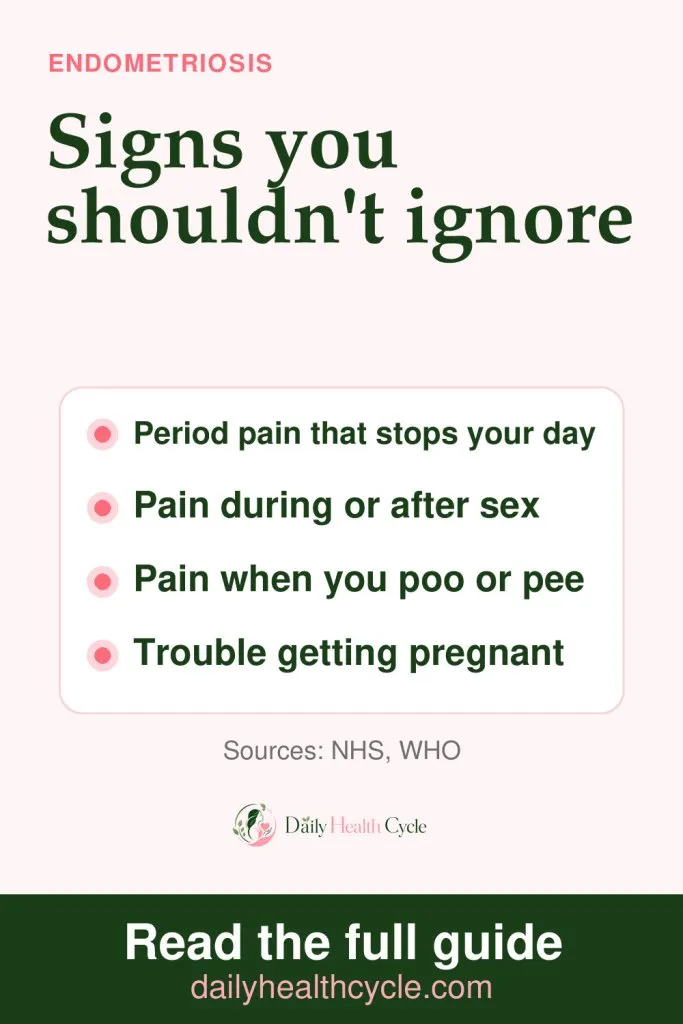
- The main signs are period pain that stops you doing normal activities, pelvic pain at other times, pain during or after sex, pain when you poo or pee, heavy periods and difficulty getting pregnant.
- Diagnosis often takes 4 to 12 years. A normal ultrasound doesn’t rule it out, according to NICE guidance.
- There’s no cure yet, but painkillers, hormonal treatments and surgery can control symptoms.
- A symptom diary covering pain, bleeding, bowel and bladder symptoms helps your doctor take your symptoms seriously and decide on the next step.
In this article:
- What Is Endometriosis?
- Endometriosis Symptoms
- Why Diagnosis Takes So Long
- How Endometriosis Is Diagnosed
- Treatment Options
- Endometriosis and Fertility
- How to Prepare for Your Appointment
- Endometriosis FAQ
What Is Endometriosis?
Endometriosis is a long-term condition where tissue similar to the lining of the womb grows in other places, most often on the ovaries, fallopian tubes and the lining of the pelvis. This tissue responds to the menstrual cycle, which can cause inflammation, pain and scar tissue. The NHS notes that it’s not known what causes endometriosis (NHS).
In the US, the Office on Women’s Health says endometriosis may affect more than 11% of women aged 15 to 44, and it’s especially common in women in their 30s and 40s. Things linked to a higher risk include a mother, sister or aunt with endometriosis, periods lasting more than 7 days, short cycles of 27 days or less, and never having given birth (OWH).
Endometriosis Symptoms
The NHS lists these main symptoms (NHS):
- severe period pain that stops you doing your normal activities
- heavy periods, for example needing to change a pad or tampon every 1 to 2 hours
- pelvic pain at other times of the month
- pain during or after sex
- pain when you poo or pee
- extreme tiredness
- difficulty getting pregnant
The Office on Women’s Health adds bleeding or spotting between periods, and digestive problems such as bloating, diarrhea, constipation or nausea, especially during your period (OWH). The NHS notes it can also come with low mood or anxiety.
If tiredness is one of your main complaints, our guide to constant fatigue in women covers other causes worth checking.
Why Diagnosis Takes So Long
The WHO says long delays in diagnosis are common (WHO). A few reasons:
- Painful periods get normalized, by women themselves and sometimes by doctors.
- Symptoms overlap with other conditions. The NHS lists adenomyosis, fibroids, pelvic inflammatory disease and irritable bowel syndrome among the conditions that can look similar (NHS).
- Standard scans can look normal. Small, superficial patches of endometriosis often don’t show up on ultrasound.
- Hormonal birth control can mask it. The pill is often prescribed for painful periods. It can ease symptoms, which may delay further investigation.
How Endometriosis Is Diagnosed
Your doctor will usually start with your symptoms, an abdominal and internal pelvic exam, and sometimes blood tests to rule out other causes (NHS). From there, the usual steps are:
- Transvaginal ultrasound. NICE recommends offering one even if the exam is normal. It can find ovarian endometriosis cysts (endometriomas) and deep endometriosis affecting the bowel, bladder or ureter, and can rule out other problems.
- MRI may be used, often to map deep endometriosis before surgery.
- Laparoscopy is keyhole surgery where a camera is passed through a small cut in your tummy. It can confirm endometriosis, and patches can sometimes be removed at the same time.
Two important points. First, NICE says a normal exam and ultrasound don’t rule out endometriosis, and referral may still be needed if symptoms continue (NICE). Second, you don’t always need surgery before treatment starts. The European Society of Human Reproduction and Embryology (ESHRE) 2022 guideline moved away from treating laparoscopy as the only “gold standard” and supports diagnosis based on symptoms and imaging in many cases (ESHRE). Your doctor may suggest trying a hormonal treatment first and seeing whether your symptoms improve.
Treatment Options
There’s currently no cure, but treatment can control pain and other symptoms. The WHO notes that symptoms often persist or come back after treatment, so many women need a long-term plan (WHO). The main options (NHS; OWH):
- Pain relief: over-the-counter painkillers such as ibuprofen for milder symptoms.
- Hormonal treatments: the combined pill (sometimes taken continuously to skip periods), progestogen-only options, the hormonal IUD, or medicines that temporarily lower estrogen (GnRH agonists or antagonists). These only work while you take them, and they’re not used while trying to get pregnant.
- Surgery: removing or destroying patches of endometriosis or ovarian cysts, usually by laparoscopy. It may be offered if other treatments haven’t helped, if there’s a lot of endometriosis, or if it’s affecting fertility. Symptoms can return, and further surgery is sometimes needed.
- Hysterectomy, sometimes with removal of the ovaries, may be considered when other treatments haven’t worked and you don’t plan to have children. It isn’t guaranteed to cure endometriosis, so it’s a decision to make with a specialist.
The NHS also points to specialist endometriosis centers if treatment isn’t working or symptoms are severe. Pain often eases after menopause as estrogen falls, but the Office on Women’s Health notes that some women on menopausal hormone therapy still have symptoms. If you have endometriosis and are considering HRT, our guide to HRT in perimenopause is a good starting point for that conversation.
Endometriosis and Fertility
Many women with endometriosis get pregnant without help, but it is linked to fertility problems. The WHO says 25% to 50% of women with infertility have endometriosis (WHO). If you’re trying to conceive, the NHS says surgery may be an option and you can be referred to a fertility specialist. If you’re over 35, don’t wait as long before asking for help; our guide to pregnancy after 35 explains why timing matters.
How to Prepare for Your Appointment
The NHS advises seeing a GP if you think you might have endometriosis, if symptoms affect your daily life, work or relationships, or if treatment hasn’t helped (NHS). To get the most from the visit:
- Keep a symptom diary for 2 to 3 cycles: pain level (0 to 10) each day, bleeding, pain with sex, bowel or bladder symptoms, and days missed from work or school.
- List what you’ve tried, including painkillers, the pill and how well each worked.
- Mention family history, especially a mother or sister with endometriosis.
- Ask directly: “Could this be endometriosis? Can I have a transvaginal ultrasound? If it’s normal and I’m still in pain, can I be referred to a gynecologist?”
Get urgent help for sudden, severe pelvic pain, pain with a fever, or fainting, as these can be signs of other problems that need prompt treatment.
Endometriosis FAQ
What are the first signs of endometriosis?
The most common is severe period pain that stops you doing your normal activities. Other signs include pelvic pain at other times, pain during or after sex, pain when you poo or pee, heavy periods, extreme tiredness and difficulty getting pregnant (NHS). Symptoms vary a lot from person to person.
Can an ultrasound show endometriosis?
Sometimes. A transvaginal ultrasound can find ovarian endometriosis cysts and deep endometriosis, but small, superficial patches often don’t show up. NICE says a normal exam and ultrasound don’t rule out endometriosis, and referral may still be needed if symptoms continue.
Do you need surgery to diagnose endometriosis?
Not always. Laparoscopy can confirm it, but the 2022 ESHRE guideline supports diagnosis based on symptoms and imaging in many cases, and doctors may start hormonal treatment without surgery first. Surgery is still used when the diagnosis is uncertain, symptoms persist or fertility is affected.
Why does it take so long to diagnose endometriosis?
The WHO puts the average delay at 4 to 12 years. Painful periods are often treated as normal, symptoms overlap with conditions such as IBS, fibroids and adenomyosis, scans can look normal, and hormonal birth control can mask symptoms for years.
Does endometriosis go away after menopause?
Pain often improves after menopause as estrogen levels fall, but not always. The Office on Women’s Health notes that some women taking menopausal hormone therapy still have symptoms, so tell your doctor about endometriosis if you’re considering HRT.
Your Next Step
Start a symptom diary this cycle and book an appointment if period pain is stopping you from doing everyday things. Bring your notes and ask about an ultrasound and a referral if needed. Want to understand how your hormones fit together? Our guide to hormonal imbalance symptoms is a good next read.
Free printable
Perimenopause symptom & cycle tracker
Track your periods, sleep, hot flashes and mood on one page, then bring it to your appointment. Enter your email to download it.
Sources cited in this article
- WHO: Endometriosis (who.int)
- NHS: Endometriosis (nhs.uk)
- OWH: Endometriosis (womenshealth.gov)
- NICE (nice.org.uk)
- ESHRE (pubmed.ncbi.nlm.nih.gov)
Last checked October 22, 2026. Spot an outdated source? Tell us.
About the author: Jessica Bordo writes Daily Health Cycle out of personal interest in women’s health, not as a clinician. Each article summarizes what sources such as the WHO, the NHS, NICE and medical society guidelines say, and links to them so you can check the claims yourself. Use these guides to prepare questions for your own clinician, not to replace their advice. Our editorial standards explain how we research and update articles.
This article is for general education and isn’t medical advice. See our full disclaimer and talk with a qualified clinician about your own care.