

Last updated November 26, 2026. Educational information, not medical advice: see our Medical Disclaimer.
Once you’ve had one urinary tract infection (UTI), you never want another. The burning, the constant urge to pee and the trips to the pharmacy are miserable, and for many women they come back again and again. Some prevention tips you’ll see online have good evidence behind them, while others don’t. Here’s what the NHS and the research actually say.
Quick answer: To prevent UTIs, the NHS advises drinking plenty of water, peeing as soon as possible after sex, wiping from front to back, not holding in your pee, and avoiding scented soaps. Cranberry products may modestly reduce repeat infections, but D-mannose didn’t beat a placebo in a large trial. If you keep getting UTIs, ask your doctor about vaginal estrogen (after menopause), methenamine or low-dose antibiotics.
Key Takeaways
- Women get UTIs more often than men partly because they have a shorter urethra, so bacteria reach the bladder more easily (NHS).
- Everyday habits that help: drink plenty of water, pee soon after sex, wipe front to back, and don’t hold in your pee (NHS).
- Cranberry products probably reduce repeat UTIs by about a quarter in women with recurrent infections (Cochrane, 2023), but they don’t treat an infection.
- D-mannose didn’t beat a placebo in a 2024 trial of 598 women.
- For recurrent UTIs, medical options include vaginal estrogen after menopause, methenamine hippurate and low-dose antibiotics.
Why Women Get UTIs
Most UTIs happen when bacteria from the bowel get into the urethra and travel up to the bladder. The NHS explains that women have a shorter urethra than men, which makes this easier. Other things that raise the risk include pregnancy, having been through the menopause, kidney stones, a weakened immune system and using spermicide with contraception.
Doctors usually call UTIs recurrent if you have 2 or more in 6 months, or 3 or more in a year (AUA guideline). If that’s you, everyday habits are a good start, but it’s worth talking to a doctor about the medical options below.
Everyday Habits That Help
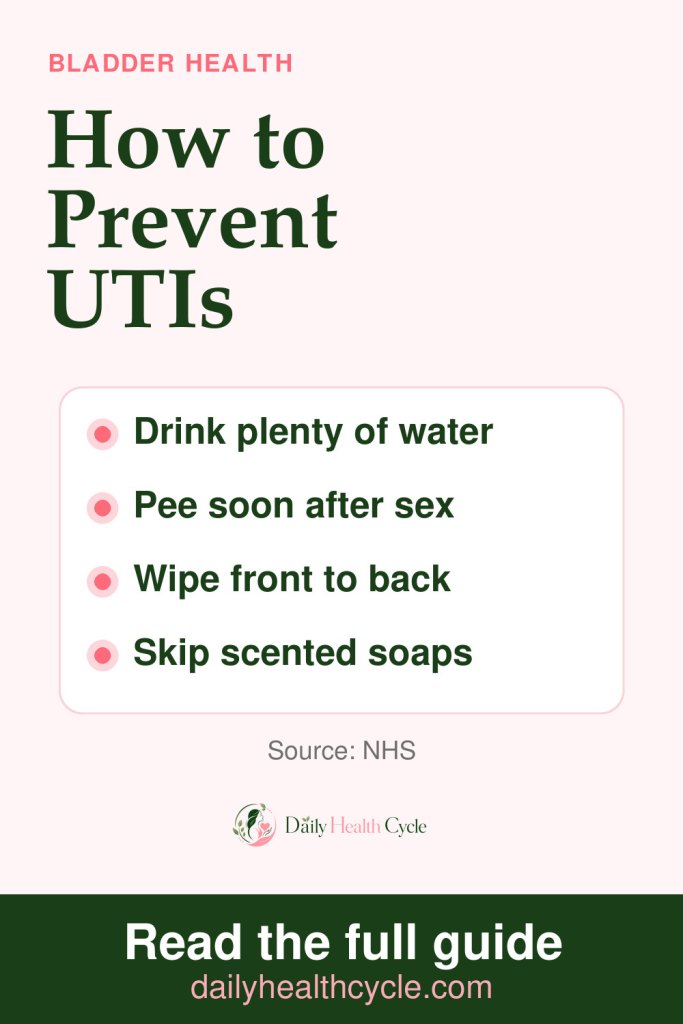
The NHS recommends these steps to lower your chance of a UTI:
Do
- Drink plenty of fluids, particularly water, so you pee regularly and flush bacteria out.
- Pee as soon as possible after sex.
- Wipe from front to back when you go to the toilet.
- Change incontinence pads promptly if they’re soiled.
Don’t
- Use scented soap around the genital area.
- Hold in your pee when you feel the urge to go.
- Wear tight underwear.
- Drink large amounts of alcohol, or have lots of sugary food and drinks.
If you use spermicide and get frequent UTIs, it may be worth asking about a different method of contraception, since the NHS lists spermicide as a risk factor.
Cranberry and D-Mannose: What the Evidence Says
- Cranberry products. A 2023 Cochrane review found that cranberry products probably reduce repeat UTIs in women with recurrent infections, by about a quarter (Cochrane, 2023). They’re for prevention only: the NHS says there’s no evidence they ease symptoms once an infection has started. They can be high in sugar, and the NHS advises avoiding them if you take warfarin.
- D-mannose. This popular supplement didn’t work in a large UK trial: 51% of women taking 2 g a day had another UTI within 6 months, compared with 56% on a placebo, a difference that could be due to chance (JAMA Internal Medicine, 2024).
Medical Options for Recurrent UTIs
- Vaginal estrogen (after menopause). Lower estrogen after menopause makes UTIs more likely. Vaginal estrogen is recommended by the NHS and the American Urological Association to help prevent repeat infections. See frequent UTIs after menopause.
- Methenamine hippurate. A daily tablet that makes urine less friendly to bacteria without being an antibiotic. In the UK ALTAR trial of 240 women, it worked about as well as daily low-dose antibiotics (BMJ, 2022).
- Low-dose antibiotics. The NHS says a GP may prescribe a low-dose antibiotic for up to 6 months, or refer you to a specialist. They work, but carry a risk of side effects and antibiotic resistance.
A urine test before treatment is useful when infections keep coming back, because it confirms there really is an infection and shows which antibiotic will work. Keeping a simple log of each episode, with the date, symptoms and treatment, helps your doctor choose the right prevention plan.
When to Get Help
In the UK, the NHS says a pharmacist can help with a suspected UTI if you’re a woman aged 16 to 64 who isn’t pregnant. See a GP urgently or contact NHS 111 if:
- You’re pregnant, aged 65 or over, have diabetes, or use a catheter
- Your symptoms get worse quickly, or don’t improve within 48 hours of starting treatment
- You have a high temperature, pain in your back or side under the ribs, or blood in your pee, which can be signs of a kidney infection
Call emergency services if someone with a UTI becomes confused, drowsy or has difficulty speaking (NHS).
UTI Prevention FAQ
What is the best way to prevent UTIs?
The NHS recommends drinking plenty of water, peeing as soon as possible after sex, wiping from front to back, not holding in your pee and avoiding scented soaps. If you get UTIs often, ask your doctor about medical prevention options.
Does cranberry juice prevent UTIs?
Cranberry products probably reduce repeat UTIs modestly in women with recurrent infections, according to a 2023 Cochrane review. They don’t treat an infection once it has started, can be high in sugar, and should be avoided if you take warfarin.
Does D-mannose prevent UTIs?
The best evidence says no. In a 2024 UK trial of 598 women with recurrent UTIs, D-mannose didn’t reduce repeat infections compared with a placebo.
Why do I get a UTI after sex?
Sex can push bacteria towards the urethra. Peeing as soon as possible afterwards helps flush them out, according to the NHS. Spermicide also raises the risk, so if you use it and get frequent UTIs, ask about other contraception.
What counts as recurrent UTIs?
Doctors usually call UTIs recurrent if you have 2 or more in 6 months, or 3 or more in a year. If that’s you, options include vaginal estrogen after menopause, methenamine hippurate or low-dose antibiotics.
Your Next Step
Start with the everyday habits: plenty of water, peeing after sex and wiping front to back. If you’ve had 2 UTIs in 6 months or 3 in a year, book a GP appointment to talk about a prevention plan, and bring a log of your past infections.
Sources
- NHS: Urinary tract infections (UTIs)
- Anger J, et al. Recurrent uncomplicated urinary tract infections in women: AUA/CUA/SUFU guideline. J Urol, 2019
- Williams G, et al. Cranberries for preventing urinary tract infections. Cochrane Database Syst Rev, 2023
- Hayward G, et al. D-mannose for prevention of recurrent urinary tract infection among women: a randomized clinical trial. JAMA Intern Med, 2024
- Harding C, et al. Alternative to prophylactic antibiotics for the treatment of recurrent urinary tract infections in women. BMJ, 2022
Sources last checked: November 19, 2026.
Free printable PDF
Perimenopause symptom & cycle tracker
A one-page PDF to print and fill in by hand: periods, sleep, hot flashes and mood, ready to bring to your appointment. Enter your email and the download link appears right away.
Prefer to track on your phone? Use our online symptom tracker, no email needed.
This article is for general education and isn’t medical advice. See our full disclaimer and talk with a qualified clinician about your own care.
Sources cited in this article
- NHS: Urinary tract infections utis (nhs.uk)
- AUA guideline (pubmed.ncbi.nlm.nih.gov)
- Cochrane, 2023 (pubmed.ncbi.nlm.nih.gov)
- JAMA Internal Medicine, 2024 (pubmed.ncbi.nlm.nih.gov)
- BMJ, 2022 (pubmed.ncbi.nlm.nih.gov)
- LinkedIn: Emma bordo a679ba450 (linkedin.com)
Last checked November 19, 2026. Spot an outdated source? Tell us.