Last updated November 10, 2026. Educational information, not medical advice: see our Medical Disclaimer.
If you think you might be in perimenopause, a blood test sounds like the obvious way to find out. Many women ask their doctor for an FSH test, or buy one online, hoping for a clear yes or no. The reality is more complicated: for most women in their mid-40s, guidelines say a test isn’t needed at all, and a single result can be misleading.
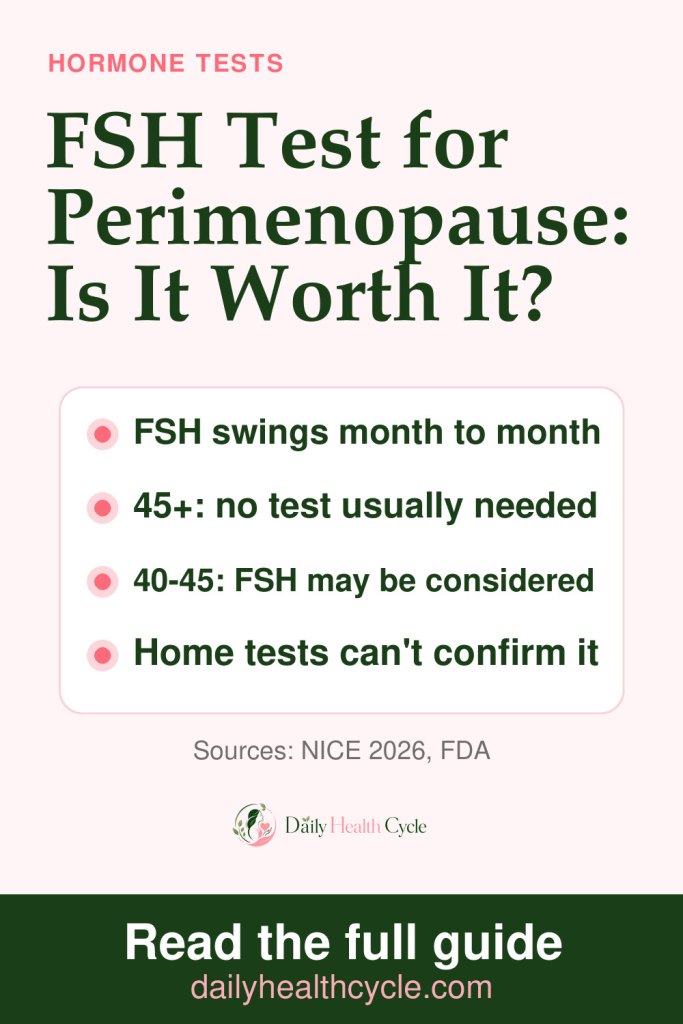
Quick answer: An FSH test for perimenopause can’t give a reliable yes or no on its own, because FSH levels rise and fall from month to month. The UK’s NICE guideline says women aged 45 or over with typical symptoms can usually be diagnosed without blood tests. An FSH test may be considered between 40 and 45, and under 40 it’s used, twice, to check for premature ovarian insufficiency.
Key Takeaways
- FSH (follicle-stimulating hormone) is made by the pituitary gland. Levels tend to rise as the ovaries slow down, but they change throughout the month (MedlinePlus).
- NICE says perimenopause can be identified without lab tests in women aged 45 or over who have recently started hot flashes or night sweats plus changes to their cycle.
- NICE suggests considering an FSH test only for women aged 40 to 45 with symptoms, or under 40 when menopause is suspected.
- Premature ovarian insufficiency (under 40) is diagnosed with symptoms plus raised FSH on two tests 4 to 6 weeks apart, never a single test.
- At-home FSH tests don’t detect perimenopause or menopause, and hormonal birth control and HRT can affect results (FDA).
What Is FSH?
Follicle-stimulating hormone is a messenger hormone made by the pituitary gland at the base of your brain (MedlinePlus). In women, it tells the ovaries to develop follicles, the small sacs that contain eggs. As the ovaries run low on follicles and make less estrogen, the pituitary pushes harder, and FSH levels tend to rise.
That’s why a high FSH can point to menopause. MedlinePlus lists menopause and primary ovarian insufficiency among the causes of high FSH, along with other conditions such as PCOS. But it also notes that FSH levels change throughout the month, so women who still have periods may need to be tested at a specific point in their cycle.
Why One FSH Test Can Mislead You
During perimenopause, your hormones don’t fall in a straight line. They swing up and down, sometimes from one week to the next. You might have a high FSH one month and a normal result the next. That’s why a “normal” FSH result doesn’t rule perimenopause out, and a single high result doesn’t prove it.
Some medicines also affect the result. NICE says not to use an FSH test to identify menopause in people taking combined estrogen and progestogen contraception or high-dose progestogen (NICE NG23).
What the Guidelines Say, by Age
The UK’s NICE guideline on menopause, last updated in April 2026, sets out when testing helps:
Age 45 or over
For otherwise healthy women with menopause symptoms, NICE says perimenopause can be identified without laboratory tests if you have recently started having hot flashes or night sweats and any change in your menstrual cycle. Menopause is identified if you haven’t had a period for at least 12 months and aren’t using hormonal contraception. NICE also says not to use AMH, inhibin, estradiol, antral follicle count or ovarian volume to identify perimenopause or menopause in this age group.
Age 40 to 45
NICE says to consider an FSH test if you have menopause symptoms, including a change in your menstrual cycle. Menopause between 40 and 45 is called early menopause, and NICE recommends offering psychological support to people going through it.
Under 40
If menopause is suspected before 40, doctors look for premature ovarian insufficiency (POI). NICE says POI is diagnosed from symptoms, including no or infrequent periods, plus raised FSH on two blood samples taken 4 to 6 weeks apart. It should never be diagnosed on a single blood test, and AMH shouldn’t be used routinely to diagnose it. If you’re diagnosed, NICE recommends hormone treatment, either HRT or a combined hormonal contraceptive, until at least the usual age of menopause, unless there’s a reason you can’t take it.
At-Home FSH and Menopause Tests
Urine tests sold as “menopause tests” usually measure FSH. The FDA says they detect raised FSH accurately about 9 times out of 10, but it’s clear about their limits:
- They don’t detect menopause or perimenopause. They only show whether FSH is raised on the day you test.
- FSH rises and falls during your cycle, so results vary.
- Birth control, HRT and estrogen supplements can affect the result, and so can how diluted your urine is.
- You can still get pregnant in perimenopause. The FDA says not to stop contraception based on these tests.
If you get a positive result, or a negative one but still have symptoms, the FDA advises talking to your doctor about both.
What Works Better Than a Single Test
For most women over 45, the most useful “test” is a clear record of your symptoms and cycle. Note when your periods come, how heavy they are, and which symptoms you have, such as hot flashes, night sweats, poor sleep, mood changes or joint aches. Two or three months of notes give your doctor far more to go on than one blood result.
Our free perimenopause symptom tracker lets you rate 12 symptoms a day and print a 30-day summary. You can also check our symptoms checklist or take the perimenopause quiz.
Blood tests still matter when something else might be going on. Thyroid problems, low iron and other conditions can cause tiredness, mood changes and period changes, so your doctor may check those instead. See our guide to hormonal imbalance symptoms for the tests doctors commonly use.
When to See a Doctor
- Your periods have become irregular or stopped and you’re under 45
- You have symptoms that affect your sleep, work or relationships
- You bleed between periods, after sex, or after 12 months without a period
- You want to talk about treatment options, such as HRT
Whatever your age, you don’t need a test result to ask about treatment. See our guide to perimenopause treatment options.
FSH Test FAQ
Can an FSH test tell if I’m in perimenopause?
Not reliably on its own. FSH levels rise and fall during perimenopause, so one normal result doesn’t rule it out and one high result doesn’t prove it. NICE says women aged 45 or over with typical symptoms can usually be diagnosed without blood tests.
What FSH level means menopause?
There’s no single cut-off that confirms menopause from one test, because levels vary through the month and in perimenopause. Doctors interpret FSH alongside your age, symptoms and cycle. Under 40, NICE requires raised FSH on two tests 4 to 6 weeks apart to diagnose premature ovarian insufficiency.
Are at-home menopause tests accurate?
They detect raised FSH accurately about 9 times out of 10, according to the FDA, but they don’t detect menopause or perimenopause. Results can be affected by your cycle, birth control or HRT. Talk to your doctor about the result and your symptoms, and don’t stop contraception based on it.
Can I have an FSH test while on the pill?
It isn’t useful. NICE says not to use an FSH test to identify menopause in people taking combined estrogen and progestogen contraception or high-dose progestogen, because the hormones affect the result.
When is an FSH test worth doing?
NICE suggests considering it if you’re 40 to 45 and have menopause symptoms, including a change in your cycle, or if menopause is suspected before 40. Over 45, perimenopause is usually identified from symptoms without a test.
Your Next Step
If you’re over 45, start tracking your symptoms and cycle rather than chasing a blood test. If you’re under 45 and your periods have changed, ask your GP whether an FSH test is appropriate, and remember that one result is only part of the picture.
Free printable
Perimenopause symptom & cycle tracker
Track your periods, sleep, hot flashes and mood on one page, then bring it to your appointment. Enter your email to download it.
Sources cited in this article
- MedlinePlus: Follicle stimulating hormone fsh levels test (medlineplus.gov)
- NICE NG23: Recommendations (nice.org.uk)
- FDA: Menopause (fda.gov)
Last checked November 10, 2026. Spot an outdated source? Tell us.
About the author: Jessica Bordo writes Daily Health Cycle out of personal interest in women’s health, not as a clinician. Each article summarizes what sources such as the NHS, NICE and published studies say, and links to them so you can check the claims yourself. Use these guides to prepare questions for your own clinician, not to replace their advice. Our editorial standards explain how we research and update articles.
This article is for general education and isn’t medical advice. See our full disclaimer and talk with a qualified clinician about your own care.