

Last updated November 17, 2026. Educational information, not medical advice: see our Medical Disclaimer.
Quick answer: Postpartum recovery usually takes six to eight weeks for the most intense healing, but your body keeps changing for months. Bleeding can last up to six weeks, stitches and soreness usually ease within a few weeks, and a postnatal check follows at around six to eight weeks. Some symptoms are emergencies at any point in the first year: heavy bleeding, chest pain, trouble breathing, a severe headache or thoughts of harming yourself need urgent medical care.
The weeks after birth are sometimes called the fourth trimester, and for good reason: your body is healing from pregnancy and birth while you learn to care for a newborn on very little sleep. Most of what happens is normal, even when it is uncomfortable. This guide sets out what to expect at each stage, what helps and which symptoms should never wait, based on advice from the NHS, ACOG, Mayo Clinic, Cleveland Clinic and the CDC. It covers recovery after any birth. If you had a caesarean, our week-by-week C-section recovery guide goes into the surgical side in detail.
How long does postpartum recovery take?
Cleveland Clinic says the postpartum period generally lasts six to eight weeks. It divides recovery into three stages: the first 6 to 12 hours after birth, the following two to six weeks, and a longer phase that runs from about six weeks to six months.
Six weeks is a checkpoint, not a finish line. ACOG calls the weeks after birth a fourth trimester and says postpartum care should be an ongoing process, not a single appointment. Bleeding and soreness usually settle within that first stretch. Muscle tone, pelvic floor strength, hair and mood can take much longer to feel like your own again.
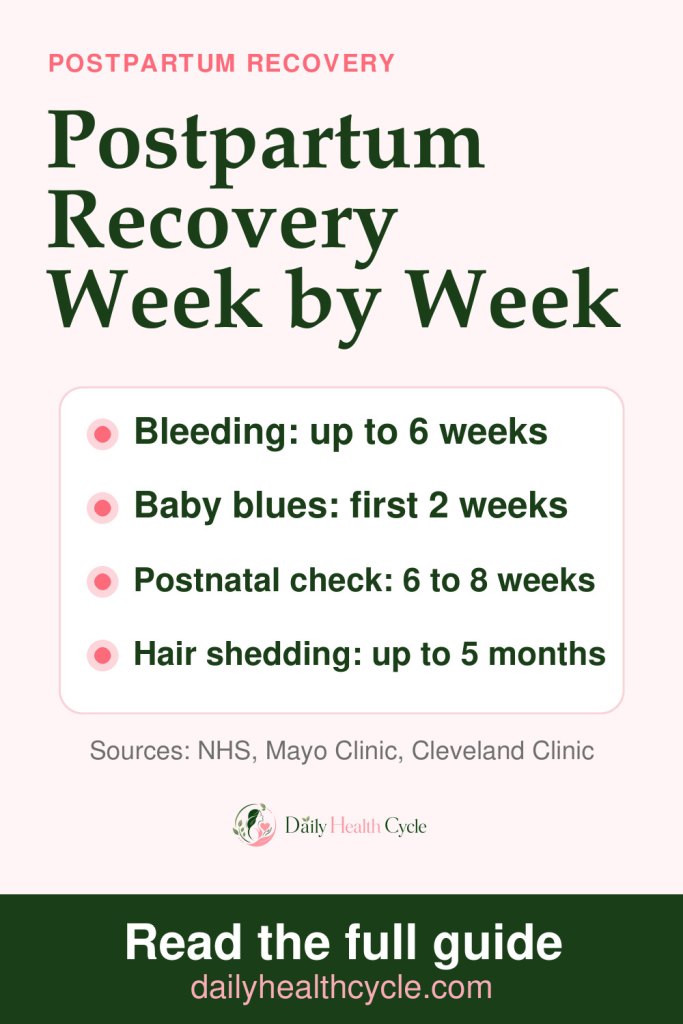
Postpartum recovery timeline at a glance
| When | What usually happens |
|---|---|
| First 24 hours | Bleeding is at its heaviest, with period-like cramps as the womb contracts |
| Days 2 to 7 | Bright red bleeding continues, milk comes in around day three or four, stitches are tender and mood swings are common |
| Weeks 2 to 6 | Bleeding turns pinkish-brown, then yellowish-white, and fades. Soreness eases and the baby blues should have lifted |
| Weeks 6 to 8 | Postnatal check. Bleeding has usually stopped. Time to talk about contraception and exercise |
| 2 to 6 months | Strength returns gradually, hair shedding is common, pelvic floor and tummy muscles keep recovering |
| Up to 12 months | Postnatal depression can start at any point in the first year, and the urgent warning signs below still apply |
The first week: bleeding, cramps and soreness
You will bleed after any birth, vaginal or caesarean. The NHS says it will be quite heavy at first, and Cleveland Clinic describes dark or bright red blood for at least the first three to four days. Use maternity pads, not tampons: the NHS says to wait until after your six-week check before using tampons. Our guide to postpartum underwear covers what to wear while you bleed.
Cramps are normal too. Mayo Clinic explains that afterpains last a few days, feel like period cramps and are common during breastfeeding, because feeding releases the hormone that makes the womb contract.
If you had a tear or a cut (an episiotomy), Mayo Clinic says the wound may hurt for a few weeks, and longer for large tears. It suggests:
- Sitting on a pillow.
- Cooling the area with an ice pack or a chilled witch hazel pad.
- Using a squirt bottle to spray warm water over the area while you pass urine.
- Sitting in a shallow warm bath for five minutes.
- Asking about pain relief and a stool softener.
The NHS advises bathing stitches every day with plain warm water and patting them dry, to help prevent infection. Tell your midwife or doctor if the pain is intense, lasts or gets worse.
Around day three or four your milk comes in, and the NHS says your breasts may feel tight and tender. Mayo Clinic advises feeding often from both breasts, using warm cloths or a warm shower before a feed and cold cloths between feeds. If you are not breastfeeding, it advises a supportive bra and ice packs for comfort, and not pumping or expressing, because that makes the breasts produce more milk.
Going to the toilet can be uncomfortable. The NHS says drinking plenty of water dilutes your urine so it stings less, and that it is important not to let yourself get constipated: fruit, vegetables, wholegrain foods and water all help. Piles are common after birth and, according to the NHS, usually disappear within a few days or weeks.
Feeling weepy, anxious or irritable in the first days is known as the baby blues. The NHS says it usually goes away within two weeks of the birth.
Weeks two to six: healing at home
This is when most of the visible healing happens. Bleeding gets lighter and changes colour, from red to pinkish-brown and then to yellowish-white, and Cleveland Clinic says it can last up to six weeks. Soreness around stitches should ease week by week.
ACOG recommends that every woman has contact with her maternity care provider within the first three weeks after birth, instead of waiting for a single visit weeks later. If nobody has been in touch and you have questions, it is reasonable to ask for that contact.
It is also a good time to start pelvic floor exercises. Leaking a little urine when you laugh, cough or move suddenly is quite common after birth, according to the NHS, and pelvic floor exercises help. Mayo Clinic describes the basic exercise like this: tighten your pelvic floor muscles for three seconds, relax for three, and work up to 10 to 15 repetitions in a row, at least three times a day. If leaking does not improve, the NHS says your GP can refer you to a physiotherapist.
Gentle movement helps as well. ACOG says that after a healthy pregnancy and a straightforward vaginal birth it is usually safe to start exercising a few days after birth, or as soon as you feel ready, and that walking is a good way to begin. After a caesarean or a complicated birth, ask your doctor first.
Six to eight weeks: your postnatal check
In the UK, the NHS says your GP surgery should offer a postnatal check six to eight weeks after the birth. In the US, ACOG advises a comprehensive visit no later than 12 weeks after birth. Either way, this appointment is for you, not only for your baby.
According to the NHS, you can expect to be asked about:
- How you are feeling, including your mood.
- Any vaginal discharge, and whether your periods have returned.
- Contraception.
- Whether your stitches or caesarean wound have healed, with an examination if needed.
- Your blood pressure, if you had problems in pregnancy or after the birth.
Tell the doctor about anything that is bothering you, including feeling sad or anxious, bladder or bowel problems and pain during sex. Our C-section guide has a longer list of questions to ask at your postpartum check.
There are no rules about when to start having sex again, says the NHS, which advises not rushing. It also says you can get pregnant three weeks after giving birth, so you need contraception from the first time you have sex.
Getting active again
ACOG’s target after birth is at least 150 minutes of moderate-intensity aerobic activity a week, which you can split into short sessions such as three 10-minute walks a day. It suggests starting with simple exercises for the tummy and back muscles, building up gradually and stopping if you feel pain.
The NHS advises avoiding sit-ups, planks and high-impact exercise at first. It says the gap that pregnancy leaves between the stomach muscles has usually gone back to normal by the time your baby is eight weeks old, and that you should see your GP if it is still obvious after that. Our guide to diastasis recti explains how to check and which exercises help.
Other changes that are normal
- Hair shedding. Mayo Clinic says that for up to five months after birth you lose more hair than you grow, and that this stops over time.
- Night sweats. Cleveland Clinic notes that it is common to sweat more after birth, especially at night.
- A soft, rounded tummy. The NHS says your tummy will probably still be a lot bigger than before pregnancy, because the muscles have stretched, and that a balanced diet and exercise should gradually bring your shape back. A wrap or shapewear will not make your waist smaller, although some women find them comfortable: see belly wrap vs belly band vs shapewear.
- No periods for a while. The NHS says you are unlikely to have periods if you breastfeed exclusively while your baby is under six months old.
If you had a C-section
Most of the above still applies after a caesarean, including the bleeding, although Cleveland Clinic notes it is typically lighter than after a vaginal birth. On top of that you are recovering from abdominal surgery, so lifting, driving and exercise come back more slowly. Our C-section recovery guide covers it week by week, and we have separate guides to the C-section shelf and to shapewear after a C-section.
Your mental health in the first year
The baby blues are short-lived. Postnatal depression is different: the NHS describes it as a common mental health condition, and says symptoms can start at any time up to a year after your baby is born. Signs include finding it hard to enjoy anything, feeling hopeless or unable to cope, and difficulty bonding with your baby.
If you think you might have postnatal depression, speak to your GP, midwife or health visitor. It is treatable with talking therapies and with antidepressants, and the NHS says many antidepressants are safe to use while breastfeeding. Thoughts of harming yourself or your baby are an emergency: get medical help straight away.
Postpartum recovery tips that actually help
- Rest and accept help. Cleveland Clinic advises allowing yourself time to rest and heal. Let other people cook, clean and shop.
- Drink water and eat fibre. According to the NHS it eases constipation and makes passing urine sting less.
- Use pads, not tampons, until after your six-week check.
- Rinse with warm water. Both Mayo Clinic and Cleveland Clinic recommend a squirt bottle of warm water when you use the toilet.
- Do your pelvic floor exercises every day.
- Walk a little every day and build up slowly.
- Ask before taking pain relief if you are breastfeeding. The NHS says a pharmacist, midwife or GP can tell you what is suitable.
- Keep your appointments, and ask for one sooner if something worries you.
What you actually need at home
A postpartum recovery kit does not have to be expensive. The items that come up again and again in NHS and Mayo Clinic advice are simple:
- Maternity pads, and plenty of them.
- Soft, high-waisted underwear that holds a pad: see our postpartum underwear guide.
- A squirt bottle for rinsing with warm water.
- Cold packs or chilled witch hazel pads for a sore perineum.
- A supportive bra, plus breast pads if you are breastfeeding.
- High-fibre food in the cupboard and a water bottle within reach.
- Pain relief that your midwife, doctor or pharmacist has said is suitable for you.
A belly wrap in the early weeks and shapewear later on are optional. Our guides to postpartum girdles, how to choose postpartum shapewear and how long to wear it explain what they can and cannot do. If you are still pregnant, our hospital bag checklist covers what to pack.
Warning signs: when to get urgent help
Most of what you feel after birth is part of normal healing, but serious problems can develop days or weeks after you go home. The CDC lists urgent maternal warning signs that apply during pregnancy and for a year after birth. If you have any of these, it says to seek medical care immediately:
- A headache that will not go away or gets worse over time.
- Dizziness or fainting.
- Changes in your vision.
- A fever of 100.4°F (38°C) or higher.
- Extreme swelling of your hands or face.
- Thoughts about harming yourself or your baby.
- Trouble breathing.
- Chest pain or a fast-beating heart.
- Severe nausea and vomiting.
- Severe belly pain that does not go away.
- Heavy vaginal bleeding, such as soaking through one or more pads in an hour or passing clots bigger than an egg.
- Severe swelling, redness or pain in a leg or arm.
- Overwhelming tiredness.
The NHS adds a few more reasons to call your midwife, health visitor or GP straight away: losing blood in large clots, pain or swelling in your calf, and a high temperature with a sore tummy. Cleveland Clinic also lists foul-smelling vaginal discharge. Mayo Clinic’s threshold for bleeding is soaking a pad every hour for two hours in a row.
If you cannot reach your doctor or midwife quickly, go to an emergency department or call emergency services, and say that you have had a baby in the last year.
Frequently asked questions
How long does postpartum recovery take?
The most intense healing takes about six to eight weeks, which is when bleeding stops and the postnatal check happens. Strength, pelvic floor control, hair and mood can take several months longer.
How long do you bleed after giving birth?
Bleeding usually lasts up to six weeks, getting lighter and changing from red to pinkish-brown and then yellowish-white. Some women have traces for up to eight weeks.
When can I exercise after giving birth?
After a healthy pregnancy and a straightforward vaginal birth, ACOG says it is usually safe to start a few days after birth or as soon as you feel ready, beginning with walking. After a caesarean or complications, ask your doctor first.
What are the warning signs after giving birth?
Get urgent medical care for heavy bleeding, chest pain, trouble breathing, a severe headache, changes in vision, a fever of 38C (100.4F) or higher, severe swelling or pain in a leg, or thoughts of harming yourself or your baby.
What do I need for postpartum recovery?
Maternity pads, soft high-waisted underwear, a squirt bottle for rinsing, cold packs, a supportive bra and suitable pain relief cover most needs. A belly wrap or shapewear is optional.
Keep reading
This page is the starting point for our postpartum series. Each guide below goes deeper into one part of recovery.
- C-section recovery week by week
- C-section shelf: why it happens and what helps
- Shapewear after a C-section: when and how to wear it
- Diastasis recti: self-check, exercises and what shapewear can do
- Postpartum underwear: what to wear after birth
- Postpartum belly wrap vs belly band vs shapewear
- Postpartum girdle: what it does and when to start
- How to choose postpartum shapewear
- How long to wear postpartum shapewear
- Hospital bag checklist
- All postpartum guides
This article is general information, not medical advice. Always follow the guidance of your doctor or midwife about your own recovery.
Sources
- NHS: Your body after the birth
- NHS: Your post-pregnancy body
- NHS: Your 6-week postnatal check
- NHS: Postnatal depression
- NHS: Sex and contraception after birth
- ACOG: Optimizing postpartum care
- ACOG: Exercise after pregnancy
- Mayo Clinic: Postpartum care after a vaginal birth
- Mayo Clinic: C-section recovery
- Cleveland Clinic: Postpartum
- Cleveland Clinic: Lochia (postpartum bleeding)
- CDC: Urgent maternal warning signs
Free printable PDF
Perimenopause symptom & cycle tracker
A one-page PDF to print and fill in by hand: periods, sleep, hot flashes and mood, ready to bring to your appointment. Enter your email and the download link appears right away.
Prefer to track on your phone? Use our online symptom tracker, no email needed.
Sources cited in this article
- Cleveland Clinic: Postpartum (my.clevelandclinic.org)
- ACOG: Optimizing postpartum care (acog.org)
- NHS: Your body (nhs.uk)
- Cleveland Clinic: 22485 lochia (my.clevelandclinic.org)
- Mayo Clinic: Art 20047233 (mayoclinic.org)
- NHS: Overview (nhs.uk)
- ACOG: Exercise after pregnancy (acog.org)
- NHS: Your 6 week postnatal check (nhs.uk)
- NHS: Sex and contraception after birth (nhs.uk)
- NHS: Your post pregnancy body (nhs.uk)
- CDC: Maternal warning signs (cdc.gov)
- Mayo Clinic: C-section recovery: Art 20047310 (mayoclinic.org)
Last checked November 11, 2026. Spot an outdated source? Tell us.
About the author: Jessica Bordo writes Daily Health Cycle out of personal interest in women’s health, not as a clinician. Each article summarizes what sources such as the NHS, Mayo Clinic, Cleveland Clinic and ACOG say, and links to them so you can check the claims yourself. Use these guides to prepare questions for your own clinician, not to replace their advice. Our editorial standards explain how we research and update articles.
This article is for general education and isn’t medical advice. See our full disclaimer and talk with a qualified clinician about your own care.