
Last updated October 29, 2026. Educational information, not medical advice: see our Medical Disclaimer.
Unusual discharge, an odd smell or itching? Most women assume it’s a yeast infection and head to the pharmacy. But bacterial vaginosis (BV) is just as likely, and the two need completely different treatments. In one study of women who bought an over-the-counter yeast treatment, only about a third actually had a yeast infection alone (Ferris et al., 2002).
This guide explains how to tell BV and yeast infections (thrush) apart, how each is treated, why they keep coming back for some women, and when to see a doctor instead of self-treating.
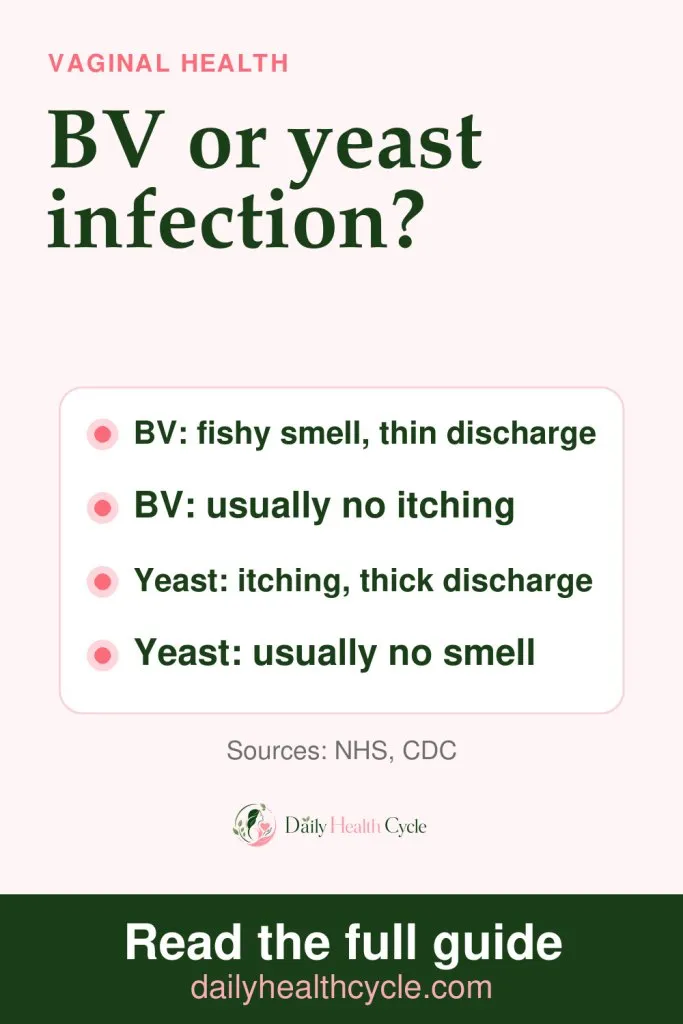
Quick answer: The key differences in BV vs yeast infection: BV usually causes thin, grayish discharge with a fishy smell and little itching, and is treated with antibiotics. A yeast infection usually causes itching, soreness and thick white discharge with no smell, and is treated with antifungals. Self-diagnosis is often wrong, so get tested if unsure.
Key Takeaways
- BV usually means thin, grayish-white discharge with a fishy smell, often worse after sex, and usually no itching. It’s treated with antibiotics.
- A yeast infection usually means itching, soreness and thick white “cottage cheese” discharge that doesn’t smell. It’s treated with antifungals.
- Self-diagnosis is unreliable. Even women who’ve had a yeast infection diagnosed before weren’t better at recognizing it in one study.
- Both often come back. A 2025 trial found that treating male partners as well cut BV recurrence from 63% to 35% in 12 weeks.
- Avoid douches and perfumed washes, which can upset the vaginal balance, and see a doctor if it’s your first time, you’re pregnant, or symptoms return.
In this article:
- BV vs Yeast Infection at a Glance
- Bacterial Vaginosis: Causes and Treatment
- Yeast Infection: Causes and Treatment
- Why Guessing Often Goes Wrong
- When It Keeps Coming Back
- Prevention Tips
- When to See a Doctor
- BV and Yeast Infection FAQ
BV vs Yeast Infection at a Glance
| Bacterial vaginosis (BV) | Yeast infection (thrush) | |
|---|---|---|
| Cause | Change in the balance of vaginal bacteria | Overgrowth of candida, a normally harmless fungus |
| Discharge | Thin, grayish-white or milky | Thick, white, like cottage cheese |
| Smell | Strong fishy smell, often worse after sex | Usually no smell |
| Itching or soreness | Usually not | Yes: itching, irritation, soreness, stinging when you pee or have sex |
| Treatment | Prescription antibiotics (metronidazole or clindamycin) | Antifungal cream, pessary or tablet, often available at a pharmacy |
These are typical patterns, not rules. The CDC notes that yeast infection symptoms aren’t specific, and many women with BV have no symptoms at all (CDC). A third common cause of discharge is trichomoniasis, a sexually transmitted infection, which is one more reason a test can be worth it (NHS).
Bacterial Vaginosis: Causes and Treatment
The CDC calls BV the most common cause of vaginal discharge worldwide (CDC). It happens when the normal balance of bacteria in the vagina shifts. It isn’t classed as a sexually transmitted infection, but sex can trigger it, and women who’ve never had sex can get it too (NHS).
Things linked to a higher risk include a new sexual partner or several partners, not using condoms consistently, douching, using perfumed products in or around the vagina, and having an IUD. The CDC says hormonal contraception doesn’t increase the risk and may even be protective (CDC; NHS).
Treatment needs a prescription. CDC-recommended options are metronidazole tablets for 7 days, metronidazole gel for 5 days or clindamycin cream for 7 days (CDC). The CDC recommends treatment for all pregnant women with symptoms, and the NHS notes that BV in pregnancy carries a small risk of complications such as premature birth (NHS).
Yeast Infection: Causes and Treatment
Yeast infections are very common: about 75% of women will have at least one, and 40% to 45% will have two or more (CDC). They’re caused by candida, a fungus that normally lives harmlessly in the body. The NHS lists these triggers (NHS):
- taking antibiotics
- poorly controlled diabetes or a weakened immune system
- pregnancy
- hormone replacement therapy (HRT)
- irritated or damaged skin
Treatment is an antifungal cream, a pessary (vaginal tablet) or an oral tablet. If you’ve had thrush diagnosed before and recognize the symptoms, you can buy treatment from a pharmacy, but the NHS says not to use it more than twice in 6 months without talking to a pharmacist or doctor (NHS). One practical warning: antifungal creams and pessaries can weaken latex condoms and diaphragms (CDC).
Why Guessing Often Goes Wrong
In a US study of 95 women who bought an over-the-counter yeast treatment based on their own diagnosis, testing showed (Ferris et al., 2002):
- only 34% had a yeast infection alone
- 19% had BV
- 21% had a mixed infection
- 14% had nothing abnormal
Women who’d had a yeast infection diagnosed by a doctor before weren’t any more accurate. The CDC warns that unnecessary use of over-the-counter treatment can delay treatment of other causes of vaginal symptoms (CDC). If an antifungal doesn’t clear your symptoms, don’t simply buy another one: get tested.
When It Keeps Coming Back
Recurring BV is common, and the NHS says it often comes back within a few months (NHS). Options include:
- Longer-term vaginal gel. If you get BV more than 4 times a year, the NHS says you may be prescribed an antibiotic gel to use for several months. The CDC notes the benefit tends to end when you stop.
- Treating a male partner. The 2021 CDC guidelines didn’t recommend routine partner treatment, but a 2025 trial changed the picture. In couples where the woman had BV, also treating the male partner with antibiotic tablets and cream cut the recurrence rate within 12 weeks from 63% to 35% (NEJM, 2025). Ask your doctor whether this applies to you. The NHS also says a female partner may need treatment.
Recurring yeast infections, usually defined as 3 or more in a year, affect fewer than 5% of women (CDC). The NHS advises seeing a GP if thrush comes back more than 4 times in 12 months; treatment may then continue for up to 6 months (NHS). If you have recurring yeast infections and other signs of high blood sugar, it’s worth checking for diabetes; our guide to insulin resistance symptoms explains the tests.
Prevention Tips
- Skip douches and vaginal washes. The CDC says douching might increase the risk of BV coming back, and there’s no evidence it helps.
- Wash with water, plus plain soap or an emollient on the outer area. Avoid perfumed soaps, bubble bath and vaginal deodorants (NHS).
- Wear cotton underwear and avoid tight underwear or tights if you’re prone to thrush (NHS).
- Use condoms with new partners. Inconsistent condom use is linked to BV.
- Don’t smoke, which the NHS lists among the things to avoid for BV.
If you’re in perimenopause or past menopause and have itching, burning or discomfort without an infection, the cause may be vaginal dryness from lower estrogen. Our guide to vaginal dryness in perimenopause explains the treatments, and our guide to frequent UTIs after menopause covers bladder symptoms.
When to See a Doctor
See a doctor or sexual health clinic rather than self-treating if (NHS; NHS):
- it’s the first time you’ve had these symptoms
- you think you have BV, which needs a prescription
- you’re pregnant or breastfeeding
- you’re under 16 or over 60
- treatment hasn’t worked, or symptoms keep coming back
- you have diabetes or a weakened immune system
- you might have been exposed to a sexually transmitted infection
Sexual health clinics often offer walk-in appointments and can test you the same day. Also get checked promptly for pelvic pain, fever, bleeding between periods or after sex, or any bleeding after menopause.
BV and Yeast Infection FAQ
How can I tell if I have BV or a yeast infection?
BV usually causes thin, grayish-white discharge with a fishy smell, often worse after sex, and usually no itching. A yeast infection usually causes itching, soreness and thick white discharge that doesn’t smell (NHS). But symptoms overlap, so a test is the only reliable way to know.
Can I treat BV with yeast infection medicine?
No. BV is caused by bacteria and needs prescription antibiotics such as metronidazole or clindamycin (CDC). Antifungal yeast treatments won’t clear it. If an over-the-counter yeast treatment hasn’t worked, see a doctor or sexual health clinic for a test.
Can you have BV and a yeast infection at the same time?
Yes. In a study of women who self-diagnosed a yeast infection, 21% actually had a mixed infection and 19% had BV alone (Ferris et al., 2002). That’s one reason testing is worthwhile when symptoms are unclear or keep coming back.
Should my partner be treated for BV?
Possibly. The 2021 CDC guidelines didn’t recommend routine partner treatment, but a 2025 trial found that treating male partners with antibiotic tablets and cream cut BV recurrence within 12 weeks from 63% to 35%. The NHS says a female partner may also need treatment. Ask your doctor.
Why do I keep getting yeast infections?
Common triggers include antibiotics, poorly controlled diabetes, pregnancy, HRT and irritated skin (NHS). Recurring yeast infections, usually 3 or more a year, affect fewer than 5% of women (CDC). See a doctor if it happens more than 4 times in 12 months, as longer treatment may help.
Your Next Step
If your symptoms include a fishy smell, or a yeast treatment hasn’t worked, book a test rather than trying another product. Keep a note of when symptoms start (after sex, around your period, after antibiotics), as triggers help your doctor choose the right plan. For more on how your hormones affect your body through the month, read our guide to hormonal imbalance symptoms.
Free printable
Perimenopause symptom & cycle tracker
Track your periods, sleep, hot flashes and mood on one page, then bring it to your appointment. Enter your email to download it.
Sources cited in this article
- Ferris et al., 2002 (pubmed.ncbi.nlm.nih.gov)
- NHS (BV): Bacterial vaginosis (nhs.uk)
- NHS (thrush): Thrush in men and women (nhs.uk)
- CDC (cdc.gov)
- CDC: Candidiasis (cdc.gov)
- NHS: Trichomoniasis (nhs.uk)
- NEJM, 2025 (pubmed.ncbi.nlm.nih.gov)
Last checked October 27, 2026. Spot an outdated source? Tell us.
About the author: Jessica Bordo writes Daily Health Cycle out of personal interest in women’s health, not as a clinician. Each article summarizes what sources such as the CDC, the NHS and published trials say, and links to them so you can check the claims yourself. Use these guides to prepare questions for your own clinician, not to replace their advice. Our editorial standards explain how we research and update articles.
This article is for general education and isn’t medical advice. See our full disclaimer and talk with a qualified clinician about your own care.