

Last updated November 6, 2026. Educational information, not medical advice: see our Medical Disclaimer.
If your periods have started to change or you’re sleeping badly in your late 30s or 40s, you may be wondering whether perimenopause has already begun. The honest answer is that there’s no fixed age: it varies a lot from woman to woman. But there is a typical range, and knowing it, along with the factors that can bring it on earlier, makes it easier to tell what’s going on.
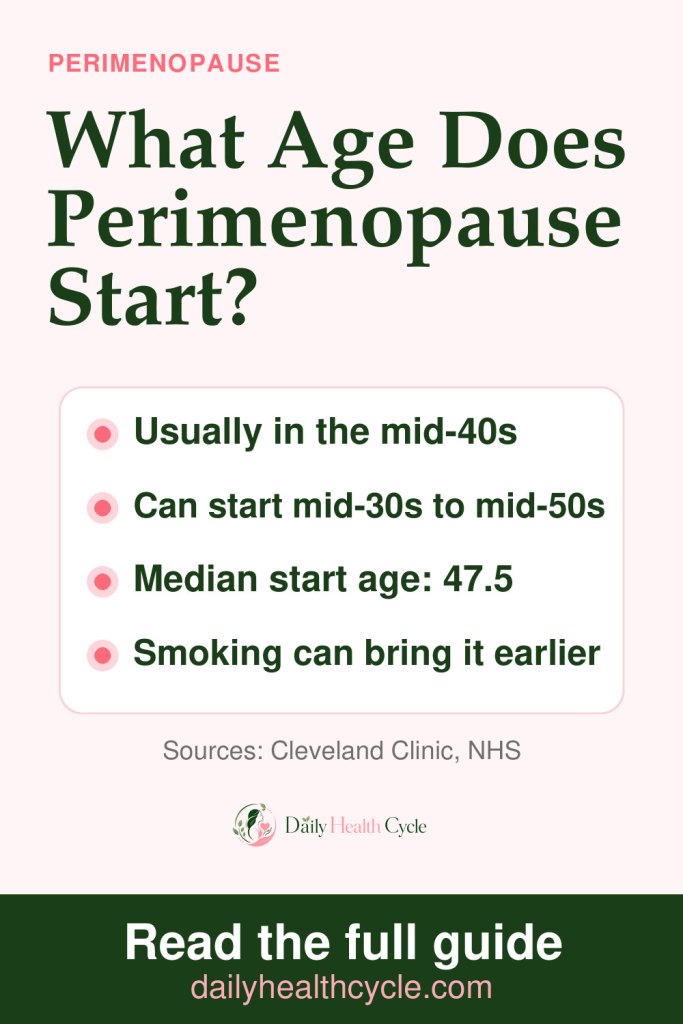
Quick answer: So, what age does perimenopause start? Usually in your mid-40s. Cleveland Clinic says it can begin as early as your mid-30s or as late as your mid-50s, and in a large US study the median age it started was 47.5. Menopause itself usually happens between 45 and 55 (NHS). Smoking and a family history of early menopause can bring it on sooner.
Key Takeaways
- Perimenopause usually starts in your mid-40s, but it can begin anywhere from the mid-30s to the mid-50s (Cleveland Clinic).
- In the Massachusetts Women’s Health Study of 2,570 women, the median age perimenopause began was 47.5, and natural menopause came at a median of 51.3.
- Menopause usually happens between 45 and 55. Before 45 is called early menopause, and before 40 is called premature menopause (NHS).
- Smoking, a family history of early menopause, cancer treatment and surgery to remove the ovaries can all bring it on earlier.
- Many women in their 30s report symptoms, but symptoms alone can’t confirm perimenopause at that age, so other causes should be checked.
The Typical Age Perimenopause Starts
Perimenopause is the transition before menopause, when your ovaries gradually make less estrogen and your hormone levels start to swing. According to Cleveland Clinic, it usually starts in your mid-40s, but it may begin as early as your mid-30s or as late as your mid-50s.
The best long-term data come from studies that followed women for years. In the Massachusetts Women’s Health Study, which followed 2,570 women, the median age at which perimenopause began was 47.5, and the median age of natural menopause was 51.3. “Median” means half of the women started earlier and half started later, so being a few years either side of 47 is completely normal.
Perimenopause ends at menopause, which is confirmed once you’ve gone 12 months in a row without a period. The NHS says menopause usually happens between 45 and 55. For more on the difference between the two stages, see perimenopause vs menopause.
How Long It Lasts Depends on When It Starts
Cleveland Clinic puts the average length of perimenopause at about four years, though it can last up to eight. Age at the start seems to matter. In the SWAN study, women who entered the transition earliest had the longest transition, with a median of about 8.6 years, compared with about 4.4 years for those who started latest (SWAN, Menopause, 2017).
So if your symptoms began in your early 40s, it’s not unusual for them to come and go for many years. Our guide to how long perimenopause lasts goes into the timeline in more detail.
What Can Make It Start Earlier
Several factors are linked to an earlier start:
- Smoking. Cleveland Clinic says people who smoke regularly tend to reach menopause about one to two years earlier. In the Massachusetts study, smokers had not only an earlier perimenopause but also a shorter one.
- Family history. Early menopause in your mother or sister makes it more likely for you too (NHS; Cleveland Clinic).
- Cancer treatment. Chemotherapy and radiotherapy can affect the ovaries (NHS).
- Surgery. Removing the ovaries brings on menopause straight away. A hysterectomy that leaves the ovaries can also bring it on earlier (Cleveland Clinic).
- Other factors. The NHS says early menopause is also more likely if you started your periods early or are underweight.
Can Perimenopause Start in Your 30s?
It can, though it’s less common. A 2025 survey of more than 4,400 US women found that over half of those aged 30 to 40 reported moderate or severe symptoms such as mood changes, poor sleep and irregular periods (npj Women’s Health, 2025). That’s a striking finding, but self-reported symptoms can’t confirm perimenopause. Stress, thyroid problems, low iron, depression and hormonal contraception can all cause similar changes.
If periods stop or become very irregular before 40, the NHS calls it premature menopause, and doctors look for premature ovarian insufficiency. That’s worth checking promptly, because early menopause can make it harder to get pregnant and raises the chance of osteoporosis and heart disease (NHS).
The First Signs to Look For
The NHS says one of the first signs of perimenopause is usually a change to your periods: they may come more or less often, and bleeding may get heavier or lighter. Other common early symptoms include:
- Hot flashes and night sweats
- Trouble getting to sleep or staying asleep
- Mood swings, low mood or anxiety
- Brain fog and trouble concentrating
- Headaches that are worse than usual
If you use hormonal contraception, it can be harder to tell, because the pill, the hormonal coil, the implant and the injection all change your bleeding pattern (NHS). Our perimenopause symptoms checklist lists the full range of signs.
How Doctors Confirm It
There’s no single test that tells you perimenopause has started. The UK’s NICE guideline says that if you’re 45 or over and have menopause-type symptoms, including a change in your periods, perimenopause can usually be identified from your symptoms alone, without blood tests. For women aged 40 to 45 with symptoms, an FSH blood test may be considered. Under 40, doctors use tests to look for premature ovarian insufficiency.
Because hormone levels swing so much during perimenopause, a single “normal” blood result doesn’t rule it out. A record of your symptoms and cycle over a few months is often more useful. Our free perimenopause symptom tracker lets you print a 30-day summary for your appointment.
When to See a Doctor
See a doctor if:
- Your periods stop or become very irregular before 40, or you have menopause symptoms before 45
- You bleed between periods or after sex, or your cycles are less than 21 days apart
- Your bleeding is very heavy, for example soaking a pad or tampon every one to two hours (Cleveland Clinic)
- You bleed after going 12 months without a period
- Your symptoms are affecting your sleep, work or relationships
Treatment can help at any stage. See our guide to perimenopause treatment options for what the evidence says.
Perimenopause Age FAQ
What is the average age perimenopause starts?
Usually in the mid-40s. In the Massachusetts Women’s Health Study, the median age perimenopause began was 47.5. Cleveland Clinic says it can start as early as the mid-30s or as late as the mid-50s.
Can perimenopause start at 35?
It can, but it’s less common. Many women in their 30s report symptoms like poor sleep and irregular periods, but other causes such as thyroid problems, low iron, stress or hormonal contraception are common too, so it’s worth seeing a doctor rather than assuming it’s perimenopause.
What age is too early for menopause?
The NHS calls it early menopause if your periods stop before 45, and premature menopause if they stop before 40. If either happens to you, see a GP, because early menopause can affect fertility and long-term bone and heart health.
Does your mother’s age at menopause predict yours?
It can be a clue. A family history of early menopause makes it more likely you’ll reach menopause earlier too, according to the NHS and Cleveland Clinic. It isn’t a guarantee, though, and lifestyle factors such as smoking also play a part.
Is there a test to tell if perimenopause has started?
Not a single reliable one. NICE says women aged 45 or over with typical symptoms can usually be diagnosed without blood tests. An FSH test may be considered between 40 and 45, but hormone levels swing so much that a normal result doesn’t rule perimenopause out.
Your Next Step
If you’re in your late 30s or 40s and noticing changes, start tracking your periods and symptoms now. After two or three months, you’ll have a clear picture to take to your doctor, and a much better chance of getting the right answer.
Free printable
Perimenopause symptom & cycle tracker
Track your periods, sleep, hot flashes and mood on one page, then bring it to your appointment. Enter your email to download it.
Sources cited in this article
- Cleveland Clinic: 21608 perimenopause (my.clevelandclinic.org)
- Massachusetts Women’s Health Study (pubmed.ncbi.nlm.nih.gov)
- NHS: Menopause and perimenopause (nhs.uk)
- SWAN, Menopause, 2017 (pubmed.ncbi.nlm.nih.gov)
- NHS: Early menopause (nhs.uk)
- npj Women’s Health, 2025 (nature.com)
- NHS: Symptoms (nhs.uk)
- NICE guideline: Recommendations (nice.org.uk)
Last checked November 6, 2026. Spot an outdated source? Tell us.
About the author: Jessica Bordo writes Daily Health Cycle out of personal interest in women’s health, not as a clinician. Each article summarizes what sources such as the NHS, NICE and published studies say, and links to them so you can check the claims yourself. Use these guides to prepare questions for your own clinician, not to replace their advice. Our editorial standards explain how we research and update articles.
This article is for general education and isn’t medical advice. See our full disclaimer and talk with a qualified clinician about your own care.