
Last updated November 20, 2026. Educational information, not medical advice: see our Medical Disclaimer.
Many women notice their waistline changing in their 40s and 50s even when their eating and exercise habits haven’t. Fat seems to move to the middle and become harder to shift. That’s not your imagination, and it’s not a lack of willpower: the menopause transition changes where your body stores fat. The good news is that the steps with the best evidence are simple, and you don’t need special diets or supplements.
Quick answer: Menopause belly fat builds up because the transition shifts fat to the middle: in the SWAN study, visceral fat rose about 8% a year. What helps most is regular aerobic exercise, which reduced visceral fat even without dieting, plus strength training twice a week, enough sleep and a sustainable eating pattern. The NHS suggests keeping your waist under half your height.
Key Takeaways
- In the SWAN Heart study, visceral fat grew about 8% a year during the menopause transition, starting about two years before the final period.
- The NHS says weight gain in perimenopause and menopause often settles around the stomach, and suggests keeping your waist to less than half your height.
- Aerobic exercise reduced visceral fat even without dieting in a meta-analysis of 15 studies.
- Two weeks of short sleep raised visceral fat by 11% in a small Mayo Clinic study, so sleep matters too.
- You can’t spot-reduce belly fat with sit-ups, and “belly fat” supplements aren’t proven.
Why Belly Fat Increases Around Menopause
The NHS says weight gain is common in perimenopause and menopause, and that it often happens around the stomach and upper body. Research shows this is partly the transition itself, not just age. In the SWAN Heart study of 362 midlife women, visceral fat, the deep fat around the organs, grew by about 8% a year during the transition, starting roughly two years before the final period (Samargandy et al., Menopause, 2021).
Muscle mass also starts to fall around this time, which lowers how many calories your body burns (Greendale et al., 2019). Our guide to perimenopause weight gain explains these changes in more detail, and cortisol belly fat looks at the role of stress.
Why It’s Worth Tackling
Visceral fat isn’t only about how clothes fit. Fat stored deep around the organs is linked to a higher risk of type 2 diabetes and heart disease, which is why doctors pay attention to waist size, not just weight. The NHS suggests a simple check: keep your waist size to less than half your height. Measure around your middle, halfway between your lowest rib and the top of your hips, after breathing out.
A growing waist can also go with insulin resistance, so if your waist is more than half your height, it’s worth asking your GP about a blood sugar check.
What Actually Works
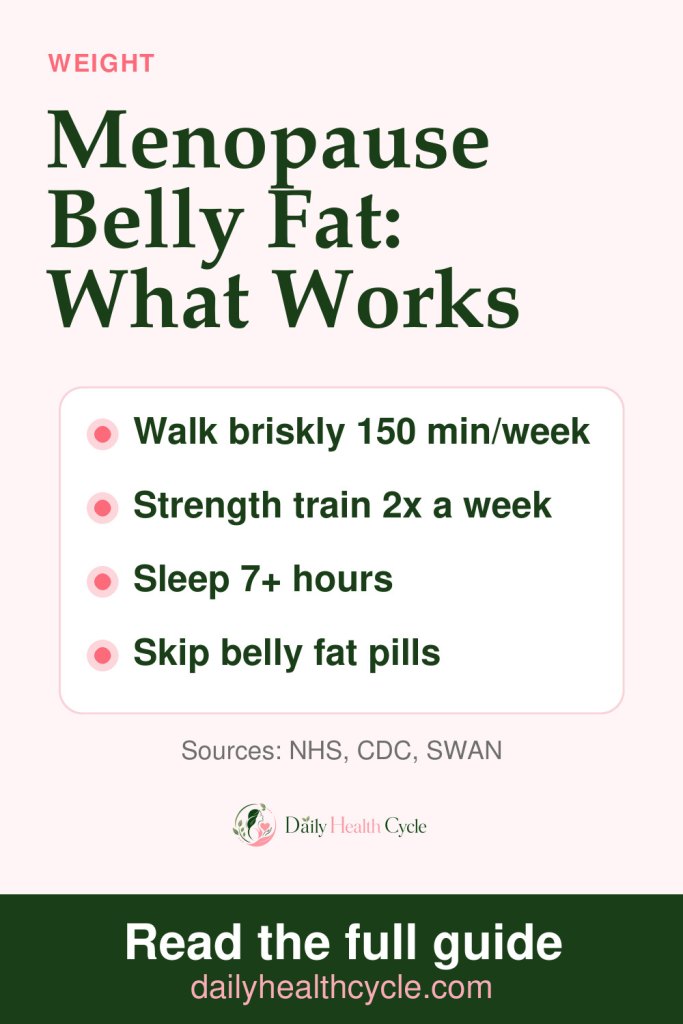
1. Aerobic exercise, most days
This has the strongest evidence for visceral fat. A meta-analysis of 15 studies and 852 people found that exercise reduced visceral fat even without cutting calories, with moderate-to-vigorous aerobic exercise having the clearest effect (Vissers et al., PLoS One, 2013). Brisk walking, cycling, swimming and dancing all count.
The CDC recommends at least 150 minutes of moderate activity a week, such as 30 minutes on 5 days. If you’re starting from little activity, build up gradually.
2. Strength training twice a week
The CDC also recommends muscle-strengthening activities on at least 2 days a week. Keeping your muscle helps counter the drop in calorie burning that comes with midlife muscle loss, and protects your bones. Weights, resistance bands, Pilates and bodyweight exercises such as squats all work.
3. Protect your sleep
In a small Mayo Clinic study, 12 adults who slept about 4 hours a night for two weeks ate over 300 extra calories a day and gained 11% more visceral fat than when they slept normally (Covassin et al., JACC, 2022). If night sweats are breaking up your sleep, treating them is part of the plan.
4. An eating pattern you can keep
There’s no special “menopause belly diet”. What matters is a modest, sustainable calorie reduction, built on vegetables, fruit, whole grains, lean proteins and healthy fats, with fewer sugary drinks and ultra-processed snacks. Mayo Clinic also suggests limiting alcohol and added sugar, since both add calories easily.
What Doesn’t Work
- Sit-ups to “burn” belly fat. Core exercises strengthen muscles, but you can’t choose where your body loses fat. Overall activity is what shrinks visceral fat.
- “Belly fat burner” supplements. The FDA has found hidden drugs in some weight-loss products sold online, and none are proven to target belly fat (FDA).
- Home cortisol tests. Stress plays a part, but these tests don’t tell you how to lose belly fat. See our guide to cortisol belly fat.
When Medical Help Makes Sense
Weight gain can also come from an underactive thyroid, PCOS or some medicines, so it’s worth a check-up if your weight is changing quickly or you have other symptoms. If lifestyle changes aren’t enough and your BMI is in the obesity range, or overweight with a weight-related condition, weight-loss medicines may be an option. See our guide to GLP-1 medicines in menopause for who they’re approved for.
HRT isn’t a weight-loss treatment, but it can help with the hot flashes and poor sleep that make it harder to stay active. See HRT in perimenopause.
Menopause Belly Fat FAQ
Why do I get belly fat during menopause?
The menopause transition shifts where your body stores fat. In the SWAN Heart study, visceral fat around the organs grew about 8% a year during the transition. Muscle loss, poor sleep and less activity add to it.
What is the fastest way to lose menopause belly fat?
There’s no quick fix, but regular aerobic exercise has the strongest evidence: it reduced visceral fat even without dieting in a meta-analysis of 15 studies. Combine it with strength training twice a week, enough sleep and a sustainable eating pattern.
Can sit-ups get rid of belly fat?
No. Core exercises strengthen your muscles, but you can’t choose where your body loses fat. Overall activity, especially aerobic exercise, is what reduces visceral fat.
How do I know if my belly fat is a health risk?
The NHS suggests keeping your waist size to less than half your height. If it’s more than that, you’re more likely to have health problems such as type 2 diabetes, so it’s worth talking to your GP.
Does HRT help with menopause belly fat?
HRT isn’t a weight-loss treatment. It can, however, ease hot flashes and night sweats that disrupt sleep and make it harder to stay active, which may help indirectly. Talk to your doctor about whether it suits you.
Your Next Step
Measure your waist today and write it down. Then aim for 30 minutes of brisk walking on 5 days a week plus two short strength sessions, and protect your sleep. Measure again in 8 to 12 weeks: your waist often changes before the scales do.
Sources
- NHS: Symptoms of menopause and perimenopause
- Samargandy S, et al. Abdominal visceral adipose tissue over the menopause transition and carotid atherosclerosis: the SWAN heart study. Menopause, 2021
- Greendale GA, et al. Changes in body composition and weight during the menopause transition. JCI Insight, 2019
- NHS: Overweight and obesity in adults
- Vissers D, et al. The effect of exercise on visceral adipose tissue in overweight adults: a systematic review and meta-analysis. PLoS One, 2013
- CDC: Physical activity guidelines for adults
- Covassin N, et al. Effects of experimental sleep restriction on energy intake, energy expenditure, and visceral obesity. J Am Coll Cardiol, 2022
- Mayo Clinic: Menopause weight gain
- FDA: Weight Loss Product Notifications
Sources last checked: November 19, 2026.
Free printable PDF
Perimenopause symptom & cycle tracker
A one-page PDF to print and fill in by hand: periods, sleep, hot flashes and mood, ready to bring to your appointment. Enter your email and the download link appears right away.
Prefer to track on your phone? Use our online symptom tracker, no email needed.
This article is for general education and isn’t medical advice. See our full disclaimer and talk with a qualified clinician about your own care.
Sources cited in this article
- NHS: Symptoms (nhs.uk)
- Samargandy et al., Menopause, 2021 (pubmed.ncbi.nlm.nih.gov)
- Greendale et al., 2019 (pubmed.ncbi.nlm.nih.gov)
- NHS: Obesity (nhs.uk)
- Vissers et al., PLoS One, 2013: Plosone (journals.plos.org)
- CDC: Adults (cdc.gov)
- Covassin et al., JACC, 2022: J.jacc.2022.01 (jacc.org)
- Mayo Clinic: Art 20046058 (mayoclinic.org)
- FDA: Tainted weight loss products (fda.gov)
- LinkedIn: Emma bordo a679ba450 (linkedin.com)
Last checked November 19, 2026. Spot an outdated source? Tell us.